
Mexico Factory Setup: A Step-by-Step Guide for U.S. Manufacturers
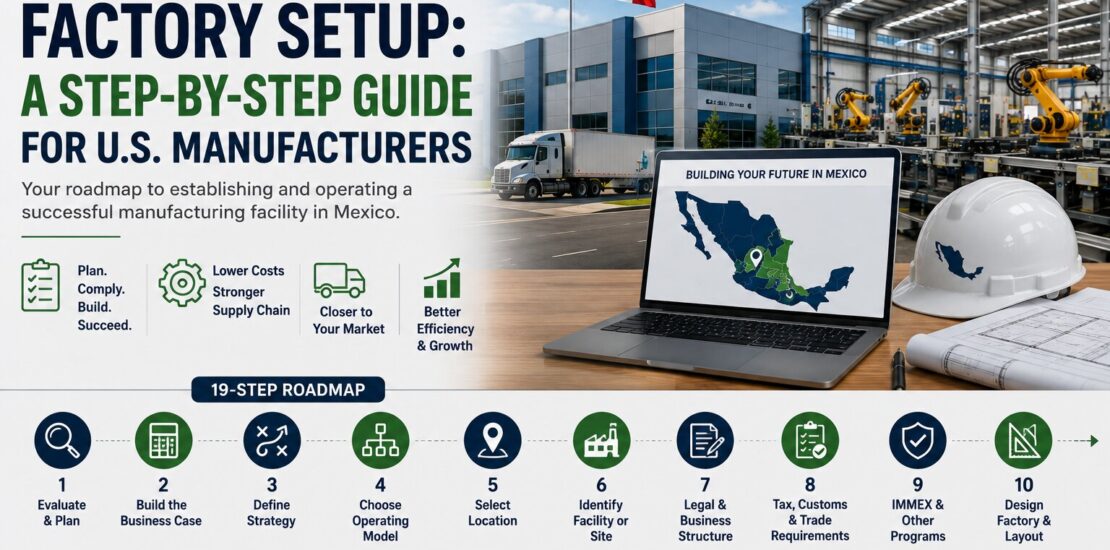
Setting up a factory in Mexico is more involved than finding an industrial building and moving equipment across the border.
A successful Mexico factory setup requires a business case, an operating model, location strategy, legal and customs planning, facility development, equipment installation, workforce development, supplier qualification, quality systems, and a controlled production ramp-up.
For some companies, contract manufacturing or a shelter arrangement may be the right starting point. For others, establishing a wholly owned operation makes more sense. The best approach depends on production volume, product complexity, automation, required control, investment capacity, timeline, and supply-chain requirements.
This guide explains how U.S. manufacturers can approach the process from initial feasibility through full production.
How Do You Set Up a Factory in Mexico?
The process generally follows this sequence:
Business case → manufacturing strategy → operating model → location → facility → legal/compliance → equipment → suppliers → workforce → quality → logistics → pilot production → ramp-up → continuous improvement.
There is no universal timeline or factory setup cost. A contract manufacturing arrangement can be established very differently from a greenfield facility, and a highly regulated operation may have substantially different requirements from a relatively simple assembly plant.
The key is to design the Mexico operation around the manufacturing process and supply chain, rather than starting with the cheapest building or lowest labor rate.
Step 1: Determine Whether Mexico Is the Right Manufacturing Location
Before spending money on a facility, determine whether Mexico actually fits your operation.
Start by analyzing:
- Product type
- Production volume
- Labor content
- Automation level
- Raw materials
- Component availability
- Current manufacturing costs
- Customer locations
- Freight
- Lead times
- Tariffs and duties
- Quality requirements
- Certifications
- Workforce requirements
- Facility requirements
- Import/export requirements
A labor-intensive product shipped primarily to the United States may have a very different business case from a highly automated product with expensive specialized components.
Mexico should be evaluated against the total cost and operational requirements of your current supply chain, not simply against hourly wages.
Step 2: Build the Financial Business Case
Next, calculate what the Mexico operation will actually cost.
Initial costs may include:
- Feasibility studies
- Consulting
- Legal setup
- Site selection
- Facility deposits
- Construction or renovation
- Equipment
- Tooling
- Installation
- IT
- Security
- Quality equipment
- Recruiting
- Training
- Initial inventory
- Working capital
- Launch costs
Recurring costs may include:
- Labor
- Benefits
- Rent or facility costs
- Utilities
- Maintenance
- Materials
- Logistics
- Customs
- Quality
- Management
- Compliance
- Insurance
- Inventory
The financial model should compare:
Current U.S. manufacturing cost
against
Mexico total cost + transition investment + logistics + inventory + management + compliance.
That gives management a much more useful picture than a simple labor-cost comparison.
Step 3: Define the Manufacturing Strategy
Decide exactly what you want to move to Mexico.
You do not necessarily need to move your entire production process.
Possible strategies include:
- Final assembly in Mexico
- Component manufacturing
- Contract manufacturing
- Packaging
- Injection molding
- Metal fabrication
- Subassembly
- Full manufacturing
- A hybrid U.S.–Mexico production model
For complex products, some components may continue to come from the United States, Canada, Asia, or other markets.
Southward Advisors notes that Mexican supply chains can require additional integration when products have complex bills of material because the final manufacturer may not be able to source every component independently.
That means the supply-chain strategy should be designed alongside the factory strategy.
Step 4: Choose the Mexico Operating Model
A U.S. company does not have to start by building its own factory.
| Model | Best suited for | Control | Setup complexity |
| Contract manufacturing | Testing Mexico or lower-capital entry | Lower | Lower |
| Shelter services | Companies wanting operational support | Medium | Medium |
| Joint venture | Shared investment/expertise | Shared | Medium–High |
| Mexican subsidiary | Direct local presence | High | High |
| Wholly owned operation | Long-term strategic manufacturing | Very high | High |
| Greenfield factory | Custom facility requirements | Very high | Very high |
| Existing facility acquisition | Faster entry with existing infrastructure | High | High |
Contract manufacturing
An existing Mexican manufacturer handles production. This can reduce upfront capital requirements, but the U.S. company has less control over equipment, workforce, processes, and capacity.
Shelter model
A shelter provider can support foreign manufacturers with selected administrative, operational, and compliance functions. It can be useful for companies that want to establish manufacturing without immediately building every local capability themselves.
Joint venture
A Mexican partner may contribute local knowledge, relationships, facilities, capital, or manufacturing expertise. Governance and intellectual-property arrangements require careful structuring.
Mexican subsidiary or wholly owned operation
This gives the company greater operational control but also creates greater responsibility for local administration, employment, compliance, taxation, customs, and management.
Greenfield vs. acquisition
A greenfield facility provides maximum flexibility but can take longer and require substantial capital. Acquiring an existing operation may provide faster access to equipment, employees, utilities, and production infrastructure, but due diligence becomes critical.
The appropriate model depends on control, capital, speed, risk tolerance, and long-term strategy.
Step 5: Select the Right Geographic Location
There is no single “best” manufacturing location in Mexico.
Potential manufacturing regions include:
- Nuevo León
- Coahuila
- Chihuahua
- Baja California
- Sonora
- Querétaro
- Guanajuato
- San Luis Potosí
- Jalisco
- Aguascalientes
The right location depends on what you manufacture.
Evaluate:
- Distance to U.S. customers
- Border crossings
- Highways
- Rail
- Airports
- Ports
- Supplier ecosystem
- Labor availability
- Skilled workforce
- Labor costs
- Industrial real estate
- Electricity
- Water
- Natural gas
- Telecommunications
- Security
- Existing industry clusters
- Room for expansion
The U.S. Commercial Service specifically emphasizes regional strategy when entering Mexico and identifies Monterrey, Guadalajara, Mexico City, and Baja California as important commercial centers for different parts of the country.
For manufacturing, however, the correct location should be selected based on the entire operating model, not just proximity to the border.
Step 6: Identify a Facility or Industrial Site
Once you have selected a region, determine whether you should:
- Lease an existing building
- Purchase an existing facility
- Renovate an existing plant
- Use a build-to-suit facility
- Construct a greenfield factory
The building must support the actual manufacturing process.
Evaluate:
- Floor loading
- Ceiling height
- Production area
- Warehouse capacity
- Loading docks
- Electrical capacity
- Water
- Gas
- Compressed air
- HVAC
- Fire protection
- Waste handling
- Security
- Employee facilities
- Office space
- Expansion potential
A cheap building that cannot support your production process is not a cheap factory.
Step 7: Establish the Legal and Business Structure
A U.S. company establishing operations in Mexico needs to determine the appropriate local structure and registrations.
Potential structures include Mexican corporations, variable-capital corporations, limited-liability structures, branches, and joint ventures. The U.S. Commercial Service notes that the choice of entity affects what the company can do in Mexico and its tax and liability considerations.
This is an area where professional Mexican legal and tax advice is essential.
Requirements can vary based on:
- Ownership
- Industry
- Location
- Manufacturing activity
- Imports
- Exports
- Employees
- Environmental impact
- Facility type
Do not treat a generic online checklist as a substitute for local professional advice.
Step 8: Understand Tax, Customs and Trade Requirements
Manufacturers importing materials into Mexico need a clear customs strategy before production begins.
Mexico’s import system includes different customs regimes, including definitive imports and temporary imports under programs such as IMMEX. Importers may also need to be registered in Mexico’s importer registry and comply with documentation requirements.
This is particularly important for companies importing:
- Machinery
- Raw materials
- Chemicals
- Electronic components
- Automotive components
- Packaging
- Tooling
As of June 1, 2026, Mexico began mandatory enforcement of an electronic value manifest requirement for applicable imports, making accurate valuation documentation and coordination between exporters, importers, and customs brokers increasingly important.
Step 9: Evaluate IMMEX
IMMEX stands for Mexico’s Manufacturing, Maquiladora and Export Services Program.
The program can allow qualifying export-oriented manufacturers to temporarily import certain inputs, components, and equipment under specified conditions. The U.S. Commercial Service notes that temporary imports through IMMEX are subject to program requirements and increasing controls.
IMMEX is not automatically appropriate for every manufacturer.
Eligibility, customs treatment, reporting, sensitive goods, VAT considerations, and compliance obligations should be evaluated with qualified Mexican tax and customs professionals.
Mexico’s own Secretariat of Economy maintains the official IMMEX information and regulatory resources.
Step 10: Evaluate USMCA Requirements
USMCA can be an important consideration when manufacturing in Mexico for the U.S. market.
But simply manufacturing a product in Mexico does not automatically mean it qualifies for preferential treatment.
Your analysis may need to consider:
- Rules of origin
- Product classification
- Regional content
- Documentation
- Supplier origin
- Customs procedures
This area is particularly important because U.S. and Mexican officials are currently conducting the 2026 USMCA Joint Review. Discussions have included rules of origin, automotive requirements, steel and aluminum, and economic security.
Trade rules should be verified immediately before making an investment decision.
Step 11: Design the Factory and Production Layout
The facility should be designed around material and information flow.
Map:
Receiving → inspection → raw-material storage → production → work-in-process → quality → finished goods → shipping
Consider:
- Material movement
- Workstation placement
- Employee movement
- Bottlenecks
- Safety
- Storage
- Quality checkpoints
- Future expansion
This is also an opportunity to incorporate lean manufacturing principles before inefficient processes become embedded.
Step 12: Purchase and Install Equipment
Equipment planning should begin well before the production launch.
Account for:
- Machinery
- Automation
- Tooling
- Fixtures
- Testing equipment
- Spare parts
- Electrical installation
- Programming
- Commissioning
- Training
- Validation
Mexico is also investing heavily in advanced manufacturing. The U.S. Commercial Service reported in August 2026 that demand is growing for smart manufacturing technologies across sectors including automotive, aerospace, medical devices, and semiconductors.
The appropriate level of automation, however, depends on your labor economics, volumes, product mix, and capital budget.
Step 13: Develop the Mexican Supplier Network
Finding a factory is only part of the job.
You may also need to develop suppliers for:
- Raw materials
- Packaging
- Components
- Tooling
- Maintenance
- Logistics
- Chemicals
- Subassemblies
The process should include:
- Supplier identification
- RFQs
- Capability review
- Factory audits
- Samples
- Quality validation
- Commercial negotiation
- Pilot orders
- Performance monitoring
Southward Advisors’ experience highlights the importance of multiple rounds of bidding, factory visits, and supplier development when shifting production into Mexico.
Step 14: Recruit and Train Employees
Do not build the workforce plan around production operators alone.
Depending on the operation, you may need:
- Operators
- Supervisors
- Engineers
- Maintenance technicians
- Quality personnel
- Production planners
- Purchasing
- Logistics
- HR
- Finance
- Plant management
Mexico’s 2026 minimum wage is 315.04 pesos per day in the general zone and 440.87 pesos in the Northern Border Free Zone, but minimum wage is not a useful substitute for modeling actual manufacturing compensation.
Actual labor economics depend on location, skill requirements, competition for talent, shifts, benefits, turnover, and training.
Step 15: Establish Quality and Compliance Systems
Quality cannot be added after production problems begin.
Before launch, establish:
- SOPs
- Work instructions
- Inspection procedures
- Supplier quality controls
- Incoming inspection
- In-process inspection
- Final inspection
- Traceability
- Nonconformance procedures
- Corrective action
- Production KPIs
- Audit procedures
For regulated industries, additional certifications and customer-specific requirements may apply.
Environmental requirements can also vary significantly. Depending on the operation, federal or local environmental permits and authorizations may apply. SEMARNAT maintains current procedures covering areas such as environmental impact and certain industrial emissions.
Step 16: Set Up Logistics and Cross-Border Transportation
Build the logistics model before the first commercial shipment.
Define:
- Supplier-to-factory transportation
- Factory-to-border transportation
- Customs broker
- U.S. receiving location
- Carrier strategy
- Incoterms
- Documentation
- Inventory buffers
- Emergency transportation
The border should be treated as part of the production system,not as an afterthought.
Step 17: Run Pilot Production
Do not immediately move 100% of production.
Start with controlled pilot production where possible.
Use the pilot to validate:
- Cycle times
- Quality
- Labor requirements
- Material flow
- Tooling
- Packaging
- Supplier performance
- Production documentation
- Logistics
- Customer requirements
A pilot also exposes problems while the organization still has time to correct them.
Step 18: Validate and Ramp Up
Once the pilot is stable, increase production gradually.
Monitor:
- First-pass yield
- Scrap
- Rework
- OEE
- Throughput
- On-time delivery
- Labor productivity
- Supplier performance
- Inventory
- Customer complaints
Do not judge the Mexico operation solely on the first few months of production. Ramp-up costs and process learning can temporarily distort performance.
Step 19: Continuously Improve the Operation
A factory is not finished when production starts.
After launch, continue improving:
- Layout
- Cycle time
- Inventory
- Supplier performance
- Quality
- Capacity
- Labor productivity
- Maintenance
- Material flow
This is where lean manufacturing and process-improvement disciplines can turn a newly established plant into a competitive long-term operation.
How Much Does It Cost to Set Up a Factory in Mexico?
There is no reliable universal price.
A supplier-based operation may require relatively little capital compared with building a dedicated facility. A greenfield plant, by contrast, can require millions of dollars once property, construction, utilities, machinery, tooling, IT, hiring, training, and working capital are included.
The most useful approach is to create a project-specific budget containing:
| Initial investment | Ongoing costs |
| Site selection | Labor |
| Legal setup | Benefits |
| Facility | Rent/ownership |
| Construction | Utilities |
| Machinery | Materials |
| Tooling | Logistics |
| Installation | Customs |
| IT | Maintenance |
| Security | Quality |
| Recruiting | Management |
| Training | Compliance |
| Initial inventory | Insurance |
| Working capital | Inventory |
Avoid relying on generic “cost per square foot” or “cost per employee” estimates until the specific process and location have been defined.
How Long Does It Take to Establish a Factory in Mexico?
There is no universal timeline.
A typical project sequence is:
Planning
↓
Location and operating-model selection
↓
Legal and compliance setup
↓
Facility preparation
↓
Equipment procurement and installation
↓
Hiring
↓
Supplier qualification
↓
Pilot production
↓
Quality validation
↓
Ramp-up
The timeline can change significantly depending on construction, permits, equipment lead times, workforce availability, customer approvals, certifications, and the complexity of the production process.
10 Common Mistakes U.S. Manufacturers Make When Setting Up a Factory in Mexico
1. Choosing a location based only on labor cost
A lower wage can be offset by poor logistics, infrastructure, utilities, or talent availability.
2. Underestimating setup costs
Equipment is only one part of the investment.
3. Choosing the wrong operating model
Building a factory may be unnecessary if contract manufacturing can validate demand first.
4. Ignoring infrastructure
Electricity, water, gas, telecommunications, roads, and industrial services can determine whether a location works.
5. Treating compliance as an afterthought
Legal, labor, customs, environmental, and safety requirements should be incorporated from the beginning.
6. Moving too much production too quickly
A phased transition can reduce operational risk.
7. Failing to qualify suppliers
A capable-looking supplier is not necessarily a reliable long-term partner.
8. Underestimating workforce requirements
A factory needs engineers, maintenance, quality, supervisors, and management,not just operators.
9. Ignoring cross-border logistics
Customs and transportation should be designed before commercial production begins.
10. Assuming U.S. processes can be copied unchanged
Processes often need adaptation to local suppliers, workforce, infrastructure, regulations, and operating conditions.
Mexico Factory Setup Checklist
Use this checklist before committing significant capital:
- Build the business case
- Analyze product and production requirements
- Calculate total landed cost
- Select the operating model
- Evaluate Mexican manufacturing regions
- Compare facility options
- Verify utilities and infrastructure
- Establish legal structure
- Review tax and customs requirements
- Evaluate IMMEX
- Evaluate USMCA qualification
- Identify equipment requirements
- Develop facility layout
- Identify Mexican suppliers
- Conduct supplier audits
- Develop workforce plan
- Recruit management and technical staff
- Establish quality systems
- Build logistics strategy
- Plan inventory
- Conduct pilot production
- Validate processes
- Ramp production
- Establish continuous-improvement KPIs
How Should You Evaluate the ROI of a Mexico Factory?
Start with:
Current U.S. Manufacturing Cost
vs.
Mexico Manufacturing Cost
Then add the costs that are easy to overlook:
- Transition investment
- Logistics
- Inventory
- Management
- Compliance
- Supplier development
- Quality
- Working capital
Then calculate:
Potential Annual Savings = Current Total Cost − Mexico Total Cost
And:
Payback Period = Transition Investment ÷ Annual Savings
This prevents the common mistake of assuming that lower labor costs automatically equal higher profitability.
Is Manufacturing in Mexico Cheaper Than the U.S.?
It can be, but not automatically.
Mexico may provide a stronger total-cost proposition for certain labor-intensive, export-oriented, or supply-chain-sensitive operations. Highly automated U.S. facilities, very low-volume production, or products dependent on specialized imported components may not achieve the same advantage.
The correct comparison is total cost of ownership, not wages alone.
Is Mexico Better Than China for U.S. Manufacturers?
It depends on the product and supply chain.
Mexico can offer proximity to U.S. customers and a different logistics and inventory profile, while China may remain highly competitive for particular products, supplier ecosystems, and production volumes.
Southward Advisors’ documented projects illustrate why the analysis needs to extend beyond factory pricing. Its case studies include a Midwest cabinet manufacturer that saved more than $200,000 in tariffs after shifting sourcing to a Mexican supplier, and a Southeast manufacturer that reports saving close to $1 million annually on tariffs after integrating parts of its supply chain in Mexico.
These are specific project outcomes, not guarantees for other manufacturers.
Should a U.S. Manufacturer Use a Mexico Manufacturing Advisor?
For a straightforward supplier transition, a company with experienced internal teams may be able to manage much of the process itself.
For a first-time Mexico factory setup, however, local expertise can help connect decisions that are often treated separately: site selection, supplier sourcing, facility requirements, workforce, customs, process design, and production implementation.
Southward Advisors provides nearshoring, supplier sourcing, supply-chain development, site-selection support, process improvement, and implementation support for manufacturers establishing or expanding operations in Mexico.
The firm’s documented case studies also show projects involving Mexican supplier development, supply-chain integration, and production migration.
Before committing capital to a Mexico manufacturing operation, U.S. manufacturers should validate the business case, operating model, location, supply chain, and implementation requirements. Southward Advisors can help companies evaluate these factors and develop a practical roadmap for establishing or expanding manufacturing operations in Mexico.
FAQ: Mexico Factory Setup
1. How do you set up a factory in Mexico?
Start with a feasibility and financial analysis, then select an operating model and location. From there, establish the legal and compliance structure, secure a facility, install equipment, develop suppliers, hire and train employees, establish quality systems, and move through pilot production and ramp-up.
2. How much does it cost to set up a factory in Mexico?
There is no universal figure. Costs depend on facility size, location, equipment, automation, workforce, production volume, construction requirements, industry, and operating model. A contract manufacturing arrangement requires far less capital than a greenfield factory.
3. How long does it take to establish a factory in Mexico?
The timeline varies substantially. Facility construction, equipment lead times, permits, hiring, supplier qualification, certifications, and production complexity can all affect the schedule.
4. Can a U.S. company establish manufacturing operations in Mexico?
Yes, U.S. companies can establish different forms of business presence in Mexico, but the appropriate structure depends on the operation. The U.S. Commercial Service recommends obtaining Mexican legal advice when establishing a local presence.
5. What is the best location for manufacturing in Mexico?
There is no universal best location. Nuevo León, Coahuila, Chihuahua, Baja California, Querétaro, Guanajuato, Jalisco, San Luis Potosí, Aguascalientes, and other regions can be attractive depending on industry, workforce, suppliers, infrastructure, logistics, and customers.
6. What is IMMEX?
IMMEX is Mexico’s Manufacturing, Maquiladora and Export Services Program. It provides a framework for qualifying export-oriented manufacturers to temporarily import certain inputs, components, and equipment under specified conditions.
7. Should a company use a shelter company?
A shelter model can make sense for companies that want local operational support without immediately building every administrative and compliance function themselves. It should be compared against contract manufacturing, a subsidiary, joint venture, and wholly owned operation.
8. Is manufacturing in Mexico cheaper than manufacturing in the United States?
It can be, particularly for some labor-intensive operations, but the answer depends on total landed cost. Facility, utilities, materials, logistics, management, compliance, and transition costs all matter.
9. Is Mexico better than China for manufacturing?
Not universally. Mexico can be attractive for U.S.-focused supply chains because of geographic proximity and regional integration, while China can remain highly competitive for certain products and supplier ecosystems. A product-specific total-cost analysis is necessary.
10. What are the biggest challenges when setting up a factory in Mexico?
Common challenges include selecting the right location, developing qualified suppliers, navigating customs and compliance, recruiting skilled employees, establishing quality systems, and managing the transition from an existing manufacturing location.
11. Do I need IMMEX to manufacture in Mexico?
Not necessarily. Whether IMMEX is appropriate depends on the company’s manufacturing and import/export model. The program should be evaluated with qualified Mexican customs and tax professionals.
12. What should I do before signing a factory lease?
Complete the manufacturing process analysis, financial model, site assessment, infrastructure review, legal/compliance review, and expansion analysis first. A building should be selected because it supports the production strategy,not simply because it has an attractive lease price.