
How to Conduct a Factory Audit in Mexico Before Choosing a Supplier
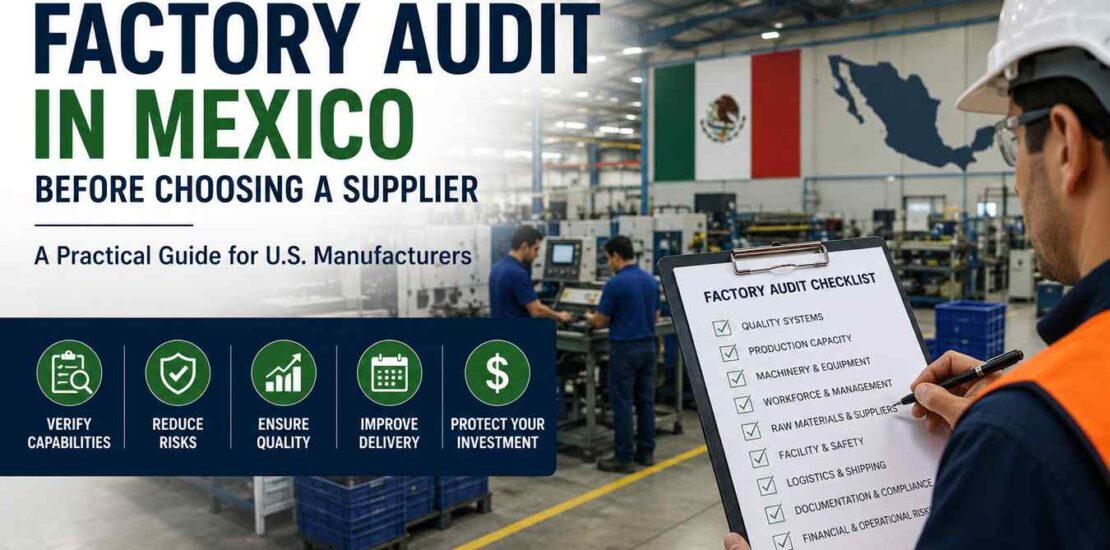
Choosing a Mexican manufacturing supplier should involve much more than comparing quotes.
A supplier may offer an attractive price, have an impressive facility, and claim substantial production capacity. None of those facts, by themselves, prove that the company can consistently deliver the right quality, right volume, right cost, right delivery, and right compliance.
That is why a factory audit in Mexico should be part of a broader supplier-qualification process.
A proper audit combines documentation review, management interviews, factory-floor inspection, production-capacity analysis, quality evaluation, supply-chain assessment, logistics review, and commercial due diligence. The goal is not to find a factory that simply looks good during a visit. It is to determine whether the supplier can perform reliably after you award the business.
Southward Advisors’ supplier-development approach similarly emphasizes vetting suppliers, developing supply chains, and validating manufacturing partners before companies commit to nearshore production.
Why Conduct a Factory Audit in Mexico?
A factory audit helps a U.S. manufacturer identify operational risks before those risks become expensive problems.
You may discover that:
- The supplier’s claimed capacity is already heavily utilized.
- Critical processes are subcontracted without adequate controls.
- Equipment is older than represented.
- Quality records do not support the supplier’s claims.
- A key raw material comes from a single supplier.
- Traceability is weak.
- Employee turnover is affecting production.
- Preventive maintenance is inconsistent.
- The supplier lacks experience with U.S. export requirements.
- Pricing is unusually low because important costs or processes were omitted.
An audit is particularly valuable before signing a major supply agreement, transferring tooling, committing substantial annual volume, or moving production from another country.
But an audit is not the same as supplier qualification. Qualification should combine pre-audit documentation, management interviews, factory inspection, process evaluation, quality validation, commercial review, customer references, sample or pilot production, and ongoing performance monitoring.
When Should You Audit a Mexican Supplier?
Ideally, conduct the audit before making the final supplier-selection decision.
You may also need follow-up audits:
- Before initial approval.
- Before transferring significant production volume.
- After major corrective actions.
- When the supplier adds a new facility or production line.
- When quality or delivery performance deteriorates.
- Before introducing a major new product.
- Periodically for strategically important suppliers.
The frequency should depend on supplier risk, product criticality, industry requirements, performance history, and the value of the business.
How to Conduct a Factory Audit in Mexico: 25-Step Process
Step 1: Define Your Supplier Requirements
Before visiting the factory, define what the supplier must deliver.
Document:
- Product specifications
- Expected annual and monthly volume
- Quality requirements
- Certifications
- Delivery requirements
- Packaging standards
- Target pricing
- Logistics requirements
- Compliance requirements
- Engineering requirements
- Customer-specific requirements
Your audit checklist should be built around these requirements. A medical-device supplier, automotive supplier, furniture manufacturer, and electronics contract manufacturer should not be evaluated using exactly the same checklist.
Step 2: Screen Suppliers Before the Factory Visit
Do not spend time auditing every company that sends you a quotation.
Start with a preliminary assessment covering:
- Manufacturing experience
- Product and process capabilities
- Industries served
- Current customers
- Facility location
- Approximate capacity
- Equipment
- Certifications
- Export experience
- Pricing
- Lead times
- Relevant references
Shortlist suppliers that appear capable of meeting your basic requirements.
Step 3: Request Documentation Before the Visit
Ask for appropriate documentation in advance.
Depending on the supplier and industry, this could include:
- Company registration information
- Facility information
- Organization chart
- Quality certifications
- Quality manual
- SOPs
- Inspection procedures
- Production records
- Capacity information
- Equipment list
- Maintenance records
- Calibration records
- Material specifications
- Supplier lists
- Customer references
- Previous audit reports
- Corrective-action records
- Quality KPIs
- On-time delivery data
- Safety records
- Environmental documentation
- Relevant permits or certifications
- Insurance information
Not every supplier will need to provide every document. The appropriate level of documentation depends on the product, industry, risk, and contractual relationship.
Step 4: Research the Supplier and Its Reputation
Look beyond the supplier’s own presentation.
Research its operating history, customers, industry reputation, ownership, facility history, and relevant references.
Ask for customer references where appropriate and verify claims that materially affect your supplier decision.
A supplier that has successfully exported to the United States for years presents a different risk profile from a company entering the U.S. market for the first time.
Step 5: Prepare the Factory Audit Checklist
Turn your requirements into measurable audit questions.
For example, instead of asking:
“Does the supplier have enough capacity?”
ask:
“What is current monthly output, rated capacity, current utilization, available shifts, bottleneck equipment, and demonstrated output for a comparable product?”
That distinction turns a general conversation into an auditable assessment.
Step 6: Schedule the On-Site Factory Visit
Give the supplier an agenda, but avoid making the visit so scripted that you only see prepared areas.
A useful audit may include:
- Management meeting
- Facility tour
- Production-floor observation
- Quality review
- Warehouse inspection
- Equipment review
- Employee interviews
- Documentation review
- Closing meeting
If possible, observe actual production rather than an empty line prepared specifically for visitors.
Step 7: Meet the Supplier’s Management Team
Meet the people responsible for production, quality, engineering, maintenance, purchasing, logistics, and general management.
Pay attention not only to their answers but also to whether different departments provide consistent answers.
Ask:
- What are your biggest production bottlenecks?
- What percentage of capacity is currently utilized?
- Which processes are subcontracted?
- What happens when equipment fails?
- How quickly can you increase output?
- What is your employee turnover?
- What is your current defect rate?
- Which customers represent a significant share of revenue?
Step 8: Inspect the Facility
Look at the factory as an operating system rather than a showroom.
Evaluate:
- Cleanliness
- Organization
- Layout
- Production flow
- Lighting
- Safety
- Utilities
- Infrastructure
- Expansion capacity
- Material movement
- Work-in-progress
- Finished-goods areas
A clean lobby tells you very little. A well-controlled production floor tells you much more.
Step 9: Evaluate Production Capacity
This is one of the most important parts of the audit.
Separate rated capacity from actual demonstrated capacity.
Examine:
- Current output
- Rated machine capacity
- Current utilization
- Number of shifts
- Cycle times
- Labor availability
- Bottlenecks
- Overtime
- Equipment constraints
- Maintenance downtime
- Backup equipment
- Expansion capability
- Subcontracting
There is a major difference between a supplier saying, “We can produce 100,000 units,” and demonstrating that its equipment, workforce, planning system, and material supply can consistently produce 100,000 acceptable units.
Step 10: Inspect Machinery and Equipment
Evaluate equipment age, condition, technology, capacity, maintenance, calibration, and redundancy.
Ask:
- How often is preventive maintenance performed?
- What is the history of unplanned downtime?
- Which machines are critical bottlenecks?
- Are spare parts readily available?
- Is critical equipment backed up?
- Are measuring instruments calibrated?
Step 11: Evaluate Quality Management
Review the supplier’s quality-management system from incoming material through final shipment.
Look for:
- Incoming inspection
- In-process inspection
- Final inspection
- Sampling procedures
- Testing
- Calibration
- Nonconformance controls
- Root-cause analysis
- CAPA
- Corrective actions
- Traceability
- Customer complaints
- Scrap
- Rework
- First-pass yield
- Defect rates
- Quality KPIs
ISO 9001 can provide useful evidence that a supplier has a formal quality-management framework, but certification should not replace your own supplier evaluation. ISO describes ISO 9001 as a framework covering quality processes, documented information, performance evaluation, and continual improvement.
Step 12: Review Raw Materials and Supplier Controls
Your supplier may look excellent while depending on a fragile upstream supply chain.
Determine:
- Who supplies critical materials?
- Which materials are imported?
- Are any components single-sourced?
- How are suppliers qualified?
- How is incoming quality checked?
- What are typical lead times?
- Is safety stock maintained?
- Are alternative suppliers available?
- How are materials traced?
Southward Advisors notes that Mexican supply chains can require additional integration, particularly where a manufacturer needs to coordinate multiple raw-material, Tier 1, and Tier 2 suppliers.
Step 13: Evaluate Workforce and Management
Assess whether the supplier has the people required to support your business.
Review:
- Production management
- Engineers
- Quality personnel
- Maintenance technicians
- Skilled operators
- Training programs
- Employee turnover
- Workforce stability
- Succession planning
Ask managers how they recruit, train, and retain critical employees.
Step 14: Review Production Planning and Inventory
Examine how orders become production schedules.
Look at:
- Production planning
- MRP/ERP systems
- Material availability
- WIP controls
- Safety stock
- Finished-goods inventory
- Production scheduling
- Capacity planning
A factory may have sufficient theoretical capacity but still miss deliveries because planning and material control are weak.
Step 15: Evaluate Maintenance and Downtime Controls
Review preventive-maintenance schedules and downtime records.
Ask to see evidence rather than relying on verbal assurances.
Critical questions include:
- What are the top causes of downtime?
- How quickly are failures repaired?
- Which machines are most critical?
- Are spare parts stocked locally?
- Is maintenance performed internally or by contractors?
Step 16: Evaluate Warehouse and Material Handling
Inspect receiving, storage, picking, production staging, and finished-goods areas.
Check:
- Inventory organization
- Identification
- Traceability
- Security
- Environmental controls where required
- FIFO/FEFO where applicable
- Inventory accuracy
- Finished-goods handling
Step 17: Review Packaging and Shipping
Examine how finished goods are prepared for shipment.
Review:
- Packaging
- Labeling
- Palletization
- Staging
- Loading
- Shipping documentation
- Carrier coordination
- Export experience
For cross-border operations, clarify who is responsible for customs documentation and broker coordination.
Mexico’s import requirements include documentation such as the pedimento de importación, commercial invoice, bill of lading, and applicable regulatory documentation. U.S. companies should verify current requirements with their Mexican importer, customs broker, and qualified trade professionals.
Step 18: Evaluate Environmental, Health, Safety, and Compliance Practices
Do not treat compliance as a paperwork exercise.
Inspect actual workplace conditions.
Relevant Mexican workplace safety requirements are governed by federal law and multiple NOM standards administered by STPS. The current STPS framework includes standards covering areas such as buildings, fire protection, machinery safeguards, hazardous materials, material handling, PPE, electrical safety, and other workplace risks.
Specific requirements depend on the supplier’s processes and industry. Mexican legal, labor, tax, environmental, customs, and regulatory requirements should be verified with qualified professionals.
Step 19: Review Documentation and Traceability
Select a few production records and trace them backward.
Can the supplier identify:
Finished product → production batch → process records → raw materials → supplier?
If traceability breaks down, investigate why.
Step 20: Interview Relevant Employees
Talk with operators, quality technicians, supervisors, engineers, and maintenance personnel where appropriate.
Employees can reveal operational realities that management presentations may not show.
Ask practical questions such as:
- What causes the most downtime?
- What problems occur most frequently?
- How are defects handled?
- What happens when material is missing?
- How are new employees trained?
Step 21: Document Findings and Nonconformities
Do not rely on memory after leaving the facility.
Record:
- Finding
- Evidence
- Risk
- Requirement
- Responsible person
- Corrective action
- Due date
- Verification status
Photographs can be useful where permitted and appropriate.
Step 22: Score the Supplier
Use a structured scoring model rather than allowing the lowest quotation to dominate the decision.
An illustrative weighting is:
| Category | Weight |
| Quality | 25% |
| Production Capacity | 20% |
| Cost Competitiveness | 15% |
| Delivery & Logistics | 15% |
| Management | 10% |
| Equipment & Technology | 5% |
| Compliance | 5% |
| Supply Chain | 5% |
| Total | 100% |
These weights and thresholds are illustrative, not an industry-standard universal system.
A possible interpretation:
- 90–100: Strong candidate
- 80–89: Potential candidate with manageable improvements
- 70–79: Significant corrective action required
- Below 70: High-risk candidate
A supplier should not automatically pass because it scores highly overall if it has a critical failure in an essential category.
Step 23: Request Corrective Actions
Separate findings into:
Minor concerns: Issues that can be corrected without materially affecting supplier suitability.
Major concerns: Issues that could affect quality, capacity, delivery, or compliance and require verified corrective action.
Critical concerns: Issues that may justify disqualification unless independently resolved and validated.
Step 24: Conduct Sample or Pilot Production
Do not move directly from a successful audit to full production.
Run samples, first articles, testing, or a controlled pilot where appropriate.
Validate:
- Product quality
- Process capability
- Cycle times
- Yield
- Packaging
- Documentation
- Traceability
- Delivery performance
Southward Advisors’ own nearshoring process includes supplier vetting followed by pilot production, process optimization, and scaling rather than treating supplier selection as the end of the process.
Step 25: Make the Final Supplier Decision
The final decision should combine:
- Audit results
- Corrective actions
- Samples
- Pilot production
- Quality validation
- Pricing
- Logistics
- Capacity
- Commercial terms
- Compliance
- Supplier references
- Long-term strategic fit
A successful factory visit should increase confidence—not automatically trigger a long-term contract.
20 Factory Audit Red Flags to Watch for
Watch closely for:
- Poor housekeeping
- Uncontrolled inventory
- Missing traceability
- Outdated equipment
- Poor preventive maintenance
- Unexplained production delays
- High employee turnover
- Weak quality documentation
- High scrap or rework
- Reluctance to provide records
- Inconsistent answers from management
- Hidden subcontracting
- Excessive customer concentration
- No backup suppliers
- No backup equipment
- Poor safety practices
- Unclear ownership or management
- Unrealistically low pricing
- Inability to demonstrate claimed capacity
- Resistance to corrective action
None of these automatically disqualifies a supplier. The important question is whether the issue is understood, measurable, controllable, and correctable.
Factory Audit Checklist
Pre-Audit
- Supplier questionnaire completed
- Documentation reviewed
- Certifications verified
- Production requirements defined
- Quality requirements defined
Facility
- Facility condition
- Production flow
- Safety
- Utilities
- Capacity
Production
- Equipment
- Cycle time
- Capacity
- Maintenance
- Bottlenecks
Quality
- QMS
- Incoming inspection
- In-process inspection
- Final inspection
- CAPA
- Traceability
Supply Chain
- Raw materials
- Supplier network
- Inventory
- Backup suppliers
Logistics
- Packaging
- Shipping
- Export processes
- Transportation
Management
- Management capability
- Workforce
- Training
- Turnover
Post-Audit
- Findings documented
- Supplier score calculated
- Corrective actions requested
- Samples validated
- Pilot production completed
- Final supplier decision
Questions to Ask a Mexican Manufacturing Supplier
Use questions such as:
- What percentage of your current capacity is being utilized?
- What are your biggest production bottlenecks?
- Which processes are performed in-house?
- Which processes are subcontracted?
- What happens if your primary raw-material supplier cannot deliver?
- What is your current defect rate?
- How do you manage nonconforming products?
- What is your employee turnover rate?
- How quickly can you increase production?
- What happens during equipment downtime?
- How do you manage customer complaints?
- How do you maintain material traceability?
- What percentage of your materials are imported?
- What are your typical production lead times?
- Which customers represent a significant share of your business?
Customize the questions to your product, industry, and risk profile.
What Is the Difference Between a Factory Audit and Supplier Qualification?
A factory audit evaluates the supplier’s facility, processes, systems, equipment, people, and controls.
Supplier qualification is broader. It combines the factory audit with commercial evaluation, documentation, references, sample approval, product testing, pilot production, corrective actions, and ongoing performance monitoring.
A factory audit is therefore one component of supplier qualification—not a substitute for it.
Should U.S. Companies Use a Third-Party Factory Auditor in Mexico?
Not always. An experienced internal procurement or quality team may be fully capable of conducting the audit.
A local expert can be valuable when the project involves:
- Language barriers
- Complex manufacturing processes
- Limited Mexico experience
- New suppliers
- Significant production commitments
- Complex upstream supply chains
- Supplier verification
- Corrective-action follow-up
- Local logistics
- Cultural or communication challenges
The benefit is not simply translation. A knowledgeable local professional can help interpret what is happening on the factory floor and identify questions that an unfamiliar visitor may miss.
How Southward Advisors Helps U.S. Manufacturers Qualify Mexican Suppliers
Southward Advisors works with U.S. manufacturers on Mexico sourcing, supplier identification and qualification, nearshoring strategy, supply-chain development, manufacturing implementation, and process improvement. Its nearshore manufacturing service specifically includes supplier vetting, sourcing, site evaluation, pilot production, and implementation support.
The company’s documented case studies also illustrate the importance of supplier selection and factory visits. In one case, Southward identified Mexican suppliers for a Midwest cabinet manufacturer, followed by multiple rounds of bidding and factory visits before selecting a supplier in Guanajuato.
Selecting a Mexican supplier is a decision that can affect quality, delivery, cost, and long-term supply-chain resilience. Southward Advisors can help U.S. manufacturers identify, evaluate, qualify, and develop Mexican suppliers before committing production.
Frequently Asked Questions
What is a factory audit?
A factory audit is a structured evaluation of a manufacturer’s facility, production processes, equipment, quality systems, workforce, capacity, supply chain, logistics, and compliance.
How do you audit a factory in Mexico?
Start by defining supplier requirements and screening the supplier. Request documentation, research the company, conduct an on-site inspection, evaluate capacity and quality, interview management and employees, document findings, score the supplier, request corrective actions, and validate the supplier through samples or pilot production.
What should I check during a factory audit?
Check facility conditions, production flow, equipment, capacity, maintenance, quality systems, raw materials, traceability, workforce, inventory, logistics, safety, environmental controls, documentation, and management capability.
What documents should a Mexican supplier provide?
Potential documents include company information, organization charts, certifications, quality procedures, production records, equipment lists, maintenance records, calibration records, capacity data, customer references, audit reports, corrective-action records, and relevant compliance documentation. Requirements vary by industry.
How do you qualify a Mexican manufacturer?
Use a combination of documentation review, factory auditing, management interviews, production-capacity validation, quality assessment, supplier references, commercial evaluation, sample approval, pilot production, and ongoing performance monitoring.
What are the biggest factory-audit red flags?
Common warning signs include poor traceability, weak quality documentation, poor maintenance, unexplained delays, high turnover, hidden subcontracting, inability to demonstrate capacity, weak safety practices, and resistance to corrective action.
How do you score a supplier?
Create weighted categories such as quality, capacity, cost, logistics, management, equipment, compliance, and supply chain. The weights should reflect your product and business risk.
How often should suppliers be audited?
There is no universal interval. High-risk or strategically important suppliers may require more frequent reviews, while low-risk suppliers with strong performance may require less frequent auditing.
Is ISO 9001 certification enough to approve a supplier?
No. ISO 9001 can provide useful evidence of a formal quality-management system, but it does not replace a product-specific supplier evaluation, factory audit, sample approval, or performance validation.
Should a factory audit include the supplier’s upstream suppliers?
When critical materials or components create significant risk, yes. Auditing only the final manufacturer may not expose single-source dependencies, imported-material risks, or weak upstream quality controls.
Can a factory audit guarantee supplier performance?
No. An audit provides evidence about the supplier at a particular point in time. Supplier qualification should continue through samples, pilot production, performance monitoring, and periodic reassessment.
Should U.S. manufacturers use local experts for supplier audits in Mexico?
It depends on the project. Local expertise can be particularly useful when the buyer lacks Mexico manufacturing experience, when the supply chain is complex, or when supplier verification and corrective-action follow-up require local presence.