
IMMEX Explained: How the Program Can Support Manufacturing in Mexico
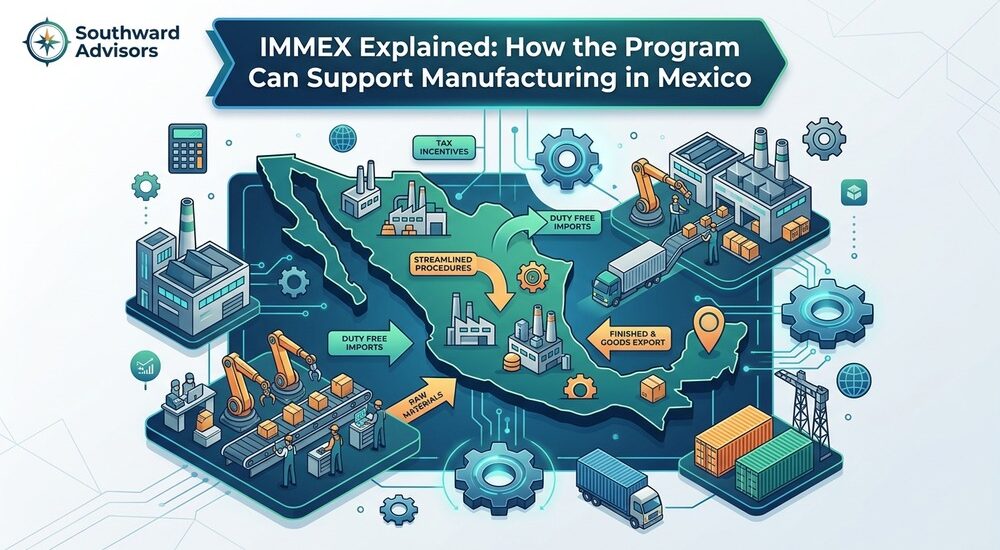
For U.S. manufacturers considering production in Mexico, IMMEX Mexico is one of the most important programs to understand.
But IMMEX is also frequently misunderstood.
It is not simply a tax loophole, a blanket duty exemption, or another name for every maquiladora operation. IMMEX is a Mexican government program that supports qualifying export-oriented manufacturing and service operations by providing a framework for temporary imports and related customs treatment, subject to specific eligibility, documentation, inventory-control, reporting, and compliance requirements.
For a U.S. company evaluating Mexico, the practical question is not just, “Can we get IMMEX?”
It is:
“Does an IMMEX structure make sense for our manufacturing model, and can we operate it compliantly?”
What Is IMMEX in Mexico?
IMMEX stands for Programa de la Industria Manufacturera, Maquiladora y de Servicios de Exportación—the Program for the Manufacturing, Maquiladora and Export Services Industry.
It is administered by Mexico’s Secretaría de Economía (Secretariat of Economy) and is designed for qualifying Mexican-resident entities involved in manufacturing, processing, or specified export services.
The program can allow qualifying companies to temporarily import certain foreign goods for manufacturing, transformation, repair, or export-related services under the conditions established by Mexican law and regulations.
The current Mexican government framework recognizes five IMMEX modalities: Industrial, Services, Controladora, Albergue (Shelter), and Terciarización (Outsourcing).
The distinction matters because the requirements and operating model can differ substantially by modality.
IMMEX and maquiladora are related—but not identical
The word maquiladora has a long history in Mexico’s export-manufacturing sector. IMMEX is the current formal government program that consolidated and replaced earlier maquiladora and export-service program structures.
In everyday business conversations, companies may still say “maquiladora,” “maquila,” or “IMMEX company.”
But technically, IMMEX is the government program; maquiladora is a broader historical and operational term associated with export manufacturing.
How Does IMMEX Work?
The simplest way to understand IMMEX is to follow the movement of materials.
A hypothetical U.S. manufacturer might:
- Establish or work with an eligible Mexican manufacturing operation.
- Import components, raw materials, or other qualifying goods into Mexico.
- Receive and record those materials in its customs and inventory systems.
- Process, assemble, manufacture, repair, or transform the goods in Mexico.
- Export the resulting products.
- Reconcile the temporary imports with their authorized disposition.
- Maintain the required customs, inventory, tax, and operational records.
IMMEX sits in the middle of that process by providing the regulatory framework under which qualifying temporary imports can be made for export-oriented operations.
The important point is that temporary importation creates obligations as well as potential benefits. Materials cannot simply enter Mexico and disappear into the general inventory. Companies need systems capable of tracking what entered, how it was used, what was transformed, and how the goods were ultimately returned, transferred, or otherwise legally discharged.
Mexico’s current customs framework specifically requires automated inventory controls for applicable IMMEX operations, with the SAT’s 2026 Annex 24 setting out the relevant control-system requirements.
Who Can Use the IMMEX Program?
IMMEX is not automatically available to every foreign company that wants to manufacture in Mexico.
The Secretaría de Economía identifies Mexican-resident legal entities that meet the applicable requirements as potential IMMEX beneficiaries. Current government guidance also identifies an export commitment of at least US$500,000 annually or 10% of total sales for the program.
Potential users can include:
- Manufacturers
- Assemblers
- Processors
- Export-oriented service providers
- Foreign-owned Mexican manufacturing companies
- Companies developing nearshore production
- Certain third-party manufacturing structures
Eligibility depends on the company’s Mexican legal structure, activity, export model, facilities, documentation, customs profile, and the specific IMMEX modality involved.
IMMEX Modalities Explained
The five current modalities are:
| Modality | Basic purpose |
| Industrial | Manufacturing or transforming goods intended for export |
| Services | Specified export-related services or services involving export goods |
| Controladora | Integrates manufacturing operations of a qualifying controlling company and controlled companies under one program |
| Albergue / Shelter | A Mexican IMMEX company operates the program while foreign companies provide technology and productive materials without directly operating the program |
| Terciarización / Outsourcing | A qualifying IMMEX company without its own production facilities has manufacturing performed by registered third parties |
These definitions are reflected in current Secretaría de Economía/VUCEM materials.
For most U.S. manufacturers establishing their own Mexican plant, the Industrial modality is the most obvious starting point. But companies entering Mexico through a shelter provider, outsourced manufacturing structure, or corporate group may need a different analysis.
Potential Benefits of the IMMEX Program
The potential value of IMMEX generally comes from the interaction between Mexico’s temporary-import regime and an export-oriented manufacturing model.
| Potential benefit | What it can mean |
| Temporary imports | Qualifying foreign goods can enter Mexico under the temporary regime for authorized activities |
| Customs treatment | Certain duties and other import charges may be deferred or treated differently depending on the goods and applicable rules |
| VAT cash-flow management | Additional VAT/IEPS mechanisms may reduce the need for an upfront cash payment when requirements are met |
| Export manufacturing | Provides a formal framework for qualifying export-oriented production |
| Supply-chain integration | Supports cross-border manufacturing and supplier networks |
| Nearshoring flexibility | Can support U.S. companies moving production closer to North American customers |
| Inventory control | Creates a structured framework for managing temporary imported materials |
Mexico’s Secretariat of Economy describes IMMEX as allowing qualifying temporary imports while deferring applicable import tax, VAT and, where applicable, countervailing duties under the program’s rules. The U.S. Commercial Service likewise explains that temporary entry through IMMEX can provide relief from import duties while goods remain under the temporary regime, subject to conditions.
IMMEX is not a blanket tax exemption
This distinction is critical.
IMMEX does not mean a company pays no Mexican taxes.
Customs duties, VAT, income tax, transfer-pricing rules, local taxes, and other obligations can involve different legal frameworks.
The treatment of a particular import can depend on factors including:
- Tariff classification
- Country of origin
- Destination
- Type of merchandise
- Temporary versus permanent import
- IMMEX modality
- Applicable trade agreements
- Other Mexican programs or certifications
- Compliance status
Companies should therefore model the entire transaction rather than assume that “IMMEX = tax-free.”
IMMEX and VAT
One of the most misunderstood parts of IMMEX is Mexican VAT.
Temporary imports under the applicable customs regime can trigger VAT rules, but qualifying companies may have access to mechanisms that prevent the VAT from becoming an immediate cash payment.
Under Article 28-A of Mexico’s VAT Law, companies that introduce goods into specified temporary-import regimes can apply for a 100% VAT credit against the VAT otherwise payable, provided they obtain the required SAT certification. Companies that do not use the certification route may, under applicable rules, use a guarantee mechanism instead.
That is why it is inaccurate to say:
“IMMEX companies pay no VAT.”
A better explanation is:
IMMEX can work with Mexico’s VAT certification or guarantee mechanisms to manage VAT associated with qualifying temporary imports, subject to specific requirements.
The SAT’s current certification framework requires, among other things, a valid IMMEX program, appropriate infrastructure, fiscal and customs compliance, and inventory controls.
IMMEX and Customs Duties
IMMEX can also affect the customs treatment of qualifying temporary imports.
But again, IMMEX does not automatically make every imported product duty-free.
Companies need to determine:
- The correct tariff classification
- Whether the import is temporary or permanent
- Country of origin
- Applicable duty rate
- Whether a trade agreement applies
- Whether special or sensitive-goods rules apply
- Whether additional guarantees or authorizations are required
- How the goods will ultimately be returned or otherwise legally disposed of
Mexico also maintains additional controls for certain sensitive goods. Current Secretaría de Economía materials identify sensitive categories including sugar, steel products, tires, and textile/apparel inputs, with additional requirements depending on the merchandise.
IMMEX and USMCA: What’s the Difference?
IMMEX ≠ USMCA.
They serve different purposes.
IMMEX is a Mexican government manufacturing/export program.
USMCA is the trade agreement among the United States, Mexico, and Canada.
They can interact in the same supply chain, but one does not automatically create the benefits of the other.
For example, a Mexican manufacturer could operate under IMMEX and export a product to the United States. Whether that product qualifies for preferential USMCA tariff treatment depends on whether it satisfies the applicable rules of origin and the importer has the required origin certification or information.
CBP’s current USMCA guidance confirms that a certification of origin is required for a preferential claim and that the certification must contain the required minimum data elements.
Therefore:
IMMEX determines how a qualifying Mexican operation may manage certain imports and export manufacturing activities. USMCA determines whether qualifying goods can receive preferential treatment under the trade agreement.
They should be analyzed together—but never confused.
IMMEX vs. Maquiladora
| Term | Meaning | Current relevance |
| IMMEX | Formal Mexican government program for qualifying manufacturing and export-service operations | Current legal/program framework |
| Maquiladora / Maquila | Historical and commonly used term for export-oriented manufacturing in Mexico | Still widely used commercially |
| IMMEX company | Mexican entity operating under an authorized IMMEX program | Current practical terminology |
In other words, calling a company a “maquiladora” does not by itself tell you exactly which IMMEX modality or customs structure it uses.
IMMEX vs. Shelter Operations
A shelter operation is different from simply establishing your own IMMEX company.
Under the IMMEX Albergue modality, a Mexican shelter company operates the IMMEX program while the foreign company provides technology and production materials without directly operating the program.
A practical comparison:
| Factor | Direct IMMEX Operation | Shelter |
| Mexican IMMEX holder | Your Mexican entity | Shelter provider |
| Operational control | Higher | Shared/structured through provider |
| Administrative burden | Higher | Generally lower for foreign entrant |
| Customs administration | Your responsibility | Primarily handled within shelter structure |
| Speed/complexity | More setup required | Can simplify market entry |
| Best fit | Companies seeking long-term direct operations | Companies testing or accelerating Mexico entry |
A shelter is not automatically better. It trades some direct administrative control for an established Mexican operating platform.
How to Apply for IMMEX
The current application framework is administered through Mexico’s Secretaría de Economía and VUCEM.
A high-level process is:
- Determine whether the business model fits IMMEX.
- Establish the appropriate Mexican legal and operating structure.
- Determine the correct IMMEX modality.
- Register the required import/export and tax information.
- Prepare the manufacturing or service description.
- Document the export project.
- Document the facility, equipment, personnel, and operating capacity as required.
- Submit the application through the applicable process.
- Respond to any government request or verification.
- Once authorized, implement customs, inventory, and reporting controls before relying on the program operationally.
Current government guidance lists documentation such as the production/service description, export contracts or orders, evidence of legal possession of the facility, investment information, facility photographs, and a “fe de hechos” documenting the premises, equipment, inventory and operations for applicable applications.
The application is not automatic.
IMMEX Requirements
Exact requirements vary by modality and merchandise, but companies should be prepared to address:
- Mexican legal entity requirements
- RFC registration
- Appropriate facilities
- Export activity
- Manufacturing/service documentation
- Facility and equipment evidence
- Customs registration
- Inventory controls
- Import/export records
- Reporting
- Product-specific requirements
- Sensitive-goods controls where applicable
- Government verification or inspections
The Secretaría de Economía’s current IMMEX materials also provide specific procedures for new programs, modality changes, plant/address modifications, sensitive products, submanufacturers, and annual reporting.
IMMEX Compliance: What Companies Need to Know
Obtaining an IMMEX authorization is the beginning of compliance—not the end.
Companies need to continuously control:
- Temporary imports
- Raw materials
- Components
- Work-in-process
- Finished products
- Scrap and waste
- Transfers
- Returns
- Export records
- Customs declarations
- Supplier documentation
- Facility information
- Authorized activities
The most important operational principle is simple:
Your customs records, physical inventory, and ERP/accounting data need to tell the same story.
Mexico’s 2026 customs rules specifically recognize automated inventory-control requirements under Annex 24 for applicable IMMEX operations.
The Secretaría de Economía also requires an annual foreign-trade operations report, and current 2026 government notices demonstrate that failure to meet reporting obligations can lead to suspension and ultimately cancellation if the deficiency is not corrected.
IMMEX and Inventory Control
Inventory control is the operational backbone of a compliant IMMEX program.
A manufacturer should be able to trace:
Imported material → production process → finished product → export/return/other authorized disposition
The system should account for:
- Raw materials
- Components
- Work-in-process
- Finished goods
- Scrap
- Waste
- Returns
- Transfers
- Temporary imports
- Exports
For many manufacturers, this means integrating the ERP or manufacturing system with customs and inventory-control processes rather than maintaining separate spreadsheets that cannot be reconciled.
10 Common IMMEX Compliance Risks
- Poor temporary-import tracking
- Incorrect tariff classification
- Missing or inconsistent customs documentation
- Failure to reconcile temporary imports and exports
- Physical inventory that does not match system records
- Unreported facility or operational changes
- Weak supplier and transfer documentation
- Failure to monitor sensitive-product requirements
- Missed reporting obligations
- Treating IMMEX as a one-time authorization instead of an ongoing compliance program
These are risk areas—not automatic violations or guaranteed penalties. The consequences depend on the facts, applicable law, and the authority’s findings.
How Much Does IMMEX Cost?
IMMEX should not be evaluated as “free.”
Companies may incur costs associated with:
- Mexican legal structure
- Application support
- Customs brokerage
- Tax and accounting
- Inventory-control systems
- ERP integration
- Compliance personnel
- Legal and professional advice
- Reporting
- Audits
- Certification or guarantee mechanisms
- Facility and documentation requirements
The better financial question is:
Do the operational, customs, and cash-flow benefits justify the implementation and ongoing compliance cost?
That calculation should be made using the company’s actual import volumes, product classifications, origin profile, export model, and operating structure.
Who Should Consider IMMEX?
IMMEX may be worth evaluating for companies that:
- Manufacture in Mexico for export
- Import significant quantities of components or raw materials
- Are establishing nearshore production
- Serve U.S. customers from Mexico
- Operate recurring cross-border supply chains
- Need a structured temporary-import framework
It may be less compelling when:
- Production is primarily for Mexico’s domestic market
- There is little qualifying export activity
- Imported inputs are minimal
- Compliance costs outweigh the potential benefits
- Another operating structure is better suited to the project
IMMEX vs. Other Mexico Manufacturing Models
| Model | Speed to market | Control | Capital/complexity | Compliance responsibility | Best fit |
| Direct IMMEX | Moderate | High | Higher | High | Long-term manufacturing operation |
| Shelter | Potentially faster | High operational control, less administrative control | Moderate | Shared/managed through shelter | Foreign companies entering Mexico |
| Contract manufacturing | Potentially faster | Lower | Lower | Shared by parties | Testing demand or outsourcing production |
| Direct Mexican subsidiary without IMMEX | Moderate | High | Higher | High | Domestic-oriented or models where IMMEX is not appropriate |
The correct model depends on ownership, export requirements, desired control, product complexity, investment appetite, and compliance capabilities.
IMMEX Decision Framework
Use this as an initial screening tool:
1. Are you manufacturing, processing, assembling, or providing a qualifying service in Mexico?
If no, IMMEX may not be the appropriate program.
2. Will you import materials or components into Mexico?
If yes, analyze temporary-import treatment.
3. Will the operation export?
If yes, determine whether the export model meets IMMEX requirements.
4. Do the potential benefits justify the compliance burden?
Model customs, VAT, inventory, professional-service, and operating costs.
5. Which IMMEX modality fits?
Industrial, Services, Controladora, Albergue, and Terciarización serve different structures.
6. Would a shelter, contract manufacturer, or another structure be more appropriate?
Do not assume direct IMMEX ownership is automatically the best approach.
This is a screening framework, not legal or tax advice.
Hypothetical Example: A U.S. Manufacturer Expanding to Mexico
Imagine a U.S. manufacturer moves final assembly to Mexico.
The company imports motors, electronic components, fasteners, and other inputs. The Mexican operation receives those materials, records them in its inventory-control system, assembles the finished product, performs quality testing, and exports the finished units to the United States.
An appropriate IMMEX structure could potentially provide the framework for temporary importation of qualifying inputs for the export-oriented operation.
But the company would still need to control:
- Tariff classifications
- Import documentation
- Temporary-import records
- Inventory movements
- Production consumption
- Scrap
- Finished-goods exports
- USMCA origin analysis
- VAT treatment
- Annual reporting
- Ongoing compliance
IMMEX supports the operating structure; it does not replace the company’s customs, tax, accounting, or supply-chain systems.
IMMEX Implementation Checklist
- ☐ Business model evaluated
- ☐ IMMEX eligibility assessed
- ☐ Mexican entity structure determined
- ☐ IMMEX modality identified
- ☐ Customs requirements reviewed
- ☐ Tax implications reviewed
- ☐ VAT treatment reviewed
- ☐ Inventory controls established
- ☐ ERP/customs systems evaluated
- ☐ Import/export procedures documented
- ☐ Compliance responsibilities assigned
- ☐ Supplier and transfer processes established
- ☐ Reporting procedures established
- ☐ Ongoing compliance monitoring established
Questions to Ask Before Applying for IMMEX
- Does our business model qualify?
- Which IMMEX modality is appropriate?
- What materials will be temporarily imported?
- What products will be exported?
- How will temporary imports be tracked?
- What customs obligations apply?
- How will VAT be handled?
- Will USMCA rules of origin apply?
- Do we handle sensitive goods?
- What additional certifications or guarantees might apply?
- What inventory-control system should we use?
- Who will own IMMEX compliance internally?
- What happens if our facility or production process changes?
- Should we operate our own IMMEX program or use a shelter or contract manufacturer?
12 IMMEX Mistakes Companies Should Avoid
- Assuming IMMEX eliminates all Mexican taxes.
- Confusing IMMEX with USMCA.
- Assuming approval is automatic.
- Treating temporary imports like ordinary domestic inventory.
- Ignoring inventory reconciliation.
- Using outdated regulatory information.
- Choosing an IMMEX modality without analyzing the operating structure.
- Underestimating customs and compliance resources.
- Ignoring tariff classification.
- Failing to document production and material flows.
- Treating compliance as an afterthought.
- Making tax or customs decisions without qualified professional advice.
How Southward Advisors Can Help
Southward Advisors works with manufacturers evaluating and implementing nearshoring and Mexico supply-chain strategies.
Its documented capabilities include nearshore manufacturing, supplier sourcing, supply-chain development, site selection, process improvement, implementation, and compliance oversight. Its nearshoring service specifically identifies IMMEX and USMCA requirements as part of the broader implementation process.
Southward Advisors is not a law firm, tax authority, or customs authority. Companies should engage appropriately qualified Mexican legal, tax, customs, and accounting professionals for matters requiring formal legal or tax advice.
For manufacturers, however, the broader strategic question often comes before the IMMEX application:
What is the right way to structure our Mexico manufacturing operation?
That decision can involve site selection, supplier development, contract manufacturing, facility setup, logistics, workforce planning, inventory controls, and cross-border supply-chain design—not IMMEX alone.
Southward Advisors can help companies evaluate those operational questions as part of a broader Mexico nearshoring strategy.
Frequently Asked Questions
What is IMMEX in Mexico?
IMMEX is Mexico’s Program for the Manufacturing, Maquiladora and Export Services Industry. It provides an authorized framework for qualifying export-oriented manufacturing and service operations, including temporary imports of certain goods under applicable rules.
What are the main benefits of IMMEX?
Potential benefits include temporary-import treatment, customs advantages, VAT cash-flow mechanisms where separately qualified, and a structured framework for export manufacturing. Benefits depend on the merchandise, operation, authorization, certifications, and compliance.
Is IMMEX a tax exemption?
No. IMMEX is not a blanket exemption from Mexican taxes. Customs duties, VAT, income tax, and other taxes are governed by different rules.
Does IMMEX eliminate VAT?
Not automatically. Qualifying companies can potentially use the SAT’s IVA e IEPS certification to apply a 100% fiscal credit against VAT caused by qualifying temporary imports, subject to requirements. A guarantee mechanism may also be available under applicable rules.
Does IMMEX eliminate import duties?
Not necessarily. IMMEX provides a temporary-import framework, but duty treatment depends on the merchandise, tariff classification, origin, destination, and applicable customs and trade rules.
What is the difference between IMMEX and maquiladora?
IMMEX is the current formal Mexican government program. Maquiladora is a historical and widely used business term associated with export manufacturing.
What is the difference between IMMEX and USMCA?
IMMEX is a Mexican manufacturing/export program. USMCA is a trade agreement. Operating under IMMEX does not automatically make a product eligible for USMCA preferential tariffs.
What is a shelter operation in Mexico?
A shelter operation generally allows a foreign manufacturer to operate in Mexico through an established Mexican shelter/IMMEX structure, with the shelter company handling specified administrative and regulatory responsibilities. The IMMEX Albergue modality is the formal framework associated with this model.
How do you apply for IMMEX?
The application is handled through Mexico’s Secretaría de Economía/VUCEM process. Applicants need to establish the appropriate Mexican structure, select the applicable modality, provide required operational and export documentation, and satisfy applicable requirements.
Who qualifies for IMMEX?
Potential beneficiaries are qualifying Mexican-resident legal entities involved in eligible manufacturing or export services. Current Secretaría de Economía guidance includes an export commitment of US$500,000 or 10% of total sales, subject to the applicable rules.
Is inventory control required for IMMEX?
Yes. Applicable IMMEX operations must maintain the required automated inventory controls, with the current SAT Annex 24 establishing the relevant system requirements.
Does IMMEX support nearshoring?
Yes. IMMEX can be an important component of a Mexico nearshoring strategy when a company imports qualifying materials into Mexico for export-oriented manufacturing. It is only one part of the broader supply-chain and operating model.
Is IMMEX right for every company manufacturing in Mexico?
No. The right structure depends on the company’s export model, imports, ownership, product, facility, supply chain, compliance capabilities, and commercial objectives.
Does IMMEX require ongoing reporting?
Yes. IMMEX companies have ongoing obligations, including the Annual Foreign Trade Operations Report and other applicable customs, inventory, and program requirements. Current government notices demonstrate that failure to meet reporting obligations can result in suspension and potentially cancellation.
Should a company use IMMEX or a shelter?
There is no universal answer. A direct IMMEX operation can provide greater direct control but requires more internal infrastructure and compliance management. A shelter can simplify market entry and administrative responsibilities. The decision should be based on the company’s long-term Mexico strategy.
IMMEX can be a powerful component of a Mexico manufacturing strategy, particularly for companies importing materials and components for export-oriented production.
But its value is not simply that it can reduce or defer certain import-related costs.
The real value comes from having a structured, compliant framework for operating a cross-border manufacturing supply chain in Mexico.
Companies considering IMMEX should evaluate the program alongside their facility strategy, supplier network, customs structure, inventory systems, tax model, logistics network, and long-term production goals.
The strongest Mexico manufacturing strategies do not begin with the question, “How do we get IMMEX?”
They begin with:
“What operating model makes the most sense for our business—and how should IMMEX fit into it?”
That is the question worth answering before committing capital, signing a facility agreement, or moving production.