
How to Move a Product From China to Mexico Without Disrupting Production
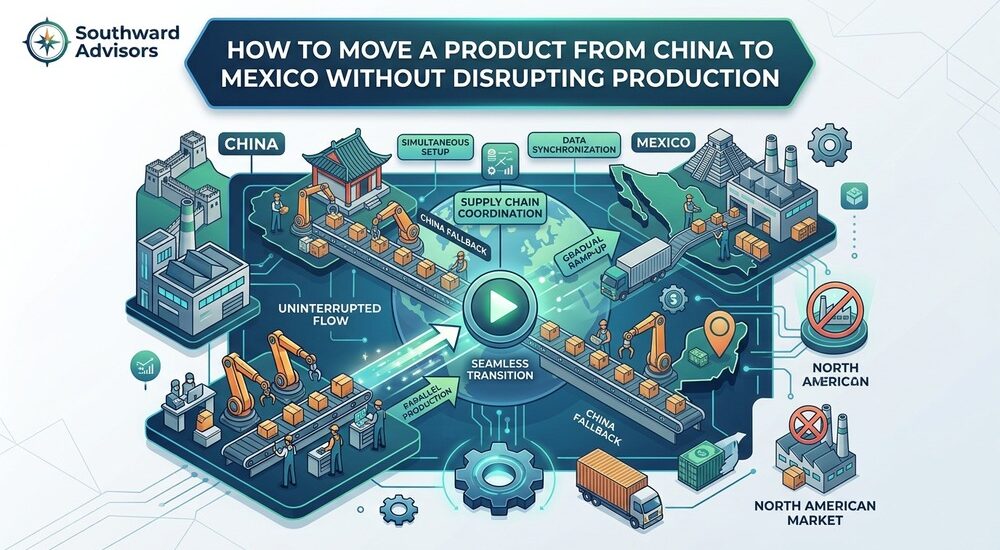
Moving manufacturing from China to Mexico is not a matter of finding a Mexican factory and sending it the same purchase order.
The safest transitions are treated as supply-chain migration projects.
A company must establish the Mexico production capability while protecting the existing China supply chain until the new operation has demonstrated acceptable quality, capacity, cost, logistics, and reliability.
The basic rule is:
Do not turn off China and turn on Mexico overnight.
Instead, use a controlled transition that may involve supplier qualification, engineering transfer, tooling, inventory buffers, pilot production, quality validation, dual production, logistics testing, and a gradual production ramp.
Southward Advisors’ experience with China-to-Mexico projects reflects this reality. Its published case studies include U.S. companies that moved production or diversified Asian supply chains into Mexico, including a cabinet manufacturer that shifted from China to Mexican suppliers and a West Coast manufacturer that migrated production from China to Mexico.
The exact process depends on the product, industry, tooling, certifications, production volume, customer requirements, supplier availability, and complexity of the bill of materials.
But the underlying strategy is consistent:
Continuity first. Optimization second.
Executive Summary: How Do You Move Manufacturing From China to Mexico?
A low-risk China-to-Mexico transition generally follows this sequence:
- Map the existing China supply chain.
- Determine which products, components, and processes should move.
- Identify appropriate Mexican manufacturing options.
- Qualify suppliers and facilities.
- Transfer engineering and process knowledge.
- Assess tooling and equipment.
- Build an appropriate inventory buffer.
- Run pilot production.
- Validate quality and production capability.
- Run China and Mexico production in parallel where appropriate.
- Test the Mexico logistics network.
- Gradually increase Mexico production.
- Reduce China production only after Mexico has demonstrated stability.
- Maintain a contingency plan throughout the migration.
The biggest mistake is treating the project as a supplier switch.
You are actually transferring a network of processes, suppliers, specifications, tooling, people, logistics flows, quality controls, and institutional knowledge.
Why Moving Production From China to Mexico Requires a Phased Approach
China manufacturing often benefits from mature supplier ecosystems, established tooling, long-running production relationships, and deeply developed component networks.
Mexico has strong manufacturing capabilities, but the supplier-development process can work differently.
Southward Advisors specifically notes that Mexico sourcing can require time, in-person meetings, multiple rounds of bidding, and deliberate supply-chain development. Complex products may require coordination between raw-material suppliers, Tier 1 and Tier 2 suppliers, final assemblers, and other parties rather than expecting one Mexican contract manufacturer to provide the entire BOM.
That makes a phased transition especially important.
The objective is not to move as quickly as possible.
The objective is to reach a stable Mexico operation without creating a customer-service crisis along the way.
Step 1: Map Your Existing China Supply Chain
Before moving anything, document what you actually have.
Start with:
- Products and SKUs
- Bill of materials
- Raw materials
- Components
- Suppliers
- Sub-suppliers
- Production processes
- Tooling
- Machinery
- Quality specifications
- Certifications
- Packaging
- Documentation
- Lead times
- Minimum order quantities
- Freight
- Customs
- Inventory
- Capacity
- Customer requirements
This exercise frequently reveals that a company is not really moving “a product.”
It is moving an interconnected supply chain.
Build a Supply-Chain Map
A useful starting structure is:
Raw Materials
↓
Component Suppliers
↓
Sub-Assemblies
↓
Final Assembly
↓
Quality Control
↓
Packaging
↓
Warehousing
↓
Export
↓
U.S. Distribution
↓
Customer
Then identify the vulnerabilities.
Flag:
- Single-source components
- China-only suppliers
- Long-lead components
- Proprietary materials
- Critical tooling
- Specialized equipment
- Regulatory dependencies
- Components with no qualified alternative
- Processes dependent on undocumented expertise
This is where many relocation projects discover their first major problem: the final assembly supplier is only one piece of the manufacturing system.
Step 2: Decide What Production Should Move
You do not necessarily need to move everything.
There are several possible strategies.
Full Production Relocation
Move the complete manufacturing operation to Mexico.
This can make sense when the product has strong Mexico manufacturing potential and the company wants to establish a long-term alternative to China.
Partial Relocation
Move selected production stages or components while maintaining China for other operations.
Product-Line Relocation
Move specific product families rather than the entire portfolio.
SKU-by-SKU Migration
Transfer products individually, allowing the company to learn from early migrations.
Final Assembly in Mexico
Continue sourcing certain components from Asia while moving final assembly and other processes to Mexico.
Dual Sourcing
Maintain qualified China and Mexico suppliers simultaneously.
There is no requirement to make the transition binary.
For many companies, China + Mexico during the transition is considerably safer than China → Mexico overnight.
Step 3: Identify Manufacturing Options in Mexico
Potential models include:
- Contract manufacturers
- Existing Mexican suppliers
- Brownfield facilities
- Greenfield facilities
- Joint ventures
- Shelter arrangements where appropriate
- A company’s own Mexican manufacturing operation
The right model depends on investment requirements, operational control, product complexity, workforce needs, speed, compliance, and long-term strategy.
Southward Advisors’ current nearshoring services include strategic site selection, sourcing-agent support, supplier sourcing, contract-manufacturer sourcing, supply-chain development, process improvement, and implementation/compliance oversight.
Do not select a facility simply because it can produce something similar.
Ask whether it can reproduce your product, at your volume, to your specification, with your quality requirements, at your required delivery performance.
Step 4: Qualify Your Mexico Supplier
Supplier qualification should go considerably deeper than reviewing a quotation.
Evaluate:
Manufacturing Capability
- Equipment
- Processes
- Capacity
- Automation
- Workforce
- Engineering
- Maintenance
- Tooling capability
Quality
- Quality-management systems
- Inspection
- Testing
- Traceability
- Corrective-action processes
- Defect history
- Customer references
Financial Stability
- Business history
- Financial condition
- Customer concentration
- Investment capability
- Ability to finance raw materials and working capital
Supply Chain
- Raw-material sources
- Tier 2 suppliers
- Single-source exposure
- Local versus imported components
- Backup suppliers
Operations
- Facility condition
- Security
- Maintenance
- Production scheduling
- Inventory controls
- ERP/MRP capabilities
Compliance
- Applicable Mexican requirements
- Customs processes
- IMMEX considerations where applicable
- Customer requirements
- Industry-specific certifications
The quoted unit price is only one variable.
A supplier offering the lowest price but poor quality, inadequate capacity, or fragile raw-material sourcing can become much more expensive after launch.
Step 5: Transfer Product and Process Knowledge
One of the largest relocation risks is undocumented knowledge.
Transfer the complete manufacturing package, including:
- Engineering drawings
- BOMs
- Product specifications
- Work instructions
- Process parameters
- Quality standards
- Tooling specifications
- Packaging specifications
- Inspection procedures
- Testing procedures
- Approved materials
- Supplier information
- Production records where appropriate
- Maintenance requirements
- Control plans
- Process-flow documentation
Ask a simple question:
If the experienced Chinese production manager disappeared tomorrow, could the Mexico team reproduce the process from the documentation?
If the answer is no, there is still knowledge to capture.
Step 6: Plan the Tooling and Equipment Transfer
Tooling can determine whether a transition takes months of preparation or becomes a prolonged engineering project.
Review:
- Molds
- Dies
- Jigs
- Fixtures
- Assembly equipment
- Test equipment
- Specialized machinery
For every major asset, establish:
- Who owns it?
- What condition is it in?
- Can it physically be moved?
- Does Mexico have the infrastructure to operate it?
- Can it be maintained locally?
- Are spare parts available?
- Should it be refurbished?
- Would new tooling be more economical?
Existing Tooling vs. New Tooling
Transfer existing tooling when:
- It is in good condition
- Ownership is clear
- It can be moved economically
- The Mexico supplier can maintain it
- Replacement would be expensive or risky
Build new tooling when:
- Existing tooling is near the end of its useful life
- Transportation is impractical
- Mexico requires different equipment
- The company wants improved tooling
- Existing ownership arrangements are complicated
The decision should be based on total transition risk and lifecycle cost, not simply the cheapest initial option.
Step 7: Build an Inventory Buffer
Inventory is one of the most important continuity tools during a manufacturing transition.
The purpose is not to build an arbitrary number of weeks of inventory.
Instead, determine how much protection is required based on:
- Current demand
- China lead time
- Mexico ramp-up assumptions
- Supplier reliability
- Customer service requirements
- Critical-component lead times
- Production risk
- Recovery time if Mexico production fails
Separate inventory into:
Finished Goods
Products available for customer shipment.
Critical Components
Parts that could stop the entire production line.
Pipeline Inventory
Material already moving through the supply chain.
Strategic Safety Stock
Inventory specifically held to protect the migration.
The correct buffer is therefore risk-based, not a universal number.
Step 8: Run Pilot Production
Pilot production is where assumptions meet reality.
A pilot should test:
- Manufacturing process
- Cycle time
- Yield
- Scrap
- Labor productivity
- Equipment
- Tooling
- Quality
- Packaging
- Testing
- Material flow
- Documentation
Do not judge the Mexico supplier based on a single successful sample.
The question is:
Can the supplier repeatedly produce conforming product under realistic production conditions?
Southward Advisors’ published nearshoring process specifically includes pilot production before process optimization and scaling.
Step 9: Validate Product Quality
Quality validation should establish that Mexico can consistently meet the same requirements expected from China.
Evaluate:
- Product specifications
- First-article inspection
- Process validation
- Testing
- Inspection procedures
- Yield
- Defect rate
- Reliability
- Packaging
- Customer approval
- Regulatory requirements where applicable
For regulated or highly engineered products, the transfer may require additional customer or regulatory approvals.
The exact requirements depend on the product and industry.
A successful prototype is not the same thing as a validated production process.
Step 10: Run China and Mexico Production in Parallel
This is the heart of a low-risk transition.
While Mexico ramps up, China continues producing.
That gives the company two objectives:
Mexico: prove capability.
China: protect customer supply.
Dual production allows management to compare:
- Quality
- Yield
- Cost
- Capacity
- Lead time
- Delivery
- Scrap
- Customer complaints
- Production stability
It also provides a fallback if Mexico encounters an unexpected problem.
This is particularly valuable for products with:
- Large customer commitments
- Tight inventory
- Long certification cycles
- Complex tooling
- High production volumes
- Single-source components
Step 11: Test the Mexico Logistics Network
Do not assume that the physical distance automatically produces the desired logistics outcome.
Test the actual route:
Supplier → Mexico Factory → Border → U.S. Distribution → Customer
Evaluate:
- Supplier-to-factory transportation
- Factory-to-border transportation
- Cross-border trucking
- Rail where appropriate
- Warehousing
- Customs brokerage
- Documentation
- Border processes
- U.S. distribution
- Transit variability
- Contingency routes
The U.S. Commercial Service reports that Mexico has extensive road, rail, airport, port, and intermodal infrastructure, while also noting that logistics costs can be significant and vary by route and product.
Therefore, logistics should be validated with the actual product and route.
Step 12: Gradually Ramp Up Mexico Production
A typical illustrative migration might look like:
Phase 1
Prototype and pilot production.
Phase 2
Controlled initial production.
Phase 3
Increase Mexico production after quality and delivery targets are demonstrated.
Phase 4
Move the majority of production.
Phase 5
Move to full Mexico production if the business case supports it.
The actual percentages should be determined by:
- Product complexity
- Capacity
- Quality
- Demand
- Inventory
- Customer requirements
- Supplier performance
- Business risk
There is no universal “25% / 50% / 75%” rule.
Step 13: Maintain a Contingency Plan
Ask:
What happens if the Mexico supplier misses the launch date by 60 days?
Your answer should already exist.
Possible contingency measures include:
- Maintain China production
- Increase China inventory
- Keep an alternate China supplier
- Dual-source critical components
- Use emergency freight where justified
- Maintain temporary production
- Approve alternate components where technically and commercially appropriate
The goal is to avoid creating a new single point of failure while eliminating an old one.
China vs. Mexico: How to Compare Total Production Costs
Do not compare a Chinese factory quotation with a Mexican factory quotation and call that a business case.
Calculate total landed cost.
| Cost Category | China | Mexico | Difference |
| Labor | Actual | Actual | Calculate |
| Materials | Actual | Actual | Calculate |
| Factory overhead | Actual | Actual | Calculate |
| Freight | Actual | Actual | Calculate |
| Customs/duties | Actual | Actual | Calculate |
| Inventory carrying cost | Actual | Actual | Calculate |
| Quality | Actual | Actual | Calculate |
| Management | Actual | Actual | Calculate |
| Tooling | Actual | Actual | Calculate |
| Transition costs | N/A/current | Actual estimate | Calculate |
| Total landed cost | Calculate | Calculate | Calculate |
The Mexico model should also include transition costs that do not exist in the steady-state China model.
Southward Advisors’ own China-vs.-Mexico analysis emphasizes that Mexican sourcing can require deliberate supplier development and multiple rounds of bidding rather than assuming that the Chinese supply chain can simply be replicated.
For companies evaluating the financial side in more detail, the related Mexico nearshoring ROI analysis should be linked from this section once published.
Trade, Customs, and Country-of-Origin Considerations
Moving manufacturing to Mexico does not automatically make a product eligible for preferential U.S.-Mexico trade treatment.
The analysis needs to consider:
- Tariff classification
- Country of origin
- Rules of origin
- Customs documentation
- Import/export procedures
- USMCA eligibility
- Recordkeeping
- Product-specific requirements
USMCA preferential treatment depends on applicable rules of origin and the required certification. CBP states that USMCA certification can be provided in any format containing the agreement’s required minimum data elements.
Country of origin is also a product-specific customs determination. Simply performing some processing in Mexico does not mean that every product automatically becomes eligible for USMCA treatment.
For complex products, companies should have customs specialists determine classification, origin, marking, and applicable trade treatment before building those assumptions into the financial model.
Where IMMEX May Fit Into a China-to-Mexico Transition
For qualifying export-oriented manufacturing operations, IMMEX may be relevant to the Mexico operating model.
In broad terms, the program can support qualifying temporary imports of inputs, components, and certain equipment connected with export production. Current U.S. Commercial Service guidance explains that temporary-entry benefits are conditional and subject to Mexican requirements, with SAT and ANAM overseeing relevant federal procedures.
That means IMMEX should be treated as part of the operating and customs design, not as a blanket “tax-free manufacturing” program.
Compliance matters.
Mexico’s government continues to enforce IMMEX requirements, including reporting obligations. In 2026, the Secretaría de Economía published a notice concerning IMMEX programs suspended for failure to file the required annual report, with cancellation possible if the issue was not corrected by the applicable deadline.
Companies should therefore determine whether IMMEX applies to their particular structure with qualified Mexican customs and tax professionals.
Product Certifications and Regulatory Requirements
Before transferring production, create a product-approval matrix.
Ask whether the manufacturing change affects:
- Product certifications
- Customer approvals
- Regulatory approvals
- Quality certifications
- Testing
- Labeling
- Packaging
- Country-of-origin marking
- Traceability
- Industry-specific requirements
A manufacturing location change can trigger additional approval work even when the physical product remains identical.
Do not wait until the Mexico factory is producing at full volume to discover that a customer needs to approve the new production source.
Industry-Specific Considerations
The transition strategy can differ substantially by industry.
Automotive
Expect significant emphasis on supplier quality, traceability, process control, capacity, and customer requirements.
Electronics
Focus heavily on BOM control, component sourcing, testing, ESD controls, traceability, and supplier continuity.
Medical Devices
Quality systems, validation, documentation, traceability, and regulatory requirements can make the transfer more controlled and documentation-intensive.
Aerospace
Production qualification, traceability, quality systems, customer requirements, and specialized processes can materially affect the transition.
Consumer Products
Packaging, cost, SKU complexity, seasonal demand, and speed-to-market may be particularly important.
Industrial Equipment
Tooling, engineering, subassemblies, low-volume/high-mix production, and supplier capability may dominate the transition.
Plastics and Metal Products
Tooling, molds, dies, material availability, process capability, and secondary operations can become major considerations.
The exact regulatory requirements must always be evaluated against the specific product and market.
China-to-Mexico Project Management Framework
A successful transition should have one accountable project owner and clearly assigned workstreams.
PROJECT OWNER
↓
ENGINEERING
↓
PROCUREMENT / SOURCING
↓
OPERATIONS
↓
QUALITY
↓
LOGISTICS
↓
FINANCE
↓
LEGAL / COMPLIANCE
↓
MEXICO SUPPLIER
Each workstream should have:
- Deliverables
- Owner
- Due date
- Dependencies
- Risks
- Approval criteria
Do not allow “Mexico transition” to become an initiative with no single owner.
Illustrative China-to-Mexico Migration Timeline
The following is an illustrative planning framework, not a promised timeline.
| Phase | Primary Activities |
| Phase 1 — Assessment | Cost analysis, BOM review, supply-chain mapping |
| Phase 2 — Supplier Identification | Market research, RFQs, facility screening |
| Phase 3 — Qualification | Audits, capability review, quality assessment |
| Phase 4 — Engineering & Tooling | Documentation, tooling, equipment, process transfer |
| Phase 5 — Pilot Production | Initial production, testing, process validation |
| Phase 6 — Quality Validation | First articles, yield, reliability, customer approvals |
| Phase 7 — Dual Production | China continues while Mexico ramps |
| Phase 8 — Mexico Ramp | Controlled production increases |
| Phase 9 — China Reduction | Reduce China volume once Mexico demonstrates stability |
The actual duration can vary substantially based on product complexity, tooling, certification, supplier availability, production volume, and customer requirements.
China-to-Mexico Transition Risk Register
| Risk | Potential Impact | Mitigation |
| Mexico supplier delay | Production shortage | Maintain China capacity |
| Quality problems | Returns/customer disruption | Pilot + validation |
| Tooling delay | Launch delay | Early tooling assessment |
| Labor shortages | Capacity constraints | Workforce planning |
| Component shortages | Production interruption | Dual sourcing |
| Logistics disruption | Late deliveries | Test routes + contingency |
| Customs issue | Shipment delay | Pre-launch customs review |
| Certification delay | Cannot ship | Approval matrix |
| Ramp-up problems | Low output | Controlled production increase |
| Customer approval delay | Sales disruption | Start approvals early |
| Unexpected costs | Weak ROI | Detailed transition budget |
| Supplier financial stress | Supply interruption | Financial due diligence |
15 Mistakes Companies Make When Moving Production From China to Mexico
- Shutting down China production too early
- Choosing a supplier based only on price
- Underestimating tooling transfer
- Ignoring Tier 2 suppliers
- Failing to document manufacturing processes
- Not establishing an inventory buffer
- Skipping pilot production
- Underestimating quality validation
- Ignoring logistics testing
- Leaving customs planning until the end
- Ignoring product certifications
- Moving too many SKUs simultaneously
- Failing to establish transition KPIs
- Underestimating transition costs
- Having no contingency plan
The most dangerous mistake is number one.
If China production is terminated before Mexico has demonstrated stable production, the manufacturer has converted a controlled migration into a forced launch.
KPIs to Track During the Transition
Create a dashboard covering three stages.
Before Migration
Establish the China baseline:
- On-time delivery
- Defect rate
- First-pass yield
- Scrap
- Cycle time
- Unit cost
- Lead time
- Inventory
- Freight
- Customer complaints
During Migration
Track both factories:
- Mexico production volume
- China production volume
- Mexico yield
- Defect rate
- Scrap
- Cycle time
- Labor productivity
- Supplier delivery
- Inventory
- Freight
- Quality incidents
- Customer complaints
After Migration
Compare Mexico against the original baseline:
- Total landed cost
- Quality
- Delivery
- Capacity
- Inventory
- Lead time
- Supplier performance
- Customer satisfaction
Do not declare the migration successful simply because Mexico has started shipping.
The real test is whether the new supply chain performs sustainably.
90-Day / 180-Day / 12-Month Planning Framework
Again, these are illustrative phases, not guaranteed timelines.
First 90 Days
Focus on:
- Current-state assessment
- Supply-chain mapping
- Product prioritization
- Cost model
- Mexico supplier search
- Initial supplier qualification
- Business-case development
Next 90 Days
Focus on:
- Supplier selection
- Factory audits
- Engineering transfer
- Tooling strategy
- Logistics planning
- Pilot preparation
- Quality planning
- Inventory strategy
Following 6–12 Months
Where appropriate, focus on:
- Pilot production
- Validation
- Dual production
- Mexico ramp-up
- Logistics stabilization
- China volume reduction
- Continuous improvement
A highly complex product may require substantially more time.
Can We Safely Move This Product From China to Mexico?
Use this decision checklist before reducing China production:
- Current China supply chain mapped
- Critical components identified
- Mexico supplier identified
- Supplier qualified
- Manufacturing capability verified
- Tooling plan completed
- Engineering documentation transferred
- Quality requirements transferred
- Inventory buffer established
- Pilot production completed
- Quality validated
- Logistics tested
- Customs process established
- Customer approvals obtained where required
- Mexico capacity demonstrated
- Mexico production stable
- Contingency plan established
- China production reduction approved
If several boxes remain unchecked, the transition probably is not ready for a full production switch.
When You Should Not Move Everything at Once
A phased migration is particularly appropriate when you have:
- Complex products
- Large customer commitments
- Long certification cycles
- Single-source components
- Expensive tooling
- High production volumes
- Tight inventory
- Mission-critical products
- Significant customer approval requirements
- Limited Mexico supplier capacity
There is no strategic requirement to move 100% of production immediately.
A company can move one product family, one assembly, one SKU group, or one production process first.
The first successful migration then becomes a template for the next one.
How Southward Advisors Can Help
Southward Advisors positions itself as a strategic supply-chain implementation firm focused on nearshoring manufacturing supply chains to Mexico and Latin America. Its services include nearshore manufacturing, strategic site selection, supplier sourcing, supply-chain development, and process improvement.
Its Mexico nearshoring process includes discovery and feasibility analysis, supplier vetting and site selection, pilot production, process optimization, and scaling.
That makes Southward Advisors relevant when a U.S. manufacturer is trying to determine not simply whether production can move from China, but how the new Mexico supply chain should actually be developed.
Southward also has published China-to-Mexico examples. One case study describes a West Coast manufacturer that was producing office cubicle dividers in China and wanted to migrate production to Mexico; another describes a Midwest cabinet manufacturer that moved from Chinese production toward Mexican suppliers.
Moving production from China to Mexico is not simply a supplier switch. It is a supply-chain transition that requires careful planning, supplier qualification, quality validation, logistics testing, and a controlled production ramp. Southward Advisors helps U.S. companies evaluate and execute Mexico manufacturing strategies designed around operational continuity and long-term supply-chain performance.
Frequently Asked Questions
How do I move manufacturing from China to Mexico?
Start by mapping the existing China supply chain, identify what should move, find and qualify Mexico suppliers, transfer engineering and process knowledge, plan tooling, build inventory protection, run pilot production, validate quality, and gradually ramp Mexico while maintaining China production as a contingency.
Should I shut down my China factory before moving to Mexico?
Generally, companies should avoid shutting down China production until Mexico has demonstrated the required quality, capacity, delivery performance, and commercial viability. Maintaining China production during the transition can provide an important supply-continuity buffer.
How long does it take to move production from China to Mexico?
There is no universal timeline. Product complexity, tooling, certifications, supplier availability, customer approvals, production volume, and industry requirements can materially change the duration. Any published timeline should therefore be treated as an illustrative planning framework rather than a guarantee.
How can I move production without disrupting customer supply?
Use phased migration, maintain appropriate inventory protection, continue China production while Mexico ramps up, validate Mexico quality before increasing volume, and establish contingency plans for supplier, tooling, logistics, and certification delays.
How do I qualify a Mexico manufacturer?
Evaluate manufacturing capability, equipment, capacity, workforce, quality systems, financial stability, engineering, raw-material sourcing, Tier 2 suppliers, customer references, facility condition, security, and applicable compliance requirements.
How do I transfer production knowledge from China to Mexico?
Transfer drawings, BOMs, specifications, work instructions, process parameters, quality standards, tooling information, testing procedures, packaging requirements, approved materials, and other production documentation. Capture undocumented tribal knowledge from experienced China personnel before the transfer.
How do I move tooling from China to Mexico?
First establish ownership, condition, transport requirements, maintenance capability, and replacement cost. Then decide whether to move, refurbish, or replace the tooling. Tooling decisions should be made early because tooling can become a critical path.
How much inventory should I hold during a China-to-Mexico transition?
There is no universal number of weeks. Calculate the required buffer based on demand, China lead times, Mexico ramp-up assumptions, supplier reliability, critical-component lead times, customer requirements, and the time needed to recover from a Mexico production problem.
Is Mexico a good alternative to China manufacturing?
Mexico can be a viable manufacturing alternative for many U.S. companies, but suitability depends on the product, supplier ecosystem, labor requirements, materials, logistics, quality requirements, investment, and total landed cost. It should be evaluated through a company-specific business case rather than a generic China-versus-Mexico comparison.
Does moving production to Mexico automatically qualify the product for USMCA?
No. USMCA treatment depends on applicable rules of origin and compliance requirements. CBP states that USMCA preferential claims require the appropriate certification of origin information.
Can I keep some components coming from China?
Yes. A Mexico manufacturing strategy does not necessarily require 100% local sourcing. Complex Mexican supply chains can continue to use imported components when appropriate, provided the company properly manages sourcing, customs, origin, inventory, and compliance requirements. Southward Advisors specifically notes that some components in Mexican supply chains may continue to come from the U.S., Canada, Asia, or other regions.
Where does IMMEX fit into the transition?
IMMEX may be relevant to qualifying export-oriented manufacturing operations using temporary imports. However, eligibility, customs treatment, reporting, and compliance requirements depend on the company’s specific structure and operations. Current government guidance shows that IMMEX compliance is actively enforced.
What is the biggest risk when moving manufacturing from China to Mexico?
For many companies, the biggest operational risk is switching production before Mexico has demonstrated repeatable quality and capacity. That is why dual production and a controlled ramp can be more valuable than simply trying to complete the move as quickly as possible.
Should I move the entire factory or only some products?
That depends on the economics and risk. A product-line, SKU-by-SKU, assembly-level, or partial migration may be more appropriate when the portfolio is complex or customer commitments are high.
What KPIs should I monitor during the transition?
At minimum, monitor on-time delivery, defect rate, first-pass yield, scrap, production volume, cycle time, labor productivity, supplier delivery, lead time, inventory, freight cost, unit cost, customer complaints, and downtime.
How do I know when Mexico is ready to take over production?
Mexico should meet predefined acceptance criteria for quality, capacity, delivery, process capability, tooling, logistics, documentation, and customer requirements. The decision should be based on measured performance rather than simply reaching a calendar date.
The safest way to move manufacturing from China to Mexico is not to treat the project as a relocation date.
It is a controlled migration.
First understand the China operation. Then determine what should actually move. Build the Mexico supply chain, qualify the suppliers, transfer the manufacturing knowledge, validate tooling, establish inventory protection, run pilots, test logistics, and prove quality.
Only then should Mexico production begin taking a larger share of customer demand.
The goal is not to eliminate China as quickly as possible.
The goal is to build a Mexico supply chain that can eventually stand on its own without putting today’s customers at risk while tomorrow’s operation is being built.
That is the difference between simply changing suppliers and successfully executing a China-to-Mexico manufacturing strategy.