
Nearshoring for SMEs: Is Manufacturing in Mexico Right for Your Business?
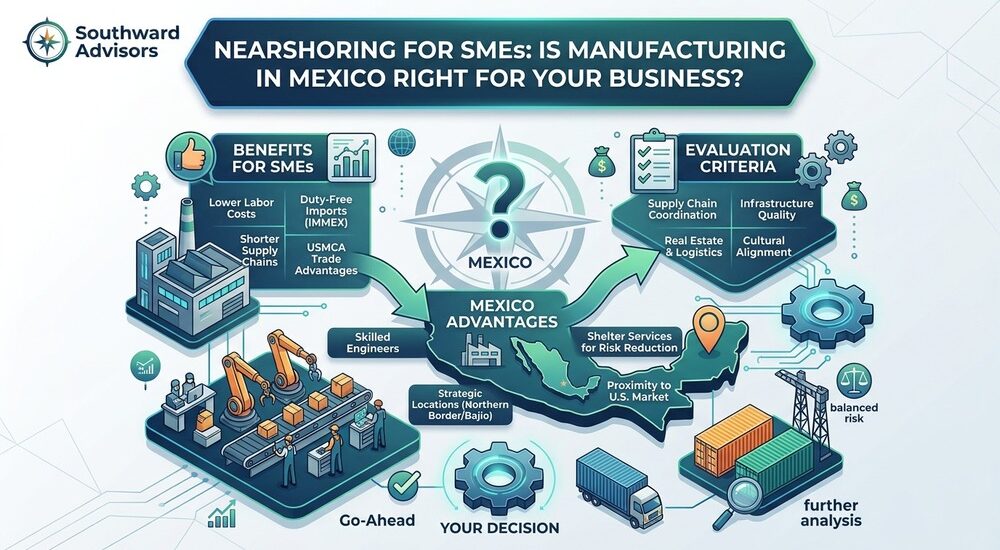
For a small or mid-sized manufacturer, the decision to move production to Mexico is rarely as simple as comparing Mexican labor rates with U.S. or Asian labor rates.
The better question is:
Can Mexico give your company a better combination of total landed cost, quality, lead time, supply-chain resilience, capital requirements, and scalability?
That distinction matters. Nearshoring for SMEs can create meaningful advantages, but it can also introduce new supplier, workforce, logistics, compliance, and management challenges.
Mexico has a substantial and diverse manufacturing base. The U.S. International Trade Administration describes Mexico as a major manufacturing and logistics hub, with established capabilities in sectors including automotive, electronics, medical equipment, aerospace, and industrial manufacturing.
But manufacturing in Mexico is not automatically cheaper, faster, or easier.
Nearshoring works best when the economics, product requirements, supply chain, and operating model fit the business.
What Is Nearshoring?
Nearshoring means moving manufacturing, sourcing, or other business operations to a nearby country rather than maintaining production in a distant offshore location.
For U.S. manufacturers, Mexico is one of the most prominent nearshoring destinations because of its geographic proximity and established industrial base.
It helps to distinguish four strategies:
| Strategy | Basic concept |
| Offshoring | Production is moved to a distant country, such as China or another Asian manufacturing market. |
| Nearshoring | Production is moved to a geographically closer country, such as Mexico. |
| Reshoring | Production returns to the United States. |
| Friendshoring | Production moves toward countries considered strategically aligned with the company’s home market. |
Nearshoring can reduce geographic distance between a U.S. company, its suppliers, and its customers. That can make factory visits, engineering collaboration, quality oversight, transportation planning, and communication easier.
It does not, however, guarantee lower costs.
Why Are SMEs Considering Manufacturing in Mexico?
Small and mid-sized manufacturers are evaluating Mexico for several different reasons.
Some are looking for an alternative to long Asian supply chains. Others want to diversify suppliers, reduce transportation exposure, support faster replenishment, or position production closer to U.S. customers.
Mexico’s logistics infrastructure includes major highway, rail, airport, port, and border-crossing networks. The U.S. Commercial Service identifies key U.S.-Mexico commercial corridors through crossings such as Laredo-Nuevo Laredo, El Paso-Ciudad Juárez, and San Diego-Tijuana.
But logistics advantages depend heavily on where your supplier is located, where your customers are located, what you are shipping, and how your supply chain is designed.
For an SME, the decision should therefore begin with its current supply chain—not with a predetermined conclusion that Mexico is the answer.
10 Potential Benefits of Nearshoring to Mexico for SMEs
1. Geographic proximity to the United States
Mexico’s proximity can make supplier visits, engineering meetings, quality investigations, and management oversight more practical.
2. Potential logistics advantages
A Mexico-based supply chain may reduce dependence on long ocean freight routes, but transportation costs still need to be modeled. The U.S. Commercial Service notes that logistics can represent a significant portion of product costs in Mexico.
3. Potentially shorter lead times
A shorter physical supply chain can make replenishment more responsive. That may be particularly valuable for companies carrying expensive inventory or dealing with variable demand.
4. Labor economics
Mexico can offer competitive manufacturing labor economics, but SMEs should compare total labor cost and productivity, not hourly wages alone.
5. Established manufacturing ecosystems
Mexico has mature clusters supporting industries such as automotive, aerospace, electronics, medical equipment, machinery, and other manufacturing sectors.
6. Supply-chain diversification
Mexico can become a second source rather than replacing an existing supplier entirely.
7. Easier supplier communication
Geographic proximity and overlapping business hours can simplify communication compared with some overseas relationships.
8. More practical factory oversight
For many U.S. companies, traveling to Mexico for supplier meetings or production reviews can be operationally easier than maintaining frequent oversight of distant overseas factories.
9. Potential inventory benefits
If lead times and replenishment reliability improve, some companies may be able to reduce certain inventory requirements. That should be demonstrated through an actual inventory model rather than assumed.
10. Scalability
Mexico has established industrial clusters and export-oriented manufacturing operations. INEGI continues to publish active IMMEX manufacturing data across Mexican states and municipalities.
The key word in all ten benefits is potential.
A benefit only matters if it improves your company’s economics or operating performance.
What Makes an SME a Good Candidate for Mexico Manufacturing?
The strongest candidates typically have several characteristics:
- Repeatable production
- Reasonably predictable demand
- Sufficient production economics
- Meaningful labor or manufacturing content
- Significant logistics costs or long lead times
- Products that can be manufactured by capable Mexican suppliers
- A need for supply-chain diversification
- Enough management capacity to oversee the transition
- Long-term demand rather than a short-lived production requirement
Industries can include industrial components, metal products, plastics, machinery components, consumer products, packaging, electronics assembly, furniture components, and selected automotive or medical-related products.
But industry alone does not determine suitability.
A highly specialized manufacturer in a “good” industry may be a poor candidate if it needs a capability unavailable in its target region. Conversely, a smaller company in a less obvious industry may have an attractive Mexico opportunity because its product is simple, repeatable, labor-intensive, and expensive to ship from Asia.
Who Should Think Twice About Nearshoring to Mexico?
Nearshoring may not make sense for a business with:
- Very low production volume
- Highly customized one-off production
- Extremely thin margins
- Unreliable demand forecasts
- Unique China-only components
- Complex certifications that would require substantial revalidation
- Very limited working capital
- No internal person capable of managing the project
- No clear cost or strategic advantage
These companies do not necessarily need to abandon the idea.
Alternatives include dual sourcing, moving only selected SKUs, relocating final assembly, using a Mexican contract manufacturer, or maintaining the existing supply chain while testing Mexico on a limited basis.
How Much Production Do You Need to Manufacture in Mexico?
There is no universal minimum volume that makes Mexico viable.
The right question is:
At what production volume does Mexico create an attractive total-cost and strategic advantage for this particular business?
Consider:
- Unit economics
- Product complexity
- Labor content
- Tooling requirements
- Fixed costs
- Supplier pricing
- Logistics
- Gross margin
- Working capital
- Expected growth
Illustrative example — not a typical Mexico cost
Suppose an SME currently spends $2.0 million annually on a product line.
A hypothetical Mexico model produces:
- $1.65 million annual operating cost
- $200,000 one-time transition investment
- $350,000 annual operating difference
The simple payback would be:
$200,000 ÷ $350,000 = approximately 0.57 years
That looks attractive—but management should then test whether the assumed production costs, quality performance, inventory requirements, supplier capacity, and transition risks are realistic.
The example is deliberately hypothetical. It is not a claim about typical Mexico manufacturing economics.
What Does Manufacturing in Mexico Cost for an SME?
A serious Mexico manufacturing strategy should model much more than factory price.
One-time costs
Potential transition costs include:
- Supplier qualification
- Engineering work
- Tooling
- Equipment
- Facility setup
- Product validation
- Testing
- Travel
- Training
- Legal and professional services
- Logistics setup
- Initial inventory
- Dual-production costs
Recurring costs
Consider:
- Labor
- Materials
- Overhead
- Facility
- Utilities
- Maintenance
- Quality
- Management
- Transportation
- Customs
- Warehousing
- Insurance
- Compliance
- Supplier management
- Travel
- Inventory carrying costs
The result should be a total landed cost model, not a wage comparison.
Total Landed Cost Matters More Than Factory Price
A useful model is:
Manufacturing + materials + labor + overhead + transportation + customs + warehousing + inventory + quality + applicable compliance costs = total landed cost
For example:
| Cost category | Current U.S. model | Mexico model* |
| Manufacturing | $1,500,000 | $1,050,000 |
| Materials | $900,000 | $850,000 |
| Logistics | $120,000 | $180,000 |
| Quality/management | $100,000 | $125,000 |
| Inventory impact | $80,000 | $65,000 |
| Other applicable costs | $50,000 | $70,000 |
| Illustrative total | $2,750,000 | $2,340,000 |
* Illustrative hypothetical example only. These figures are not typical Mexico manufacturing costs.
This approach can reveal why a supplier offering the lowest factory price is not necessarily the best economic option.
How to Calculate Nearshoring ROI
Start with five numbers:
- Current annual manufacturing cost
- Expected Mexico annual cost
- One-time transition investment
- Required CAPEX
- Expected annual savings or economic improvement
A basic payback calculation is:
Payback period = Total initial investment ÷ Annual cash savings
ROI can then be expanded to include working capital, inventory, quality, logistics, and other strategic effects.
For larger investments, SMEs should also consider NPV and IRR, particularly when the project requires significant capital expenditure over several years.
The financial analysis should answer:
Does Mexico create enough value to justify the cash, management attention, operational risk, and transition cost?
Start Small: Phased Nearshoring
An SME does not have to move its entire operation immediately.
Possible starting points include:
- One SKU
- One product family
- One assembly
- Selected components
- Final assembly
- A second-source program
- Contract manufacturing
This is often a more practical way to learn how a Mexican supplier performs before committing substantial capital.
Southward Advisors’ nearshoring process similarly emphasizes feasibility analysis, supplier vetting, site selection, pilot production, process optimization, and scaling.
Contract Manufacturing vs. Building Your Own Factory
For many SMEs, the first decision is not simply “Mexico or no Mexico.”
It is:
What operating model should we use in Mexico?
Contract manufacturing can reduce upfront capital and operational complexity. Owning a facility provides greater control but requires substantially more management, capital, and infrastructure.
| Model | Upfront investment | Control | Speed | Complexity | SME suitability |
| Contract manufacturer | Low–medium | Lower | Usually faster | Lower | Often attractive |
| Existing Mexican facility/partner | Medium | Medium | Moderate | Medium | Attractive for growing SMEs |
| Shelter/managed operation | Medium | Medium–high | Moderate | Medium | Depends on operating model |
| Own facility | High | High | Slower | High | Better for larger, established programs |
The correct model depends on volume, product complexity, IP, quality requirements, growth expectations, and how much operational control the company requires.
How to Find and Qualify a Mexico Manufacturing Partner
Supplier selection should go well beyond the quotation.
Evaluate:
- Manufacturing capabilities
- Equipment
- Available capacity
- Quality systems
- Certifications
- Engineering capability
- Workforce
- Financial stability
- Existing supplier network
- Raw-material sourcing
- Lead times
- Communication
- Customer references
- Facility condition
- Scalability
- Business continuity
Lowest price does not equal best supplier.
This is especially important in Mexico because supply-chain development can require more supplier development and coordination than a U.S. company may initially expect. Southward Advisors specifically notes that Mexico sourcing can require time, in-person engagement, and multiple rounds of bidding because supply chains may not be as vertically integrated as those an importer is accustomed to elsewhere.
How to Choose the Right Location in Mexico
There is no universally “best” Mexican manufacturing state.
Evaluate the location against your supply chain:
- Customer proximity
- Border access
- Highways
- Rail
- Airports
- Ports
- Workforce availability
- Industrial infrastructure
- Supplier ecosystem
- Utilities
- Security
- Real-estate costs
- Local engineering and management talent
The U.S. Commercial Service identifies major industrial and logistics corridors across Mexico, while also noting that transportation conditions vary by region.
The location should follow the manufacturing strategy—not the other way around.
Supply-Chain Considerations for SMEs
Moving final assembly to Mexico does not necessarily eliminate China dependence.
Your Mexican supplier may still need:
- Chinese electronics
- Asian raw materials
- Specialized components
- Proprietary tooling
- Imported machinery
- China-based subassemblies
Map the entire chain before deciding that you have “nearshored.”
A proper assessment should identify:
Raw materials → components → subassemblies → manufacturing → quality → packaging → warehousing → border → U.S. distribution
The goal is to understand where the actual risk remains.
Customs, USMCA, and Country of Origin
Manufacturing in Mexico does not automatically mean a product qualifies for preferential USMCA treatment.
Companies need to evaluate:
- HTS classification
- Country of origin
- Applicable rules of origin
- Product-specific requirements
- Customs documentation
- Certification of origin
- Import/export procedures
CBP states that a USMCA certification of origin is required for preferential treatment and that the certification can use any format as long as the required data elements are included.
CBP rulings also demonstrate that origin and USMCA eligibility can depend on the specific product, components, processing, and circumstances.
For that reason, SMEs should not build their business case around an assumed tariff benefit without confirming the actual product-specific treatment.
Could IMMEX Be Relevant to Your Business?
IMMEX is Mexico’s Manufacturing, Maquiladora and Export Services Program.
For qualifying operations, it can provide a framework for temporarily importing eligible inputs, components, and qualifying equipment associated with export production, subject to applicable requirements and controls. The U.S. International Trade Administration notes that temporary importation can provide relief from import duties while goods remain under the temporary regime, while VAT/IEPS treatment can depend on applicable certification.
IMMEX is not automatically appropriate for every SME.
The right structure depends on the company’s ownership, transactions, exports, imported materials, manufacturing model, and compliance obligations. Treat IMMEX as part of the feasibility analysis—not as a guaranteed cost-saving mechanism.
10 Questions SME Owners Ask About Nearshoring
1. Is Mexico manufacturing affordable for a small company?
It can be, but affordability depends on volume, product economics, supplier pricing, logistics, and transition costs.
2. How much production do I need?
There is no universal threshold. Calculate the volume at which the Mexico model produces an acceptable return.
3. Do I need my own factory?
No. Contract manufacturing and other partner-based models can allow SMEs to test Mexico without building a facility.
4. Can a small business manufacture in Mexico?
Yes. The challenge is finding a manufacturing model that fits the company’s volume, product, capital, and management capacity.
5. How do I find a reliable Mexican supplier?
Build a qualified supplier shortlist, verify capabilities, review quality and capacity, visit facilities, check references, and validate production before scaling.
6. How long does setup take?
There is no reliable universal timeline. Product complexity, tooling, certifications, supplier availability, and customer approvals can materially change the schedule.
7. What if production goes wrong?
Use pilot production, documented quality requirements, contingency suppliers, inventory buffers, and controlled ramp-up.
8. Can I keep manufacturing in China during the transition?
Yes. In many cases, maintaining the existing supply chain while Mexico ramps up is the lower-risk approach.
9. How do I calculate ROI?
Compare current total landed cost against the complete Mexico cost, then subtract transition investment and account for working capital and risk.
10. What happens if demand grows?
Supplier capacity and scalability should be evaluated before selecting the manufacturing partner.
10 Risks SMEs Should Consider Before Nearshoring
| Risk | Why it matters | Mitigation |
| Supplier quality | Defects can erase expected savings | Pilot production and quality validation |
| Limited capacity | Growth can exceed supplier capability | Verify capacity and expansion plans |
| Labor turnover | Productivity can suffer | Evaluate workforce, training, supervisors |
| Logistics | Border or domestic delays can affect customers | Model routes and maintain contingencies |
| Customs | Incorrect documentation can create delays/costs | Engage qualified customs professionals |
| Currency | Exchange-rate changes affect economics | Model FX sensitivity |
| Production ramp-up | Early output may be inconsistent | Phase production |
| Inventory | Transition problems can create shortages | Build appropriate buffers |
| Management complexity | SMEs have limited bandwidth | Assign a dedicated project owner |
| Unexpected costs | Small omissions can change ROI | Build a detailed total-cost model |
SME Nearshoring Scorecard
Score each category from 1 to 5:
| Factor | 1 | 3 | 5 |
| Production volume | Very low | Moderate | Strong |
| Product repeatability | Highly variable | Mixed | Highly repeatable |
| Gross margin | Thin | Moderate | Healthy |
| Current manufacturing cost | Very competitive | Moderate | High |
| Logistics burden | Low | Moderate | High |
| Supply-chain risk | Low | Moderate | High |
| Mexico supplier availability | Limited | Possible | Strong |
| Capital capacity | Limited | Moderate | Strong |
| Management capacity | Limited | Moderate | Strong |
| Growth potential | Low | Moderate | High |
Interpretation
40–50: Mexico may warrant serious feasibility work.
30–39: Conduct a detailed business-case and supplier study before deciding.
Below 30: Explore alternatives such as dual sourcing, partial nearshoring, or retaining the current model.
This is an educational screening tool, not a financial or investment recommendation.
Is Mexico Right for Your Business? A Decision Framework
Ask these questions in order:
Do you have repeatable production?
→ No: Consider whether nearshoring can work for selected products or processes.
→ Yes: Continue.
Do the production economics support a Mexico option?
→ No: Continue the existing model or investigate other alternatives.
→ Yes: Continue.
Is there a qualified Mexico supplier or viable operating model?
→ No: Conduct supplier-market research before committing.
→ Yes: Continue.
Can the company finance and manage the transition?
→ No: Consider contract manufacturing, dual sourcing, or a smaller pilot.
→ Yes: Continue.
Does total landed cost plus strategic value justify the risk and investment?
→ No: Do not move simply because nearshoring is popular.
→ Yes: Proceed to a structured feasibility and implementation plan.
A Step-by-Step Nearshoring Roadmap for SMEs
Phase 1: Feasibility assessment
Map products, volumes, suppliers, costs, risks, and customer requirements.
Phase 2: Cost and ROI analysis
Build the current-state and Mexico-state total-cost models.
Phase 3: Mexico supplier search
Identify contract manufacturers, suppliers, facilities, and potential operating models.
Phase 4: Supplier qualification
Validate capability, capacity, quality, financial stability, workforce, and scalability.
Phase 5: Pilot production
Produce a controlled quantity and evaluate actual performance.
Phase 6: Quality validation
Confirm specifications, testing, process capability, yield, packaging, and customer requirements.
Phase 7: Initial production
Begin with a controlled share of demand.
Phase 8: Scale
Increase production only after the supplier consistently meets agreed performance requirements.
There is no universal timeline for these phases. Regulatory requirements, product complexity, tooling, customer approvals, supplier readiness, and production volume can all change the schedule.
When Nearshoring May Be the Wrong Move
An SME should not move manufacturing to Mexico simply because competitors are doing it.
Do not make the decision solely because:
- Mexican labor is cheaper
- Mexico is geographically close
- Nearshoring is fashionable
- China has become more difficult
- A supplier promises a lower quotation
If the current manufacturer is reliable, the product has very low volume, the Mexico supplier ecosystem is weak, or the transition cost overwhelms the expected benefit, staying with the existing model may be the smarter decision.
The best nearshoring strategy may even be not to nearshore everything.
A company might retain its current production while adding a Mexican second source. Another might move only final assembly. Another might transfer one product family while leaving complex products where they are.
Nearshoring Checklist for Small and Mid-Sized Manufacturers
Business
Production volume analyzed
Demand forecast reviewed
Product margins analyzed
Current cost baseline established
Financial
Mexico cost estimate created
Transition costs estimated
CAPEX estimated
ROI calculated
Payback calculated
Cash-flow impact reviewed
Supply Chain
Current suppliers mapped
China dependencies identified
Mexico supplier ecosystem evaluated
Logistics analyzed
Inventory requirements calculated
Operations
Manufacturing process reviewed
Quality requirements documented
Tooling evaluated
Workforce requirements assessed
Pilot production planned
Risk
Supplier risk assessed
Customs requirements reviewed
Country-of-origin requirements reviewed
Customer approvals identified
Contingency plan created
How Southward Advisors Can Help
Mexico can be an attractive manufacturing option for many U.S. SMEs, but the right approach depends on the company’s product, volume, costs, supply chain, and growth plans.
Southward Advisors focuses on nearshoring manufacturing supply chains to Mexico and Latin America and works with both SMEs and larger companies. Its services include nearshoring, sourcing and supply-chain development, and process-improvement consulting.
The company’s Mexico nearshoring work includes feasibility analysis, supplier sourcing and vetting, strategic site selection, pilot production, process improvement, and implementation/compliance support.
For an SME, that can mean evaluating the Mexico opportunity before committing to a facility, supplier, tooling program, or major production transfer.
The objective should not be to manufacture in Mexico simply because Mexico is available. The objective is to determine whether Mexico creates a better manufacturing and supply-chain model for your particular business.
Frequently Asked Questions
Is Mexico good for small manufacturers?
Mexico can be a strong option for small manufacturers with repeatable products, sufficient production economics, accessible supplier capabilities, and a realistic plan for managing the transition.
Is nearshoring worth it for SMEs?
It can be, particularly when logistics, inventory, lead-time, supplier diversification, or production economics create a meaningful strategic advantage. The answer should come from a company-specific business case.
Can a small business manufacture in Mexico?
Yes. An SME does not necessarily need to own a factory. Contract manufacturing and supplier partnerships can provide an entry point.
Is Mexico cheaper than China for small manufacturers?
Not automatically. Compare total landed cost, including manufacturing, materials, freight, customs, inventory, quality, management, and transition costs.
How much production do you need to manufacture in Mexico?
There is no universal minimum. The appropriate volume depends on fixed costs, supplier economics, product complexity, margins, logistics, and expected growth.
Do SMEs need their own factory in Mexico?
No. Many SMEs should investigate contract manufacturing or an existing manufacturing partner before considering a wholly owned facility.
How do I find a Mexico manufacturing partner?
Start by defining your technical, quality, volume, capacity, and commercial requirements. Then identify, vet, visit, and qualify potential suppliers through a structured process.
What are the biggest nearshoring risks for SMEs?
Supplier quality, capacity, labor, logistics, customs, transition costs, inventory, and limited management resources are among the most important risks.
Can I move only part of my manufacturing to Mexico?
Yes. Partial nearshoring, dual sourcing, final assembly, selected SKUs, and product-line transfers can all be considered.
Does manufacturing in Mexico automatically qualify for USMCA benefits?
No. Eligibility depends on the applicable rules of origin and product-specific requirements. CBP’s current guidance requires certification for preferential treatment.
Could IMMEX help an SME?
Potentially. IMMEX may be relevant to qualifying export-oriented manufacturing operations, but its applicability and compliance requirements need to be evaluated for the specific business model.
How long does Mexico nearshoring take?
There is no universal timeline. Tooling, supplier qualification, certifications, customer approvals, product complexity, and capacity requirements can significantly affect implementation.
Should an SME move all production at once?
Usually, a phased approach deserves serious consideration. Maintaining the existing supply chain while validating Mexico can reduce transition risk.
What is the first step?
Start with a feasibility assessment: establish the current cost baseline, map the supply chain, define what should move, identify Mexico options, and calculate the potential business case.
Nearshoring for SMEs is not a question of whether Mexico is “good” or “bad.” It is a question of fit.
For the right manufacturer, Mexico can provide geographic proximity, access to established manufacturing ecosystems, supply-chain diversification, potentially attractive production economics, and closer access to U.S. customers.
For the wrong manufacturer, the same move can create unnecessary capital requirements, supplier risk, quality problems, management complexity, and transition costs.
The smartest approach is therefore to build the business case before moving the business.
Start with total landed cost. Map the supply chain. Identify Mexico supplier options. Test quality and capacity. Evaluate the operating model. Understand customs and country-of-origin requirements. Build a realistic ROI model. Then decide whether the right answer is full nearshoring, partial nearshoring, dual sourcing, contract manufacturing—or staying with the current model.
For SMEs, disciplined evaluation is more valuable than following a manufacturing trend.