
Quick answer: Mexico has four time zones: Northwest (UTC-8), Pacific (UTC-7), Central (UTC-6) and Southeast (UTC-5). Most of the country, including Mexico City, Guadalajara and Monterrey, is on Central time. Mexico stopped using daylight saving time in October 2022, except in Baja California and a group of municipalities on the U.S. border.
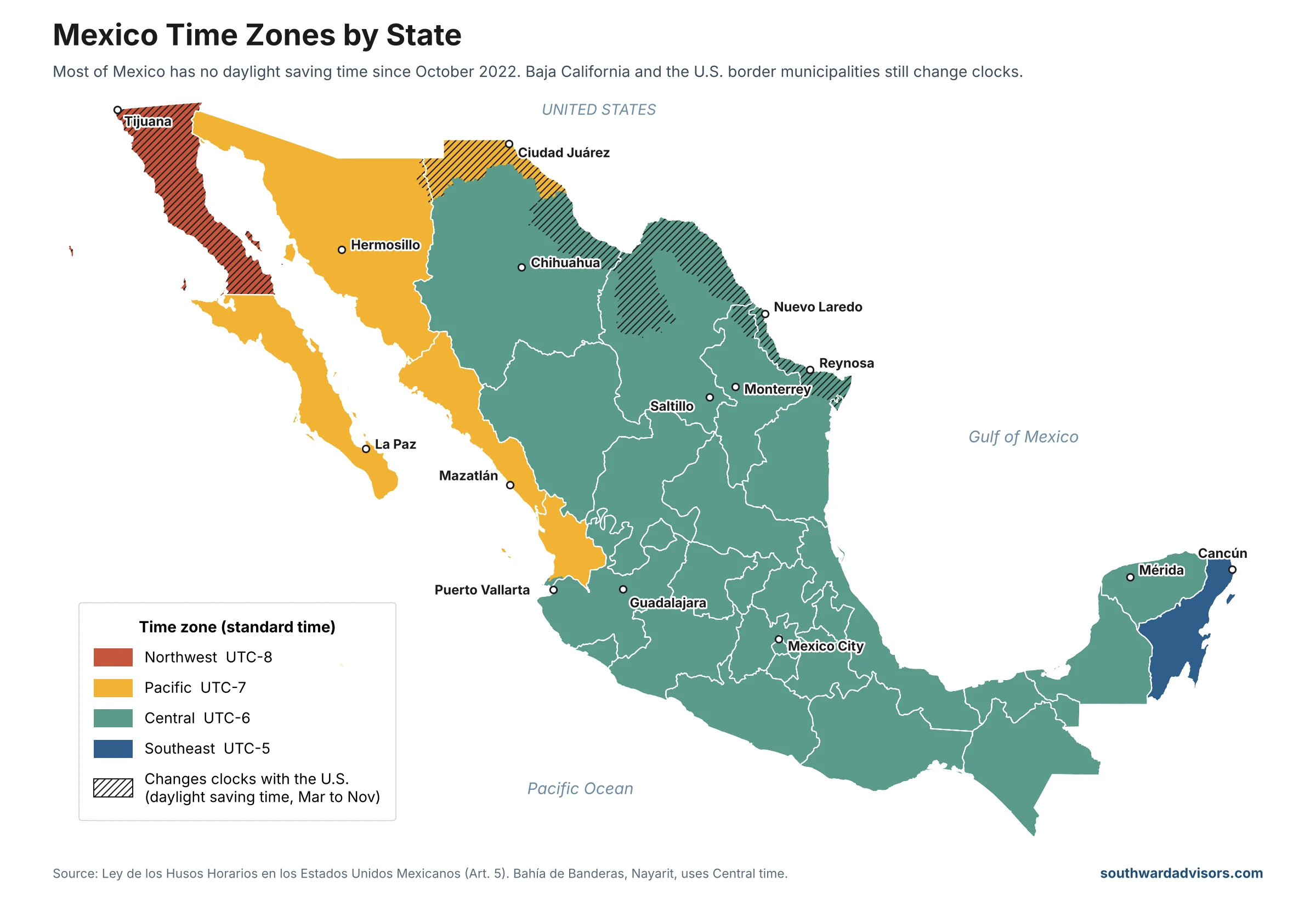
The four time zones of Mexico
Mexico's time zones are set by the Time Zones Law (Ley de los Husos Horarios en los Estados Unidos Mexicanos), which took effect in October 2022. The table summarizes them.
| Zone (Spanish name) | English name | UTC offset | Same as U.S. standard time | States |
|---|---|---|---|---|
| Zona Noroeste | Northwest | UTC-8 | Pacific (PST) | Baja California |
| Zona Pacífico | Pacific | UTC-7 | Mountain (MST) | Baja California Sur, Nayarit (except Bahía de Banderas), Sinaloa, Sonora |
| Zona Centro | Central | UTC-6 | Central (CST) | 26 states, including Mexico City, Jalisco, Nuevo León, Chihuahua and Yucatán |
| Zona Sureste | Southeast | UTC-5 | Eastern (EST) | Quintana Roo |
Mexicans usually refer to the zones by their Spanish names, such as hora del centro or tiempo del centro for Central time. In English, the U.S.-style abbreviations CST, MST, PST and EST are often used informally. Scheduling software uses database names such as America/Mexico_City, America/Tijuana, America/Hermosillo and America/Cancun.
Zona Noroeste (UTC-8)
The Northwest zone covers only the state of Baja California, including Tijuana, Mexicali and Ensenada. It is the only whole state that still changes its clocks, so it moves to UTC-7 in summer and stays aligned with California all year.
Zona Pacífico (UTC-7)
The Pacific zone covers Baja California Sur (La Paz and Los Cabos), Sinaloa (Mazatlán and Culiacán), Sonora (Hermosillo) and most of Nayarit. The name can confuse English speakers: Mexico's "Pacific" zone is on UTC-7, the same as U.S. Mountain Standard Time, not U.S. Pacific time.
Zona Centro (UTC-6)
The Central zone covers most of Mexico, from Chihuahua and Nuevo León in the north to Chiapas and Yucatán in the south. Mexico City, Guadalajara, Monterrey, Puebla, Querétaro and Mérida are all on Central time.
Zona Sureste (UTC-5)
The Southeast zone covers only Quintana Roo, the state that includes Cancún, Playa del Carmen, Tulum and Cozumel. Quintana Roo moved its clocks one hour ahead on February 1, 2015, to give tourists more daylight in the evening, according to TravelPulse.
Time zones by state
| State | Time zone | UTC offset | Notes |
|---|---|---|---|
| Aguascalientes | Central | UTC-6 | |
| Baja California | Northwest | UTC-8 | Changes to UTC-7 in summer |
| Baja California Sur | Pacific | UTC-7 | |
| Campeche | Central | UTC-6 | |
| Chiapas | Central | UTC-6 | |
| Chihuahua | Central | UTC-6 | Border municipalities follow U.S. time (see below) |
| Mexico City | Central | UTC-6 | |
| Coahuila | Central | UTC-6 | Border municipalities change clocks in summer |
| Colima | Central | UTC-6 | |
| Durango | Central | UTC-6 | |
| Estado de México | Central | UTC-6 | |
| Guanajuato | Central | UTC-6 | |
| Guerrero | Central | UTC-6 | |
| Hidalgo | Central | UTC-6 | |
| Jalisco | Central | UTC-6 | |
| Michoacán | Central | UTC-6 | |
| Morelos | Central | UTC-6 | |
| Nayarit | Pacific | UTC-7 | Bahía de Banderas uses Central time (UTC-6) |
| Nuevo León | Central | UTC-6 | Anáhuac changes clocks in summer |
| Oaxaca | Central | UTC-6 | |
| Puebla | Central | UTC-6 | |
| Querétaro | Central | UTC-6 | |
| Quintana Roo | Southeast | UTC-5 | |
| San Luis Potosí | Central | UTC-6 | |
| Sinaloa | Pacific | UTC-7 | |
| Sonora | Pacific | UTC-7 | Never changes clocks |
| Tabasco | Central | UTC-6 | |
| Tamaulipas | Central | UTC-6 | Border municipalities change clocks in summer |
| Tlaxcala | Central | UTC-6 | |
| Veracruz | Central | UTC-6 | |
| Yucatán | Central | UTC-6 | |
| Zacatecas | Central | UTC-6 |
Choosing a location in Mexico?
Time zone is one factor among many. We compare labor, logistics and suppliers across Mexican regions for U.S. manufacturers.
Talk to Our TeamDoes Mexico have daylight saving time?
Most of Mexico does not. Daylight saving time ended for most of the country on October 30, 2022, when clocks went back for the last time under the new Time Zones Law. Since then, Mexico City and the rest of the interior stay on standard time all year.
The exception is the northern border. Cities such as Tijuana, Ciudad Juárez, Nuevo Laredo and Reynosa are economically tied to their U.S. neighbors, with workers, shoppers and trucks crossing every day. To keep their clocks aligned with the U.S., the law lets them follow a seasonal schedule (horario estacional) that matches U.S. daylight saving time.
Border areas that still change their clocks
Article 5 of the Time Zones Law lists the areas that change their clocks, grouped by the U.S. time they follow, according to the text of the law:
| State | Municipalities | Follows U.S. time of | Standard / summer offset |
|---|---|---|---|
| Baja California | The whole state, including Tijuana, Mexicali and Ensenada | California (Pacific) | UTC-8 / UTC-7 |
| Chihuahua | Juárez, Ascensión, Guadalupe, Janos, Praxedis G. Guerrero | El Paso, Texas (Mountain) | UTC-7 / UTC-6 |
| Chihuahua | Ojinaga, Coyame del Sotol, Manuel Benavides | Presidio, Texas (Central) | UTC-6 / UTC-5 |
| Coahuila | Acuña, Allende, Guerrero, Hidalgo, Jiménez, Morelos, Nava, Ocampo, Piedras Negras, Villa Unión, Zaragoza | Texas (Central) | UTC-6 / UTC-5 |
| Nuevo León | Anáhuac | Texas (Central) | UTC-6 / UTC-5 |
| Tamaulipas | Nuevo Laredo, Guerrero, Mier, Miguel Alemán, Camargo, Gustavo Díaz Ordaz, Reynosa, Río Bravo, Valle Hermoso, Matamoros | Texas (Central) | UTC-6 / UTC-5 |
The rest of Coahuila, Nuevo León and Tamaulipas, including Saltillo and Monterrey, stays on Central standard time all year. In summer, Monterrey is therefore one hour behind Nuevo Laredo, even though the two cities are only about 140 miles apart.
2026 and 2027 dates
The border areas follow the U.S. calendar. Clocks go forward at 2:00 a.m. on the second Sunday of March and back at 2:00 a.m. on the first Sunday of November.
| Year | Clocks go forward | Clocks go back |
|---|---|---|
| 2026 | March 8 | November 1 |
| 2027 | March 14 | November 7 |
Special cases
Sonora has not changed its clocks since 1999 and stays on UTC-7 all year. That keeps it aligned with Arizona, its main trading partner, which also does not use daylight saving time.
Chihuahua was in the Pacific zone (UTC-7) until late 2022. At the state's request, it moved to Central time (UTC-6) at the end of November 2022, while the border municipalities listed above kept following U.S. time.
Quintana Roo moved from Central to Southeast time (UTC-5) in February 2015 and does not change its clocks.
Bahía de Banderas, the Nayarit municipality next to Puerto Vallarta, switched from UTC-7 to Central time (UTC-6) in 2010. It now shares the same time as Puerto Vallarta, which is just across the state line in Jalisco, according to records in the IANA time zone database.
U.S. and Mexico time zones
Because most of Mexico no longer changes its clocks and most of the U.S. does, the time difference between the two countries changes twice a year. The tables show how Mexican time lines up with U.S. time in each season.
From early November to mid-March (U.S. standard time)
| Mexican zone or area | UTC offset | Same time as | Example |
|---|---|---|---|
| Baja California | UTC-8 | U.S. Pacific | Tijuana = Los Angeles |
| Pacific zone (Sonora, Sinaloa, Baja California Sur, most of Nayarit) | UTC-7 | U.S. Mountain and Arizona | Hermosillo = Denver and Phoenix |
| Ciudad Juárez area | UTC-7 | U.S. Mountain | Ciudad Juárez = El Paso |
| Central zone | UTC-6 | U.S. Central | Mexico City = Chicago and Dallas |
| Quintana Roo | UTC-5 | U.S. Eastern | Cancún = New York |
In winter, Mexico City and Chicago show the same time. Mexico City is one hour behind New York and two hours ahead of Los Angeles.
From mid-March to early November (U.S. daylight saving time)
| Mexican zone or area | UTC offset | Same time as | Example |
|---|---|---|---|
| Baja California | UTC-7 | U.S. Pacific | Tijuana = Los Angeles |
| Pacific zone | UTC-7 | U.S. Pacific and Arizona | Hermosillo = Los Angeles and Phoenix |
| Ciudad Juárez area | UTC-6 | U.S. Mountain | Ciudad Juárez = El Paso |
| Central zone | UTC-6 | U.S. Mountain | Mexico City = Denver |
| Texas border municipalities (Nuevo Laredo, Reynosa, Piedras Negras and others) | UTC-5 | U.S. Central | Nuevo Laredo = Laredo |
| Quintana Roo | UTC-5 | U.S. Central | Cancún = Chicago |
In summer, Mexico City is one hour behind Chicago and Dallas, two hours behind New York and one hour ahead of Los Angeles. Many U.S. companies notice the change only when a recurring meeting with a Mexican plant suddenly starts an hour earlier or later in March and November.
Setting up production in Mexico?
Southward Advisors helps U.S. companies find suppliers, choose a site and launch pilot production in Mexico.
Book a Free ConsultationTime zones of major Mexican cities
| City | State | Time zone | UTC offset | Matches U.S. time in winter | Matches U.S. time in summer |
|---|---|---|---|---|---|
| Mexico City | Mexico City | Central | UTC-6 | Central | Mountain |
| Guadalajara | Jalisco | Central | UTC-6 | Central | Mountain |
| Monterrey | Nuevo León | Central | UTC-6 | Central | Mountain |
| Saltillo | Coahuila | Central | UTC-6 | Central | Mountain |
| Querétaro | Querétaro | Central | UTC-6 | Central | Mountain |
| León | Guanajuato | Central | UTC-6 | Central | Mountain |
| Puebla | Puebla | Central | UTC-6 | Central | Mountain |
| Mérida | Yucatán | Central | UTC-6 | Central | Mountain |
| Chihuahua City | Chihuahua | Central | UTC-6 | Central | Mountain |
| Puerto Vallarta | Jalisco | Central | UTC-6 | Central | Mountain |
| Cancún | Quintana Roo | Southeast | UTC-5 | Eastern | Central |
| Tijuana | Baja California | Northwest | UTC-8 (UTC-7 in summer) | Pacific | Pacific |
| Mexicali | Baja California | Northwest | UTC-8 (UTC-7 in summer) | Pacific | Pacific |
| Ciudad Juárez | Chihuahua | Mountain (border) | UTC-7 (UTC-6 in summer) | Mountain | Mountain |
| Nuevo Laredo | Tamaulipas | Central (border) | UTC-6 (UTC-5 in summer) | Central | Central |
| Reynosa | Tamaulipas | Central (border) | UTC-6 (UTC-5 in summer) | Central | Central |
| Hermosillo | Sonora | Pacific | UTC-7 | Mountain | Pacific |
| Mazatlán | Sinaloa | Pacific | UTC-7 | Mountain | Pacific |
| La Paz and Los Cabos | Baja California Sur | Pacific | UTC-7 | Mountain | Pacific |
Working across U.S. and Mexican time zones
For companies with plants or suppliers in Mexico, time zones are one of the practical advantages of nearshoring. Most Mexican industrial cities share at least six hours of the working day with U.S. offices all year, compared with almost none for suppliers in Asia. Our comparison of Mexico vs China manufacturing covers that difference in more detail.
A few habits avoid confusion:
- Set calendars to a city, not an offset. Choose "Mexico City" or "Monterrey" in calendar and scheduling tools, rather than "Central Time", so meetings move correctly when the U.S. changes its clocks.
- Check meetings in March and November. Recurring calls between U.S. and Mexican teams shift by one hour twice a year, except for teams in Baja California and the border cities.
- Know which border rules apply. A plant in Reynosa follows U.S. Central time all year, while a plant in Monterrey, a few hours away by road, does not. Shift changes, cross-border shipments and customs appointments should use the local time of the plant.
- Use the Spanish names in local documents. Contracts and production schedules in Mexico usually say hora del centro or name the city.
If you are choosing where to locate, our guide to the best manufacturing cities in Mexico compares the main regions, and our Saltillo guide looks at one of the largest industrial cities on Central time.
Frequently asked questions
How many time zones does Mexico have?
Mexico has four time zones: Northwest (UTC-8), Pacific (UTC-7), Central (UTC-6) and Southeast (UTC-5). Most of the population lives in the Central zone.
Is all of Mexico in one time zone?
No. Most states are on Central time, but Baja California, Baja California Sur, Sonora, Sinaloa, most of Nayarit and Quintana Roo use other zones.
What time zone is Mexico City in?
Mexico City is on Central time (hora del centro), UTC-6, all year. It matches U.S. Central time in winter and U.S. Mountain time in summer.
Is Cancún on Eastern time?
Cancún is on UTC-5 all year. That matches U.S. Eastern time in winter and U.S. Central time in summer, when the U.S. moves its clocks forward.
Does Mexico change its clocks?
Most of Mexico stopped changing its clocks in October 2022. Baja California and a group of municipalities on the U.S. border still change them on the same dates as the U.S.
What is the time difference between Mexico City and New York?
Mexico City is one hour behind New York from early November to mid-March and two hours behind from mid-March to early November.
Is Tijuana on Pacific time?
Yes. Tijuana and the rest of Baja California follow the same time as California all year, including daylight saving time.
What time zone is Guadalajara in?
Guadalajara is on Central time (UTC-6), the same as Mexico City, and does not change its clocks.
What is the abbreviation for Mexico's time zones?
There are no official English abbreviations. In practice, CST is often used for Central time, MST for the Pacific zone, PST for Baja California and EST for Quintana Roo. Scheduling tools use names such as America/Mexico_City.
What time zone is New Mexico in?
New Mexico is a U.S. state, not part of Mexico. It is on U.S. Mountain time and observes daylight saving time.
About Southward Advisors
Southward Advisors is a supply chain implementation firm that helps manufacturers move production from Asia to Mexico and other Latin American countries. Founded in 2016 by John Hyatt, the firm has offices in Charlotte, North Carolina, and Mexico City, and works with small and mid-sized companies as well as multinationals.
Southward works on the client's side and does not sell factory space. Its team finds and qualifies suppliers, compares costs and locations, sets up pilot production and helps new operations run efficiently. Its three core services are:
- Nearshore manufacturing in Mexico: feasibility, site selection, supplier vetting, pilot runs and scale-up.
- Sourcing and supply chain development: supplier discovery and qualification, factory assessments and supply chain design.
- Process improvement consulting: lean manufacturing, value stream mapping, changeover reduction and KPI systems.
Recent client results include a Midwest cabinet maker that saved more than $200,000 in tariffs, a Southeast consumer products manufacturer with tariff savings approaching $1 million a year, and a West Coast office furniture maker that saved about $3 million after moving production to Mexico. The details are available in our case studies.
Southward Advisors is a member of the US-Mexico Chamber of Commerce, Holland House Mexico, the Irish-Mexican Chamber and the Mexico Strategic Sourcing Alliance, and has been featured on CBS News and Deutsche Welle.
Let's build your Mexico supply chain
Tell us what you make and where you sell it. We will outline the options for moving production to Mexico.
Schedule a Strategy Call