
Beyond Cost Savings: KPIs That Measure Nearshoring Success
When companies first consider nearshoring, the conversation usually starts with one question: How much money can we save?
Lower transportation costs, reduced tariffs, and competitive labor rates are certainly important. But after helping manufacturers move production closer to North America, one lesson becomes clear: cost savings alone don’t determine whether a nearshoring strategy is successful.
A successful nearshoring initiative should improve your entire operation—not just your budget. Faster deliveries, stronger supplier relationships, better product quality, improved inventory management, and greater supply chain resilience often create more long-term value than lower production costs alone.
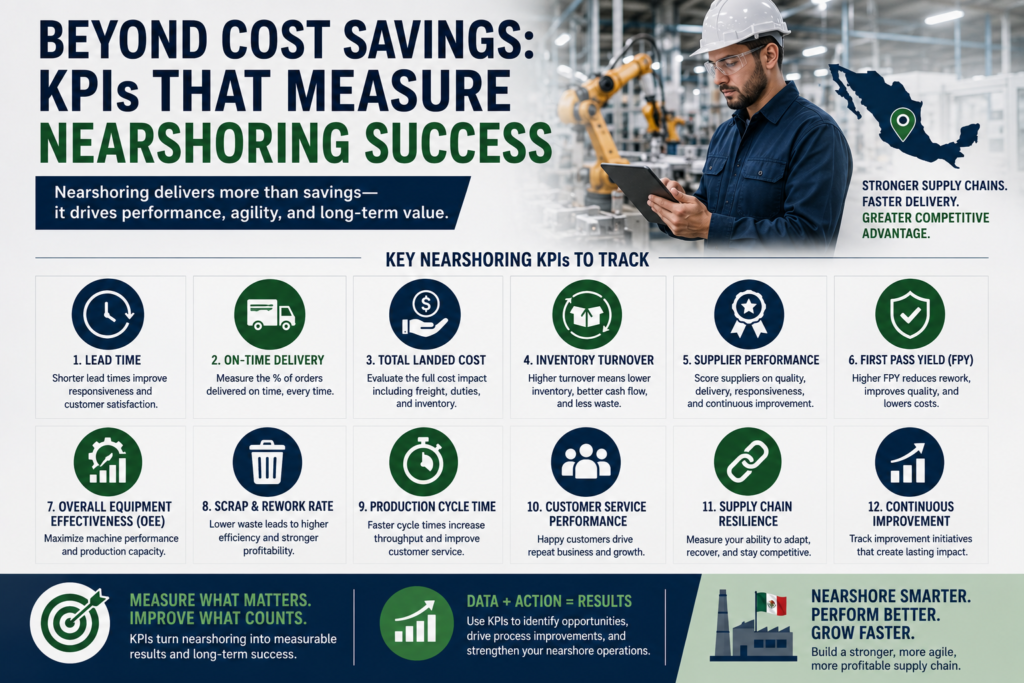
That’s why leading manufacturers rely on nearshoring KPIs to measure performance across every stage of the supply chain. By tracking the right supply chain performance metrics and manufacturing KPIs, businesses can identify what’s working, uncover opportunities for improvement, and ensure their nearshore manufacturing strategy delivers measurable results.
In this guide, we’ll explore the most important metrics to monitor, explain why they matter, and show how process improvement consulting can help organizations turn operational data into continuous improvement.
Why Measuring Nearshoring Success Matters
Moving production to Mexico or another nearby market isn’t the finish line—it’s the starting point.
Once production begins, companies need objective ways to evaluate whether their investment is delivering the expected benefits.
Without measurable KPIs, businesses often rely on assumptions rather than facts.
A structured performance measurement system helps answer questions like:
- Are lead times improving?
- Has product quality increased?
- Are suppliers meeting delivery expectations?
- Is inventory decreasing?
- Are production costs becoming more predictable?
- Is customer satisfaction improving?
The answers provide the insight needed to make better operational decisions.
What Are Nearshoring KPIs?
Nearshoring KPIs (Key Performance Indicators) are measurable metrics used to evaluate the effectiveness of relocating manufacturing or sourcing closer to the end market.
Unlike financial metrics alone, these KPIs evaluate operational performance across the entire supply chain.
They typically focus on:
- Delivery performance
- Manufacturing efficiency
- Inventory management
- Supplier reliability
- Quality
- Customer service
- Production flexibility
Together, they provide a complete picture of supply chain health.
KPI #1: Lead Time Reduction
One of the biggest advantages of nearshore manufacturing is shorter lead times.
Lead time measures how long it takes from placing an order until products arrive at their destination.
Lower lead times often result in:
- Faster customer deliveries
- Lower inventory levels
- Better forecasting accuracy
- Improved production scheduling
Rather than simply measuring average lead time, monitor trends over several months.
Consistent improvement is more valuable than occasional short-term gains.
KPI #2: On-Time Delivery (OTD)
Reliable delivery builds customer confidence.
On-Time Delivery measures the percentage of orders delivered when promised.
Strong OTD performance reflects:
- Effective planning
- Reliable suppliers
- Stable production schedules
- Efficient logistics
When delivery performance begins to decline, it often signals deeper operational issues that should be addressed before they become larger problems.
KPI #3: Total Landed Cost
Many companies judge success by comparing labor rates.
A better approach is measuring total landed cost.
This includes:
- Manufacturing
- Freight
- Customs
- Duties
- Inventory carrying costs
- Warehousing
- Handling
- Packaging
Nearshoring frequently improves overall profitability by reducing these indirect expenses, even if unit production costs remain similar.
KPI #4: Inventory Turnover
Inventory ties up working capital.
Inventory turnover measures how efficiently products move through the supply chain.
Higher inventory turnover generally indicates:
- Better demand planning
- Faster replenishment
- Reduced excess inventory
- Improved cash flow
Since manufacturing in Mexico typically shortens transportation times compared to overseas sourcing, companies often gain opportunities to reduce inventory without sacrificing service levels.
KPI #5: Supplier Performance
Your supply chain is only as strong as your suppliers.
Supplier performance should be measured consistently using criteria such as:
- On-time delivery
- Product quality
- Communication
- Responsiveness
- Corrective action effectiveness
- Capacity utilization
Supplier scorecards make it easier to identify high-performing partners while highlighting suppliers that require additional development.
KPI #6: First Pass Yield (FPY)
First Pass Yield measures how many products pass inspection without requiring rework.
Higher FPY usually means:
- Better production processes
- Improved quality control
- Lower manufacturing costs
- Higher customer satisfaction
When production moves to a new location, FPY is one of the earliest indicators of process stability.
KPI #7: Overall Equipment Effectiveness (OEE)
OEE evaluates how efficiently manufacturing equipment operates.
It combines three measurements:
- Availability
- Performance
- Quality
Monitoring OEE helps manufacturers identify equipment bottlenecks and opportunities to increase production without additional capital investment.
KPI #8: Scrap and Rework Rate
Waste directly affects profitability.
High scrap or rework rates often indicate:
- Process variation
- Equipment problems
- Training gaps
- Material quality issues
Reducing waste supports both operational efficiency and sustainability goals.
KPI #9: Production Cycle Time
Cycle time measures how long it takes to manufacture a product from start to finish.
Lower cycle times typically improve:
- Throughput
- Customer responsiveness
- Factory utilization
Lean manufacturing initiatives frequently target cycle time reduction as one of their primary objectives.
KPI #10: Customer Service Performance
Nearshoring should improve the customer experience—not just internal operations.
Useful customer-focused KPIs include:
- Order fulfillment rate
- On-time customer deliveries
- Return rate
- Customer complaints
- Warranty claims
These metrics reveal whether operational improvements are reaching the customer.
KPI #11: Supply Chain Resilience
Supply chain resilience is more difficult to quantify, but it has become one of the most valuable measurements.
Questions to evaluate include:
- Can suppliers recover quickly after disruptions?
- Do alternative suppliers exist?
- How quickly can production increase?
- How well does the supply chain adapt to changing demand?
Resilience has become a competitive advantage rather than simply a risk-management objective.
KPI #12: Continuous Improvement Projects
Companies practicing Lean Manufacturing rarely stop improving.
Track metrics such as:
- Number of improvement projects completed
- Cost savings generated
- Process improvements implemented
- Employee participation
- Productivity improvements
Continuous improvement demonstrates that operational excellence is becoming part of the company’s culture.
Practical Example
Imagine a U.S. company moving production from Asia to Mexico.
Six months after launch, management reviews only one number: labor cost.
The savings are modest.
At first glance, leadership questions whether the project was worthwhile.
However, a broader KPI review reveals:
- Lead time reduced from eight weeks to ten days.
- Inventory levels decreased significantly.
- Customer delivery performance improved.
- Production quality became more consistent.
- Freight expenses declined.
- Engineering changes were implemented much faster.
- Supplier communication improved because teams worked in similar time zones.
When viewed through multiple supply chain performance metrics, the project clearly delivered value—even though labor costs weren’t dramatically lower.
How Process Improvement Consulting Supports KPI Performance
Collecting data is only the first step.
The real value comes from understanding why performance changes and implementing improvements.
This is where process improvement consulting becomes valuable.
Consultants help manufacturers:
- Establish meaningful KPIs
- Develop performance dashboards
- Analyze production bottlenecks
- Improve factory layouts
- Optimize workflows
- Reduce waste
- Standardize operating procedures
- Train teams on continuous improvement methods
The goal isn’t simply better reporting—it’s better operational performance.
Common Mistakes to Avoid
Many companies track KPIs, but not all use them effectively.
Avoid these common mistakes:
Measuring Too Many Metrics
Focus on KPIs that support business objectives rather than tracking everything.
Looking Only at Cost
Operational improvements often create greater long-term value than labor savings alone.
Ignoring Trends
Performance should be evaluated over time, not through isolated monthly reports.
Failing to Share Results
KPIs should be visible across departments to encourage accountability.
Not Acting on the Data
Metrics only matter when they lead to improvement initiatives.
Frequently Asked Questions
What are nearshoring KPIs?
Nearshoring KPIs are measurable indicators used to evaluate the operational and financial performance of relocating manufacturing closer to the target market. They typically include lead time, delivery performance, inventory turnover, quality, and supplier reliability.
Which manufacturing KPI is most important?
There isn’t one universal KPI. Most manufacturers monitor a combination of lead time, on-time delivery, first pass yield, inventory turnover, and overall equipment effectiveness to gain a complete view of operational performance.
Why are supply chain performance metrics important?
Supply chain performance metrics help businesses identify inefficiencies, improve customer service, reduce operational risk, and support continuous improvement efforts.
How often should KPIs be reviewed?
Most manufacturers review operational KPIs monthly, while critical production metrics may be monitored weekly or even daily depending on the manufacturing environment.
Key Takeaways
Successful nearshoring isn’t defined by lower labor costs alone. The most effective organizations measure performance across the entire supply chain to ensure long-term value.
Keep these principles in mind:
- Track nearshoring KPIs that align with your strategic goals.
- Measure supply chain performance metrics such as lead time, inventory turnover, supplier performance, and delivery reliability.
- Use manufacturing KPIs like FPY, OEE, and cycle time to evaluate production efficiency.
- Review KPI trends regularly and use the insights to drive continuous improvement.
- Combine data with process improvement consulting to identify root causes and implement meaningful operational changes.
Final Thoughts
Nearshoring is about much more than reducing manufacturing expenses. It offers an opportunity to build a supply chain that is faster, more responsive, and better equipped to meet changing customer demands.
Organizations that define clear KPIs before launching a nearshoring initiative are better positioned to measure progress, identify challenges early, and continuously improve performance. Instead of focusing solely on short-term cost reductions, they evaluate the broader impact on quality, inventory, supplier relationships, production efficiency, and customer satisfaction.
At Southward Advisors, we help manufacturers establish meaningful performance metrics, optimize production processes, and strengthen nearshore operations through strategic sourcing, supplier development, and process improvement consulting. By measuring what truly matters, businesses can transform nearshoring from a cost-saving initiative into a long-term competitive advantage.