
Contract Manufacturing in Mexico: What U.S. Companies Need to Know
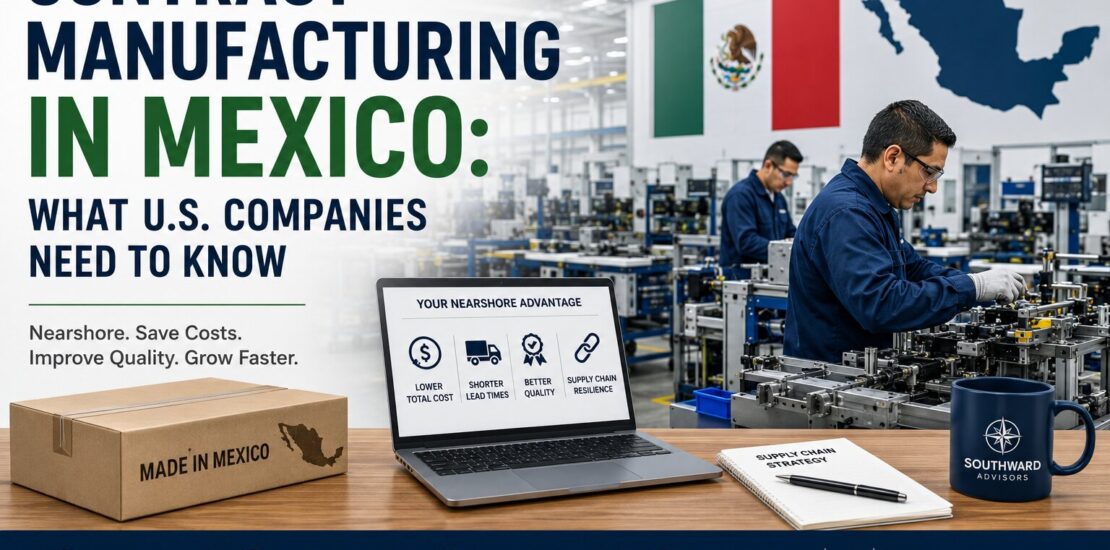
For a U.S. company considering production in Mexico, choosing a contract manufacturer is not simply a matter of finding a factory with a lower quoted unit price.
The real decision is whether a Mexican manufacturing partner can consistently deliver the required quality, volume, cost, lead time, compliance, and scalability while fitting into your broader North American supply chain.
That requires supplier sourcing, technical screening, factory auditing, commercial analysis, pilot production, quality validation, and careful logistics planning. The goal of this guide is to provide that decision-making framework rather than simply argue that Mexico is cheaper.
The approach below follows the practical supplier-qualification and risk-management framework in the supplied brief: evaluate the manufacturer before committing production, compare total landed cost rather than factory price, and validate the supplier through samples and pilot production.
What Is Contract Manufacturing in Mexico?
Contract manufacturing in Mexico is an arrangement in which a U.S. company hires a Mexican manufacturer to produce some or all of its products according to agreed specifications, quality standards, volumes, and commercial terms.
The U.S. company may retain ownership of:
- Product designs
- Intellectual property
- Specifications
- Brands
- Customer relationships
- Tooling
- Certain raw materials or components
The Mexican contract manufacturer may be responsible for:
- Production
- Labor
- Manufacturing equipment
- Factory overhead
- Production scheduling
- In-process quality control
- Packaging
- Some material procurement
- Finished-goods preparation
The exact division of responsibility is negotiated.
For example, a U.S. company selling commercial furniture might own the designs, customer relationships, and tooling while a Mexican manufacturer purchases specified materials, fabricates components, assembles products, performs inspections, and prepares shipments to the United States.
Another company might provide most of the components itself and use the Mexican supplier primarily for assembly.
That is why contract manufacturing is a business model, not a standardized package of services.
Contract manufacturing vs. other models
Supplier sourcing: You purchase components or finished goods from an independent supplier.
Contract manufacturing: You outsource defined manufacturing activities to a partner under an agreed commercial and technical relationship.
Private labeling: A manufacturer produces a product that another company sells under its own brand. Private-label manufacturing can overlap with contract manufacturing but is not synonymous with it.
Joint venture: Two or more parties establish shared ownership or control of an operation.
Wholly owned factory: Your company owns and operates the Mexican manufacturing facility.
Shelter manufacturing: A specialized structure in which a service provider supports foreign companies with certain Mexican administrative, labor, compliance, and operational functions while the client controls its manufacturing activities.
Contract assembly: A narrower arrangement focused primarily on putting components together.
The right model depends on how much control, capital, operational responsibility, and risk your company wants to assume.
Why Are U.S. Companies Using Contract Manufacturers in Mexico?
Mexico’s main attraction is not simply labor cost.
For many U.S. manufacturers, the strategic advantage is the possibility of building a shorter, more responsive North American supply chain.
Potential advantages include:
- Geographic proximity to U.S. customers
- Established manufacturing clusters
- Access to manufacturing labor and engineering talent
- Cross-border logistics infrastructure
- Similar or overlapping time zones
- Easier management visits compared with distant offshore production
- Shorter supply-chain distances for some products
- Potential inventory reductions
- Potential tariff or duty advantages when applicable
- Established supplier ecosystems in industries such as automotive, electronics, appliances, industrial products, and consumer goods
Southward Advisors’ current nearshoring service specifically focuses on supplier sourcing, site selection, supplier validation, process improvement, and implementation support in Mexico.
But these advantages are not automatic.
A Mexican supplier located far from your customers, dependent on imported Asian components, operating at maximum capacity, or struggling with quality may produce a worse total result than a supplier in the United States or China.
The question is not:
“Is Mexico cheaper?”
It is:
“Does Mexico provide the best total landed cost and operational risk profile for this particular product?”
What Products Can Be Contract Manufactured in Mexico?
Mexico has substantial manufacturing capabilities across numerous industries.
Potential applications include:
- Automotive components
- Electronics
- Appliances
- Industrial equipment
- Metal fabrication
- Plastics
- Furniture
- Consumer products
- Electrical products
- Machinery components
- Industrial assemblies
- Packaging
- Certain medical-device manufacturing
- Contract assembly
The important question is whether your particular product fits the supplier ecosystem.
Consider:
Labor content
Labor-intensive products may have more opportunity to benefit from manufacturing-cost differences than highly automated products.
Material availability
If 80% of your product cost comes from materials that must still be imported from Asia, moving final assembly to Mexico may produce less savings than expected.
Production volume
A high-volume product may justify tooling, supplier development, engineering support, and dedicated production capacity.
A very low-volume product may not.
Process complexity
Highly specialized processes may have fewer qualified suppliers.
Certification requirements
Products with demanding regulatory, testing, traceability, or quality requirements need a supplier capable of meeting those standards.
Benefits of Contract Manufacturing in Mexico
1. Lower capital requirements
Using an existing manufacturer can eliminate or reduce the need to build your own factory, purchase every machine, recruit an entire production organization, and develop infrastructure from scratch.
2. Faster market entry
An established supplier may already have:
- Equipment
- Employees
- Production systems
- Warehouse space
- Supplier relationships
- Quality personnel
- Logistics relationships
That can make the transition faster than a greenfield factory project.
3. Greater geographic proximity
A U.S. management team can generally visit a Mexican supplier much more easily than a distant overseas facility.
That matters when production problems require hands-on intervention.
4. Supply-chain flexibility
A well-selected Mexican contract manufacturer can become part of a broader North American sourcing strategy rather than simply replacing one overseas supplier.
5. Potential total-cost advantages
The opportunity may come from a combination of:
- Manufacturing cost
- Freight
- Inventory
- Lead time
- Tariffs/duties where applicable
- Quality costs
- Working capital
- Management time
- Supply-chain risk
Southward Advisors similarly frames Mexico sourcing around total landed cost, visibility, quality, logistics, and resilience rather than factory price alone.
Potential Challenges of Contract Manufacturing in Mexico
Contract manufacturing also creates risks.
Supplier qualification
Finding a factory is relatively easy. Finding one capable of consistently meeting your specifications is harder.
Quality consistency
A supplier may produce excellent samples but struggle when volume increases.
Imported components
A Mexican factory can still be highly dependent on Asia or other foreign suppliers.
Logistics
The factory’s distance from your customers, border crossings, ports, warehouses, and transportation providers affects economics.
Communication
Language and cultural differences can create misunderstandings around specifications, quality, deadlines, and escalation.
Capacity
A supplier may promise capacity that is not actually available during peak demand.
Supplier dependency
If one supplier becomes responsible for your entire product line, a production interruption can become a major business problem.
Intellectual property
Designs, tooling, CAD files, processes, and confidential information need appropriate protection.
Compliance
Mexico’s labor, customs, environmental, safety, tax, and product requirements must be evaluated for the particular operation.
Mitigation: Use supplier screening, factory audits, references, samples, pilot production, contractual controls, KPI monitoring, and contingency planning.
How to Find a Contract Manufacturer in Mexico
A disciplined sourcing process should look like this:
Step 1: Define the product
Document:
- Drawings
- BOM
- Materials
- Specifications
- Tolerances
- Testing
- Packaging
- Annual volume
- Monthly volume
- Forecast
- Delivery requirements
Step 2: Define certifications
Determine which quality, industry, customer, safety, or regulatory requirements apply.
Step 3: Establish commercial requirements
Define:
- Target cost
- MOQ
- Payment terms
- Lead time
- Tooling expectations
- Packaging
- Incoterms
- Forecasting requirements
Step 4: Identify potential Mexico manufacturing suppliers
Build a longlist before selecting finalists.
Consider technical capability, industry experience, location, capacity, export experience, and customer base.
Step 5: Screen suppliers
Eliminate companies that cannot meet fundamental requirements.
Step 6: Issue RFQs
Provide sufficiently detailed specifications so suppliers are quoting the same product and scope.
Step 7: Compare proposals
Do not compare unit price alone.
Compare the entire commercial package.
Step 8: Conduct factory audits
Verify what the supplier told you.
Step 9: Check references
Ask comparable customers about:
- Quality
- Delivery
- Responsiveness
- Corrective actions
- Capacity
- Communication
Step 10: Validate samples
Do not approve mass production based solely on a quotation or presentation.
Step 11: Run pilot production
Test the real production process.
Step 12: Negotiate the manufacturing agreement
Define responsibilities before production begins.
Step 13: Launch and monitor
Use KPIs during the initial production period and continue supplier reviews after launch.
How to Qualify a Mexican Contract Manufacturer
Supplier qualification should evaluate at least eight areas.
| Category | What to Evaluate |
| Capacity | Actual output, utilization, bottlenecks, shifts |
| Quality | QMS, inspections, CAPA, defects, traceability |
| Equipment | Condition, capacity, maintenance, technology |
| Workforce | Skills, turnover, training, management |
| Engineering | Product/process engineering capability |
| Supply Chain | Raw materials, suppliers, redundancy |
| Logistics | Shipping, warehousing, cross-border experience |
| Business Stability | Customers, growth, investments, management |
Southward Advisors describes its supplier-qualification work around technical capability, capacity, quality systems, certifications, financial stability, scalability, and geographic alignment.
One of the most important rules is simple:
Do not accept claimed capacity at face value.
If a supplier says it can produce 500,000 units per year, ask:
- What is current output?
- What is current utilization?
- How many shifts are operating?
- Which machines are bottlenecks?
- How much capacity is already committed?
- What happens during peak season?
- Can you demonstrate comparable production?
- What additional investment is required?
How to Conduct a Factory Audit
A factory audit should verify the supplier’s claims.
Facility
Inspect:
- Cleanliness
- Organization
- Layout
- Infrastructure
- Production flow
- Safety
- Expansion capacity
Equipment
Review:
- Condition
- Age
- Capacity
- Maintenance
- Calibration
- Redundancy
- Technology
Production
Observe:
- Cycle times
- Bottlenecks
- Actual output
- Workforce
- Standard work
- Process controls
- WIP levels
Quality
Review:
- Quality-management system
- Incoming inspection
- In-process inspection
- Final inspection
- Testing
- CAPA
- Traceability
- Scrap
- Rework
- FPY
- Defect rates
Supply Chain
Ask about:
- Raw materials
- Key suppliers
- Imported components
- Single-source dependencies
- Supplier qualification
- Inventory
- Backup suppliers
Logistics
Inspect:
- Warehouse
- Packaging
- Shipping area
- Transportation processes
- Export documentation
- Cross-border experience
Concise factory audit checklist
- Facility condition
- Production flow
- Equipment condition
- Actual capacity
- Maintenance
- Quality system
- Traceability
- Raw materials
- Supplier network
- Inventory
- Workforce
- Logistics
- Export experience
- Safety/compliance
- Corrective-action system
Southward Advisors’ process-improvement service also includes supplier audits and capability assessments, process standardization, quality alignment, and KPI development.
How Much Does Contract Manufacturing in Mexico Cost?
There is no reliable single “Mexico contract manufacturing price.”
The cost depends heavily on the product and manufacturing model.
Your analysis should include:
- Unit manufacturing cost
- Direct labor
- Materials
- Tooling
- Engineering
- Quality control
- Packaging
- Factory overhead
- Transportation
- Customs/brokerage
- Applicable duties/tariffs
- Inventory
- Working capital
- Supplier-development costs
- Travel
- Management
- Compliance
- Quality failures and rework
The crucial distinction is:
Manufacturing cost
What the supplier charges to manufacture the product.
Total landed cost
What your company actually spends to get an acceptable product into its intended distribution or customer location.
A supplier quoting $20 per unit is not necessarily cheaper than one quoting $22.
If Supplier A has:
- $20 factory price
- $3 freight
- $2 additional inventory
- $1.50 quality/rework cost
- $1 management cost
while Supplier B has:
- $22 factory price
- $1.50 freight
- $0.50 inventory impact
- $0.25 quality cost
- $0.50 management cost
Supplier B may actually be cheaper.
That is why the sourcing decision should be based on total landed cost, not the quotation headline.
Cost Comparison Framework: Mexico vs. China vs. U.S.
The following is an illustrative decision model, not a market quotation.
| Cost Category | Mexico Supplier A | China Supplier B | U.S. Supplier C |
| Factory price | $X | $X | $X |
| Transportation | +$X | +$X | +$X |
| Duties/tariffs | +$X | +$X | +$X |
| Inventory carrying cost | +$X | +$X | +$X |
| Quality/rework | +$X | +$X | +$X |
| Supplier management | +$X | +$X | +$X |
| Compliance | +$X | +$X | +$X |
| Estimated landed cost | $X | $X | $X |
The correct numbers must come from your actual product, classifications, supplier quotations, freight lanes, inventory model, and trade treatment.
This framework prevents a common sourcing mistake: selecting the factory with the lowest nominal unit price.
Mexico vs. China Contract Manufacturing
Mexico may be attractive when a company values:
- Geographic proximity
- Faster management access
- North American supply-chain integration
- Shorter logistics routes for some products
- Time-zone alignment
- Lower inventory exposure
- Regional supplier development
China may remain attractive where:
- The supplier ecosystem is exceptionally deep
- Production volumes are very large
- Specialized components are concentrated there
- Existing tooling and supplier relationships are difficult to replicate
- Total landed cost remains superior
There is no universal winner.
The right comparison is Mexico vs. China for your specific product and supply chain.
Southward Advisors’ current sourcing work emphasizes supplier qualification, geographic alignment, logistics, capacity, and ongoing KPI monitoring rather than selecting suppliers solely on cost.
Mexico vs. U.S. Manufacturing
The same principle applies to domestic manufacturing.
A U.S. supplier may offer:
- Very strong proximity
- Easier management
- Shorter domestic logistics
- Existing customer relationships
- Lower cross-border complexity
Mexico may offer different economics depending on:
- Labor content
- Overhead
- Supplier ecosystem
- Production volume
- Logistics
- Facility requirements
- Automation
- Product complexity
The correct question is not:
“Is Mexican labor cheaper?”
It is:
“What is the total cost and operational risk of delivering this product from each location?”
USMCA and Contract Manufacturing in Mexico
USMCA can be an important part of a Mexico manufacturing strategy, but manufacturing in Mexico does not automatically mean a product receives preferential USMCA treatment.
Rules of origin determine whether a product qualifies.
The analysis can involve:
- Product classification
- Regional value content
- Product-specific rules
- Materials and components
- Documentation
- Certification
- Recordkeeping
CBP states that USMCA requires a certification of origin and that the certification must contain the required data elements; the claim should be supported by appropriate records.
This is especially important because U.S. and Mexican officials are actively reviewing USMCA in 2026. Current discussions include rules of origin, economic security, automotive products, steel and aluminum, labor, and other issues. A fourth bilateral negotiating round was scheduled for September 2026.
Do not assume preferential treatment. Have the applicable rules reviewed for your actual product and supply chain by qualified trade counsel or specialists.
What U.S. Companies Should Know About IMMEX
IMMEX is Mexico’s Manufacturing, Maquiladora and Export Services Program.
In simple terms, it provides an export-oriented framework under which qualifying Mexican companies can temporarily import certain goods for manufacturing or export services, subject to program requirements and compliance obligations. Mexico’s Secretariat of Economy describes IMMEX as an export-promotion instrument for companies performing qualifying industrial or service processes connected to export production.
For some contract-manufacturing structures, IMMEX can be highly relevant because the manufacturer may import qualifying inputs under a temporary regime.
But IMMEX is not a universal tax-free manufacturing program.
Eligibility, sensitive goods, inventory control, customs procedures, reporting, and other requirements matter. U.S. companies should have their particular structure reviewed by qualified Mexican customs and tax professionals.
Mexico’s current customs guidance also identifies temporary entry, including IMMEX, as one of several customs regimes and recommends determining the appropriate regime at the quote and contract stage.
How to Protect Intellectual Property When Contract Manufacturing in Mexico
IP protection should be addressed before you send sensitive engineering information to a supplier.
Consider:
Ownership
Clearly establish who owns:
- Product designs
- CAD files
- Tooling
- Molds
- Fixtures
- Production drawings
- Process documentation
Confidentiality
Use appropriate confidentiality agreements and contractual provisions.
Access controls
Not every supplier employee needs access to every design file.
Tooling
Document:
- Ownership
- Location
- Maintenance
- Access
- Transfer rights
- What happens when the relationship ends
Subcontractors
Control whether the manufacturer can send your work to another company.
Data security
Protect digital engineering files, specifications, production records, and customer information.
Legal review
A U.S. or Mexican attorney experienced in cross-border manufacturing should review enforceability, IP rights, confidentiality, dispute resolution, and related provisions.
Do not rely on an NDA alone to solve every IP risk.
Key Contract Terms to Review
A contract manufacturing agreement should clearly define responsibilities.
Potential areas include:
- Product specifications
- Pricing
- MOQ
- Forecasts
- Lead times
- Capacity commitments
- Quality standards
- Inspection rights
- Acceptance criteria
- Defective products
- Warranty
- Tooling ownership
- IP ownership
- Confidentiality
- Change control
- Subcontracting
- Audit rights
- Packaging
- Delivery terms
- Payment terms
- Corrective actions
- Termination
- Dispute resolution
This is not a substitute for a legal agreement. Have qualified counsel review the actual contract and applicable Mexican and U.S. requirements.
Quality Control and Supplier Management
Outsourcing production does not mean outsourcing responsibility for product quality.
Your quality system should establish:
- Product specifications
- Approved drawings
- SOPs
- Inspection plans
- Incoming inspection
- In-process inspection
- Final inspection
- Testing
- Traceability
- Nonconformance procedures
- CAPA
- Corrective actions
- Supplier audits
- Customer-complaint procedures
Track meaningful KPIs such as:
- First-pass yield
- Defect rate
- Scrap
- Rework
- On-time delivery
- OTIF
- Customer complaints
- Corrective-action closure
- Production throughput
Southward Advisors’ process-improvement practice specifically identifies FPY, OEE, lead time, takt adherence, rework, and scrap as useful performance measures.
Logistics and Cross-Border Shipping
A contract manufacturer’s location can materially affect your supply-chain economics.
Evaluate:
- Factory-to-border distance
- Factory-to-customer distance
- Trucking
- Cross-border carriers
- Warehousing
- Packaging
- Customs brokers
- Export documentation
- Import documentation
- Delivery terms
- Inventory buffers
- U.S. distribution
Do not assume that a factory near the U.S. border is automatically the best option.
A supplier farther inland may have better:
- Labor availability
- Industrial infrastructure
- Supplier ecosystem
- Capacity
- Cost
- Process capabilities
Mexico’s customs system covers tariff classification, valuation, licensing, documentation, and compliance with applicable NOM standards. U.S. companies should establish responsibilities between the manufacturer, importer of record, customs broker, freight provider, and buyer before launch.
15 Common Mistakes U.S. Companies Make
- Choosing solely on price
- Skipping factory audits
- Failing to verify capacity
- Ignoring quality systems
- Underestimating logistics
- Failing to protect IP
- Providing unclear specifications
- Not checking references
- Ignoring supplier-concentration risk
- Failing to plan for ramp-up
- Not defining corrective-action procedures
- Ignoring backup suppliers
- Underestimating management oversight
- Failing to understand customs and trade requirements
- Moving production before completing pilot production
The most expensive mistakes often happen before the first production order.
20 Red Flags When Evaluating a Mexican Contract Manufacturer
Minor concerns
- Disorganized paperwork
- Small housekeeping issues
- Minor documentation gaps
- Noncritical process inconsistencies
Major concerns
- High scrap
- Poor traceability
- Weak corrective-action processes
- Overstated capacity
- High employee turnover
- Repeated delivery problems
- Heavy dependence on subcontractors
- Weak supplier controls
- Poor maintenance
Potential disqualifiers
- Unusually low pricing without a credible explanation
- Refusal to provide basic documentation
- Contradictory management answers
- Unsafe production conditions
- Serious traceability failures
- Inability to demonstrate claimed capacity
- Hidden subcontracting
- Major unresolved quality problems
- Poor customer references
- No credible corrective-action process
- No backup for critical equipment
- No backup for critical materials
- Significant unexplained delivery failures
- Unclear ownership or management
- Refusal to permit reasonable audits
- Refusal to protect confidential information
- Unwillingness to document tooling ownership
- Excessive customer concentration
- No realistic production-scaling plan
- Resistance to transparency
A red flag does not always mean “reject the supplier.” The appropriate response depends on severity, root cause, corrective action, and verification.
Contract Manufacturing vs. Building Your Own Factory
| Factor | Contract Manufacturing | Own Factory |
| Upfront capital | Lower | Higher |
| Speed to launch | Usually faster | Usually slower |
| Control | Lower | Higher |
| Fixed costs | Lower | Higher |
| Supplier dependency | Higher | Lower |
| Operational responsibility | Shared | Primarily yours |
| Scalability | Potentially high | Depends on investment |
| Quality control | Contractually managed | Direct |
| Long-term economics | Depends on supplier pricing | Depends on utilization |
| Management complexity | Lower initially | Higher |
Contract manufacturing may make sense when:
- You want to test Mexico before investing heavily.
- Volumes are uncertain.
- You need faster market entry.
- You lack Mexican operational infrastructure.
- Capital preservation matters.
- An established supplier already has the necessary equipment.
Owning a facility may make sense when:
- Volumes are substantial and predictable.
- Manufacturing is strategically important.
- IP or process control requires direct ownership.
- You need dedicated capacity.
- Long-term economics justify capital investment.
- You want direct control over the workforce and factory.
The two models are not necessarily permanent alternatives. A company can begin with contract manufacturing and later develop its own operation after proving the Mexican business case.
When Mexico May Not Be the Right Choice
Mexico is not automatically the right manufacturing location.
It may be less attractive when:
- Production volume is extremely low.
- The product requires highly specialized capabilities unavailable locally.
- The operation is extremely automated with little labor content.
- Critical materials remain heavily dependent on distant imports.
- Logistics erase the expected cost advantage.
- Regulatory requirements create disproportionate complexity.
- Your existing U.S. facility already has excellent economics and capacity.
- A Chinese or other international supplier has a dramatically stronger ecosystem for the particular product.
The answer should come from a product-specific feasibility analysis, not a generic belief that Mexico is cheaper.
How to Transition Manufacturing to Mexico
A controlled transition generally follows this sequence:
1. Feasibility analysis
Calculate total landed cost and operational risk.
2. Supplier search
Identify multiple potential manufacturers.
3. Supplier qualification
Review capabilities, quality, capacity, financial stability, and logistics.
4. Factory audit
Verify supplier claims.
5. RFQ
Obtain comparable commercial proposals.
6. Commercial negotiations
Define pricing, capacity, quality, logistics, and responsibilities.
7. Sample approval
Validate the product.
8. Pilot production
Validate the actual manufacturing process.
9. Quality validation
Confirm production quality and repeatability.
10. Initial production
Start with controlled volumes.
11. Ramp-up
Increase production as KPIs demonstrate stability.
12. Performance monitoring
Track quality, delivery, cost, throughput, and corrective actions.
Do not shut down an existing production source simply because a Mexican supplier has passed an initial audit.
Keep the transition controlled until the new supplier has demonstrated repeatable performance.
How Southward Advisors Can Help
Choosing a contract manufacturer in Mexico affects cost, quality, delivery, and long-term supply-chain resilience.
Southward Advisors helps companies develop Mexico-based manufacturing and supply chains through services including:
- Supplier sourcing
- Supplier identification and qualification
- Nearshoring strategy
- Site and facility assessment
- Supply-chain development
- Process improvement
- Supplier audits and capability assessments
- Manufacturing implementation
- Quality alignment
- KPI development
Its sourcing practice emphasizes on-the-ground supplier validation, technical capability, capacity, quality systems, financial stability, scalability, and geographic fit.
Southward’s case studies also document work involving Mexican manufacturing and supplier development. For example, one Midwest cabinet manufacturer moved sourcing from China toward Mexico after multiple supplier bids and factory visits, ultimately selecting a supplier in Guanajuato.
Choosing a contract manufacturer in Mexico is a strategic decision that affects cost, quality, delivery, and supply-chain resilience. Southward Advisors can help U.S. manufacturers identify, evaluate, qualify, and develop Mexican manufacturing partners.
Frequently Asked Questions
What is contract manufacturing in Mexico?
Contract manufacturing in Mexico is when a U.S. company outsources defined manufacturing activities to a Mexican manufacturer under agreed specifications, pricing, quality, capacity, and delivery requirements.
Is contract manufacturing in Mexico cheaper?
It can be, but there is no universal answer. The correct comparison includes manufacturing, materials, logistics, duties/tariffs where applicable, inventory, quality, management, compliance, and other costs.
How do I find a contract manufacturer in Mexico?
Define your technical and commercial requirements, identify qualified suppliers, screen them, issue RFQs, conduct factory audits, check references, validate samples, run pilot production, and negotiate the manufacturing agreement.
How do I choose a Mexican contract manufacturer?
Evaluate actual production capacity, quality systems, equipment, workforce, engineering capability, supplier network, logistics, management, business stability, references, and scalability.
What should I look for during a factory audit?
Inspect the facility, equipment, production flow, actual capacity, quality system, material controls, warehouse, workforce, maintenance, logistics, safety, and documentation.
Is contract manufacturing in Mexico cheaper than China?
Not necessarily. Mexico may have advantages in proximity, logistics, inventory, oversight, and North American supply-chain integration, while China may remain highly competitive for certain products and supplier ecosystems.
What is the difference between contract manufacturing and owning a factory?
Contract manufacturing uses an external manufacturer and generally requires less capital and management infrastructure. Owning a factory provides more direct control but requires substantially more investment and operational responsibility.
What is IMMEX?
IMMEX is Mexico’s Manufacturing, Maquiladora and Export Services Program. It provides a framework for qualifying export-oriented companies to temporarily import certain goods for manufacturing or export services under specified conditions.
Does manufacturing in Mexico automatically qualify for USMCA benefits?
No. The product must meet the applicable rules of origin and documentation requirements. CBP requires a USMCA certification of origin for preferential treatment claims.
How can I protect my IP when manufacturing in Mexico?
Clearly document ownership, use appropriate confidentiality and IP agreements, control access to technical information, establish tooling ownership, restrict unauthorized subcontracting, and have qualified legal counsel review the cross-border agreement.
Should I use a third-party expert?
Not every company needs one. However, local manufacturing expertise can be valuable when the buyer lacks Mexico experience, the supplier is strategically important, or the manufacturing and supply chain are complex.
Supplier Qualification Checklist
Company
- Years in business
- Ownership verified
- Management reviewed
- Relevant customer references
- Export experience
Manufacturing
- Required processes available
- Actual capacity verified
- Equipment adequate
- Maintenance system established
- Expansion capability understood
Quality
- QMS reviewed
- Certifications verified
- Inspection procedures reviewed
- Traceability confirmed
- CAPA process reviewed
- Quality KPIs reviewed
Supply Chain
- Key suppliers identified
- Imported components identified
- Single-source risks evaluated
- Backup suppliers identified
- Inventory policy reviewed
Commercial
- RFQ received
- Cost structure understood
- MOQ defined
- Lead times confirmed
- Payment terms reviewed
- Capacity commitments discussed
Logistics
- Shipping route defined
- Customs responsibilities defined
- Broker identified
- Packaging requirements confirmed
- Delivery terms established
Launch
- Sample approved
- Pilot completed
- Quality validated
- Corrective actions closed
- Initial production plan established
Supplier Interview Questions
Ask potential contract manufacturers:
- What percentage of your current production capacity is utilized?
- What are your biggest production bottlenecks?
- Which processes are performed internally?
- Which processes are subcontracted?
- How quickly can you increase production?
- What happens when a critical machine fails?
- What is your current scrap rate?
- How do you handle nonconforming products?
- What is your employee turnover rate?
- How do you qualify raw-material suppliers?
- Which materials are imported?
- Which materials are single-sourced?
- What backup suppliers do you have?
- What are your typical production lead times?
- How do you manage customer complaints?
- How do you maintain traceability?
- Which customers represent a significant percentage of your business?
- What quality KPIs do you monitor?
- How much of the proposed production would require new equipment?
- What would you need from us before beginning production?