
Hidden Costs of Manufacturing in China vs. Mexico: What Most Companies Overlook
For years, companies viewed manufacturing decisions through a simple lens: compare labor rates, choose the lowest-cost country, and maximize savings. That approach made sense when global supply chains were predictable and transportation costs were relatively stable.
Today, the equation is far more complex.
Manufacturers are now weighing tariffs, freight costs, inventory levels, geopolitical uncertainty, supplier responsiveness, and customer expectations alongside production costs. As a result, many businesses are taking a fresh look at manufacturing in Mexico vs China, not because labor is necessarily cheaper, but because the total cost of doing business often tells a different story.
The reality is that the quoted factory price is only one part of the financial picture. Hidden costs can quietly erode margins, disrupt production, and increase operational risk.
This article explores the overlooked expenses that affect Mexico vs China manufacturing costs, explains why total landed cost matters more than unit price, and helps decision-makers determine which manufacturing strategy best supports long-term growth.
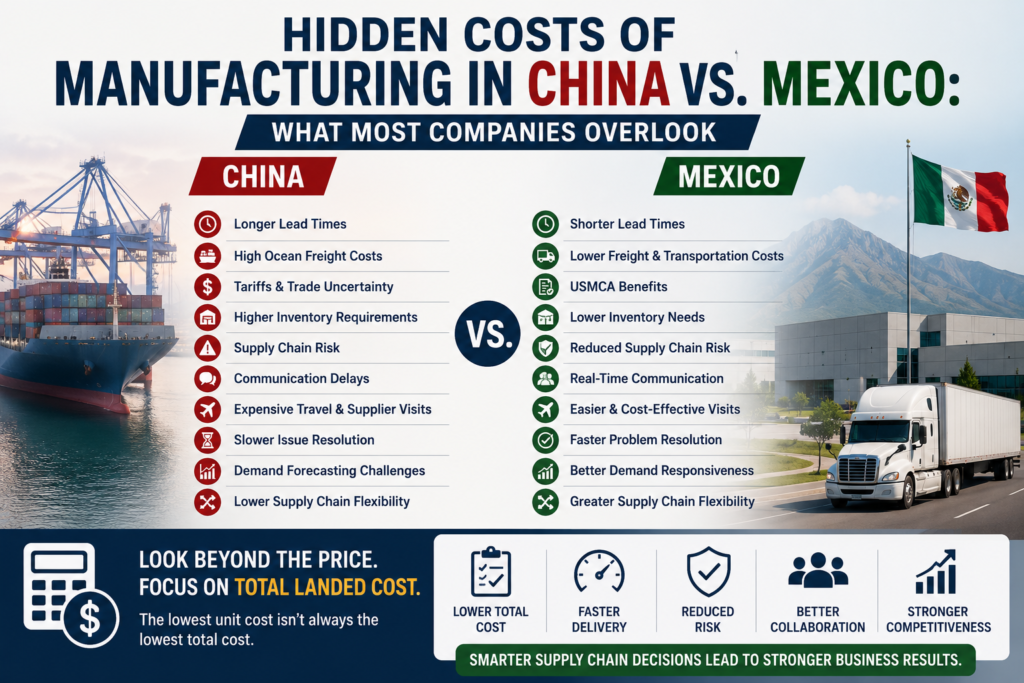
Looking Beyond the Factory Price
When manufacturers request supplier quotations, the first number they compare is usually the cost per unit.
While important, this number doesn’t capture the full financial impact of manufacturing overseas.
A lower production cost can easily be offset by:
- Higher freight expenses
- Import duties and tariffs
- Longer lead times
- Larger inventory requirements
- Supply chain disruptions
- Quality-related costs
- Increased travel expenses
- Slower response to customer demand
These hidden costs often become apparent only after production has begun.
What Is Total Landed Cost?
Total landed cost refers to the complete expense of delivering a product from the factory to its final destination.
Rather than focusing solely on manufacturing costs, total landed cost includes every expense associated with production and delivery.
Typical components include:
- Product manufacturing
- Packaging
- Ocean or ground freight
- Customs duties
- Tariffs
- Insurance
- Warehousing
- Inventory carrying costs
- Quality inspections
- Administrative expenses
- Transportation to customers
Companies that evaluate total landed cost instead of factory pricing often gain a more accurate understanding of where true savings exist.
Hidden Cost #1: Long Transportation Lead Times
Shipping products from Asia to North America requires careful planning.
Ocean freight alone can take several weeks, and additional time is needed for customs clearance, inland transportation, and warehouse processing.
Longer lead times create several challenges:
- Higher inventory levels
- Reduced flexibility
- Forecasting errors
- Slower response to customer demand
By comparison, Mexico nearshoring allows many manufacturers to transport goods by truck directly into the United States within days rather than weeks.
Shorter transportation times often reduce inventory requirements while improving customer service.
Hidden Cost #2: Inventory Carrying Costs
Many companies underestimate the cost of holding inventory.
Long international supply chains often require businesses to purchase larger quantities to account for extended shipping times.
Additional inventory increases:
- Warehouse space
- Insurance
- Capital tied up in stock
- Product obsolescence
- Inventory management expenses
Reducing inventory isn’t just about freeing warehouse space, it also improves cash flow.
Manufacturing closer to customers allows companies to replenish inventory more frequently with smaller production runs.
Hidden Cost #3: Tariffs and Trade Policies
Trade regulations can change quickly.
Over the past several years, tariffs have significantly affected the economics of manufacturing in certain regions.
Companies comparing manufacturing in Mexico vs China should evaluate:
- Existing tariffs
- Potential future policy changes
- Rules of origin
- Trade agreement eligibility
Mexico benefits from the United States-Mexico-Canada Agreement (USMCA), which provides advantages for qualifying products manufactured within North America.
Understanding these regulations is essential when calculating long-term manufacturing costs.
Hidden Cost #4: Supply Chain Risk
One of the biggest lessons manufacturers have learned recently is that resilient supply chains often outperform the lowest-cost supply chains.
A longer global supply chain naturally introduces more potential points of disruption.
Examples include:
- Port congestion
- Shipping delays
- Container shortages
- Political uncertainty
- Natural disasters
- Supplier interruptions
Reducing supply chain risk has become a strategic objective rather than simply an operational concern.
Many organizations now view supplier diversification and regional manufacturing as investments in business continuity.
Hidden Cost #5: Quality Problems That Take Longer to Resolve
Quality issues occur in every manufacturing environment.
The difference lies in how quickly they can be identified and corrected.
When production takes place thousands of miles away:
- Site visits require international travel.
- Corrective actions may take weeks.
- Replacement shipments extend delivery timelines.
- Engineering collaboration becomes more difficult.
Closer manufacturing locations often allow teams to work directly with suppliers to solve problems before they affect customers.
Hidden Cost #6: Communication Delays
Manufacturing projects depend on fast communication.
Engineering changes, production updates, tooling modifications, and quality discussions often require rapid decision-making.
Large time-zone differences can slow progress.
Simple questions sometimes take an entire business day to resolve.
Working within similar business hours often allows teams to:
- Approve changes faster
- Reduce project delays
- Improve engineering collaboration
- Accelerate product launches
Hidden Cost #7: Rising Freight Costs
Transportation expenses have become much more volatile than they were a decade ago.
Ocean freight costs can fluctuate based on:
- Fuel prices
- Port capacity
- Global demand
- Shipping availability
Ground transportation from Mexico generally offers greater flexibility for companies serving North American customers.
Although freight costs vary by product and destination, shorter transportation routes often improve cost predictability.
Hidden Cost #8: Travel and Supplier Management
Successful supplier relationships require regular engagement.
This often includes:
- Factory audits
- Supplier development
- Quality reviews
- Engineering meetings
- Production approvals
International travel increases:
- Airfare
- Hotel costs
- Travel time
- Employee downtime
Manufacturing in nearby regions makes supplier visits easier and more frequent.
That visibility often improves supplier performance over time.
Hidden Cost #9: Demand Forecasting Errors
Long lead times force companies to forecast demand months in advance.
Forecasting becomes increasingly difficult when markets change rapidly.
Forecast errors can result in:
- Excess inventory
- Stock shortages
- Emergency production
- Premium freight costs
Nearer production locations provide greater flexibility to adjust manufacturing schedules as customer demand changes.
Hidden Cost #10: Limited Supply Chain Agility
Today’s markets change quickly.
Customers expect shorter lead times and faster product updates.
Manufacturers with flexible supply chains can respond more effectively.
A regional manufacturing strategy often makes it easier to:
- Launch new products
- Modify designs
- Increase production
- Reduce production
- Introduce engineering changes
Greater agility has become a competitive advantage rather than simply an operational benefit.
Manufacturing in Mexico vs China: Looking Beyond Labor Costs
Labor cost comparisons receive significant attention, but they rarely tell the whole story.
When evaluating Mexico vs China manufacturing costs, companies should compare:
| Cost Factor | China | Mexico |
| Labor Cost | Often competitive depending on industry | Competitive, especially for export manufacturing |
| Freight Distance | Long ocean transit | Short truck transportation to North America |
| Lead Times | Longer | Significantly shorter |
| Inventory Requirements | Higher | Lower |
| Customer Response | Slower | Faster |
| Supply Chain Flexibility | Moderate | High for North American markets |
| Factory Visits | More expensive | Easier and more frequent |
| USMCA Benefits | No | Yes, for qualifying products |
Rather than asking which country is cheaper, manufacturers should ask which location creates the lowest total cost over the life of the product.
Practical Example
Imagine a U.S. manufacturer sourcing a consumer product.
A supplier in China offers a lower unit price.
Initially, the decision appears straightforward.
However, once the company includes:
- Ocean freight
- Import duties
- Larger inventory requirements
- Warehouse costs
- Engineering travel
- Production delays
- Safety stock
- Longer cash conversion cycles
…the apparent savings become much smaller.
A supplier in Mexico may have a slightly higher production cost but lower transportation expenses, shorter lead times, and reduced inventory carrying costs.
The better option depends on the company’s priorities, products, and supply chain strategy, not simply the lowest quotation.
Common Mistakes to Avoid
Companies evaluating manufacturing locations often make avoidable mistakes.
Watch out for these common pitfalls:
Comparing Only Unit Price
Always calculate total landed cost before making decisions.
Ignoring Supply Chain Risk
Operational resilience has financial value.
Underestimating Inventory Costs
Inventory ties up cash and increases operating expenses.
Choosing Suppliers Without Site Visits
Factory capability should always be verified.
Overlooking Customer Service
Long lead times can negatively affect customer satisfaction.
Assuming One Country Fits Every Product
Different products require different manufacturing strategies.
Frequently Asked Questions
Is manufacturing in Mexico always cheaper than China?
Not necessarily. Unit manufacturing costs vary by industry, product complexity, labor requirements, and production volume. However, many companies find that total landed cost becomes more competitive when manufacturing closer to North American markets.
What is total landed cost?
Total landed cost is the complete expense of producing and delivering a product, including manufacturing, transportation, duties, insurance, inventory, warehousing, and logistics.
Why is supply chain risk important?
Supply chain disruptions can delay production, increase costs, reduce customer satisfaction, and impact revenue. Diversifying suppliers and shortening supply chains can improve business continuity.
Why are companies choosing Mexico for nearshoring?
Many manufacturers are attracted by shorter lead times, easier collaboration, USMCA advantages, improved logistics, and greater flexibility when serving North American customers.
Key Takeaways
Choosing between manufacturing in Mexico vs China requires a broader perspective than comparing labor rates or factory quotes. The real financial impact comes from understanding every cost associated with producing and delivering your products.
Remember these key points:
- Total landed cost provides a more accurate picture than unit price alone.
- Long transportation routes often increase inventory, freight, and warehousing expenses.
- Tariffs, trade policies, and customs requirements can significantly affect long-term manufacturing costs.
- Shorter supply chains reduce supply chain risk and improve responsiveness.
- Nearshoring can improve collaboration, quality management, and production flexibility.
- Manufacturing location decisions should align with your products, customers, and long-term business strategy, not simply the lowest initial quote.
Final Thoughts
Manufacturing decisions have never been solely about labor costs, and today’s global environment makes that even more apparent. Companies that evaluate transportation, inventory, supplier responsiveness, trade policies, and operational resilience often discover opportunities that aren’t visible in a simple price comparison.
Whether your organization is exploring a complete relocation or a dual-sourcing strategy, the goal should be to build a supply chain that supports growth, minimizes disruption, and delivers consistent value to customers.
At Southward Advisors, we work with manufacturers to evaluate sourcing strategies, assess suppliers, optimize production processes, and develop practical nearshoring plans tailored to their operational goals. By looking beyond factory pricing and focusing on total business impact, manufacturers can make more informed decisions that strengthen both profitability and long-term supply chain performance.