
How Much Does It Cost to Move Manufacturing to Mexico? A Complete Cost Breakdown
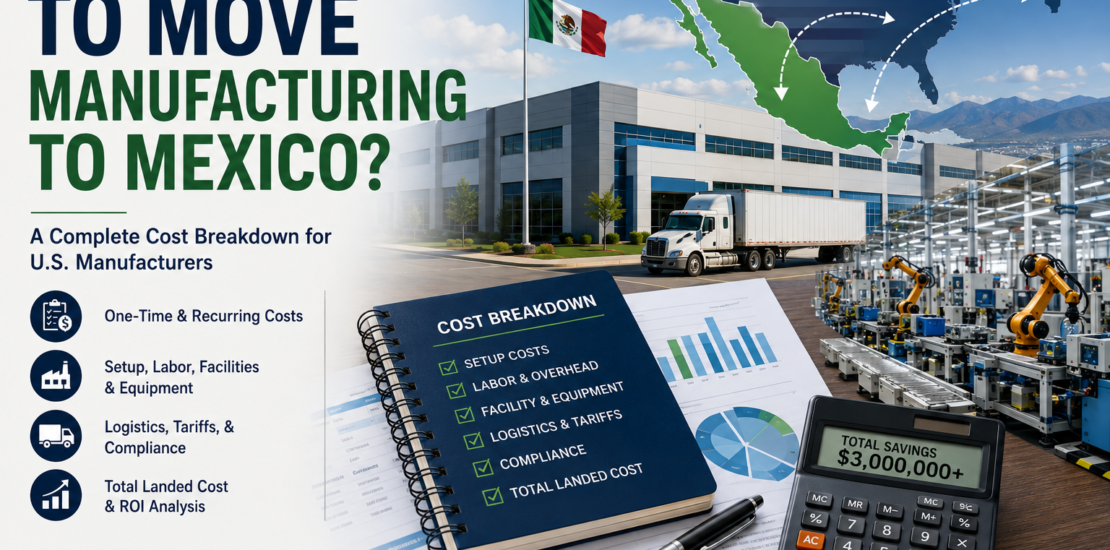
How much does it cost to move manufacturing to Mexico? There is no single answer. A small company shifting production to a Mexican supplier may spend tens of thousands of dollars on qualification, tooling, samples, travel, and transition. A manufacturer establishing its own facility can require an investment of $1 million to several million dollars, or considerably more depending on the facility, equipment, automation, production volume, and industry.
The important point is that the cost to move manufacturing to Mexico is not the same as the cost of manufacturing in Mexico.
A realistic analysis should include the entire transition and operating model: supplier development, facility costs, labor, equipment, materials, logistics, customs, compliance, inventory, quality, management, and working capital. The economics also depend heavily on labor intensity, production volume, product complexity, location, automation, supplier availability, and the existing supply chain.
What Does It Really Cost to Move Manufacturing to Mexico?
For planning purposes, manufacturers can think about the opportunity in four broad scenarios:
| Manufacturing model | Illustrative transition/setup investment* |
| Supplier-based manufacturing | ~$25,000–$150,000+ |
| Contract manufacturing / larger supplier program | ~$100,000–$500,000+ |
| Dedicated Mexican production facility | ~$1 million–$5 million+ |
| Large or highly automated operation | ~$5 million–$25 million+ |
***These are illustrative planning ranges, not quotes or universal market benchmarks. Actual costs can be substantially different depending on the operation.
A supplier-based model generally has the lowest upfront investment because the Mexican supplier already owns the facility, equipment, workforce, and operating infrastructure.
Building your own plant is completely different. You may need to lease or purchase industrial space, complete a factory build-out, install utilities, purchase machinery, hire employees, establish quality systems, develop suppliers, and fund inventory before the facility generates revenue.
The best approach is therefore to calculate Mexico’s total landed cost and total cost of ownership, rather than focusing only on wages.
What Are the Biggest Costs of Moving Manufacturing to Mexico?
A Mexico nearshoring project normally has two types of expenses:
One-time or transition costs
These can include:
- Feasibility studies and market research
- Supplier identification and RFQs
- Factory audits and site visits
- Supplier qualification
- Legal and regulatory setup
- Site selection
- Factory design and build-out
- Equipment purchases
- Tooling and molds
- Equipment installation
- Pilot production
- Product and quality validation
- Employee recruitment and training
- IT implementation
- Engineering support
- Travel and relocation
- Consulting and implementation
- Initial inventory
- Contingency reserves
Recurring operating costs
These can include:
- Labor and employee benefits
- Facility rent
- Utilities
- Raw materials
- Imported components
- Maintenance
- Quality control
- Logistics
- Cross-border transportation
- Customs and brokerage
- Compliance
- Inventory carrying costs
- Management
- IT and communications
- Supplier development
- Insurance
- Ongoing process improvement
This distinction matters because a project can look inexpensive when only the recurring manufacturing cost is considered while the transition investment is ignored.
1. Feasibility and Planning Costs
Before selecting a supplier or factory, companies should determine whether Mexico actually makes economic sense.
A feasibility study should examine:
- Current manufacturing costs
- Mexico labor requirements
- Material costs
- Freight
- Tariffs and duties
- Inventory requirements
- Supplier availability
- Production volume
- Facility requirements
- Quality requirements
- Tax and customs considerations
- Expected transition costs
Companies may also need Mexico market research, supplier mapping, competitive RFQs, engineering reviews, factory visits, and financial modeling.
This stage is relatively inexpensive compared with building a factory, but it can prevent a much more expensive mistake.
2. Supplier Identification, Qualification and Audits
Mexico sourcing is not simply a matter of finding a factory with the lowest quotation.
Companies should evaluate:
- Manufacturing capabilities
- Capacity
- Quality systems
- Financial stability
- Certifications
- Equipment
- Engineering capabilities
- Existing export experience
- Raw-material sourcing
- Lead times
- Management
- Labor practices
- Scalability
Factory audits and supplier visits create additional costs through travel, engineering time, third-party audits, samples, testing, and qualification.
For companies moving production from China, this is particularly important because the transition may require several rounds of RFQs, samples, tooling modifications, pilot production, and quality validation.
3. Facility and Factory Setup Costs
Companies establishing their own operation have substantially higher Mexico manufacturing setup costs.
Major expenses can include:
- Industrial property
- Lease deposits
- Construction
- Electrical infrastructure
- HVAC
- Compressed air
- Water systems
- Flooring
- Production areas
- Warehousing
- Offices
- Security
- Fire protection
- Loading docks
- Material-handling systems
Location can have a major impact.
For example, CBRE reported an average industrial asking rent of approximately $6.98 per square meter per month in Monterrey in Q2 2026, illustrating why facility location and local market conditions need to be incorporated into the financial model.
That does not mean every Mexican industrial market costs the same. Lease rates, labor availability, infrastructure, transportation, utilities, and supplier ecosystems vary significantly by region.
4. Equipment, Tooling and Installation
For many manufacturers, equipment represents the largest initial investment.
Costs can include:
- CNC machines
- Injection molding machines
- Presses
- Welding equipment
- Assembly equipment
- Robotics
- Testing equipment
- Packaging equipment
- Material-handling equipment
- Tooling
- Dies
- Molds
- Fixtures
- Quality-control equipment
Then there is the cost of installing and commissioning everything.
A machine that costs $500,000 does not necessarily represent a $500,000 project cost. Installation, electrical work, programming, tooling, transportation, validation, training, spare parts, and commissioning may add substantially to the initial investment.
5. Mexico Labor Costs
Labor is one reason companies investigate manufacturing in Mexico, but wage rates should never be used as a complete cost comparison.
Mexico’s 2026 minimum wage is 315.04 pesos per day in the general zone and 440.87 pesos per day in the Northern Border Free Zone. These are statutory minimums, not representative manufacturing compensation for every position.
Actual manufacturing labor costs depend on:
- Skill level
- Location
- Industry
- Shift structure
- Overtime
- Benefits
- Turnover
- Recruitment
- Training
- Supervisory requirements
- Engineering personnel
- Quality personnel
- Management
INEGI’s manufacturing remuneration data also shows significant differences between manufacturing subsectors, reinforcing why companies should model labor based on the actual workforce they need rather than a generic “Mexico labor cost.”
6. Raw Materials and Imported Components
One of the most frequently overlooked Mexico manufacturing costs is the cost of getting materials to the factory.
A Mexican operation may source:
- Entirely from Mexican suppliers.
- Primarily from the United States.
- From a combination of North American and Asian suppliers.
- From imported components that are assembled or transformed in Mexico.
The fourth model can substantially change the economics.
A company should calculate the cost of each major component, including purchase price, freight, customs, duties, brokerage, inventory, handling, and compliance.
The goal is not simply to move the factory.
The goal is to develop the lowest-risk, economically viable supply chain.
7. Logistics, Customs and Cross-Border Costs
Nearshoring changes the logistics equation, but it does not eliminate logistics costs.
A Mexico-to-U.S. supply chain can involve:
- Mexican domestic transportation
- Cross-border trucking
- Warehousing
- Customs brokerage
- Freight forwarding
- Border handling
- Insurance
- Documentation
- Duties where applicable
- Inventory buffers
For some products, proximity to the U.S. market can reduce transit time and inventory requirements compared with long-distance ocean freight.
But companies should model the complete route rather than assuming proximity automatically means lower logistics costs.
8. USMCA and IMMEX Considerations
USMCA can be an important part of the economics, but Mexican origin does not automatically mean preferential treatment.
Whether a product qualifies depends on the applicable rules of origin and other requirements. This is especially important for industries such as automotive, where rules are more complex.
USMCA is also currently undergoing its joint review process. In 2026, U.S. and Mexican officials have been discussing rules of origin, automotive requirements, steel and aluminum, and other issues.
Therefore, tariff and USMCA assumptions should be verified immediately before publication of a business case and before making major investment decisions.
What is IMMEX?
IMMEX is Mexico’s export-manufacturing program that can allow qualifying companies to temporarily import certain goods used in manufacturing or export services while deferring applicable import taxes and, in qualifying circumstances, VAT and compensatory duties.
However, IMMEX comes with eligibility, documentation, reporting, customs, and compliance requirements. It should be evaluated with qualified Mexican legal, tax, and customs professionals rather than treated as an automatic cost-saving mechanism.
Hidden Costs of Moving Manufacturing to Mexico
Some of the biggest costs are not obvious in the initial factory quote.
Potential hidden costs include:
- Supplier development
- Scrap during ramp-up
- Rework
- Product redesign
- Engineering changes
- Quality failures
- Additional inspections
- Employee training
- Travel
- Management oversight
- Inventory buffers
- Border delays
- Customs problems
- Imported components
- Infrastructure constraints
- Dual production during transition
- Temporary warehousing
- Additional tooling
- Production downtime
These costs are why companies should budget for a transition period, rather than assuming production can immediately move from one country to another.
Mexico vs. the United States: Which Is Cheaper?
Mexico can provide a compelling cost structure for certain manufacturing operations, but it is not automatically cheaper than the United States.
| Cost factor | Mexico | United States |
| Labor | Often favorable for labor-intensive operations | Generally higher |
| Facility | Varies significantly by market | Often higher in major industrial markets |
| Utilities | Highly location-dependent | Highly location-dependent |
| Equipment | Similar global equipment markets | Similar |
| Materials | Depends on supplier network | Strong domestic supplier base in many industries |
| Logistics to U.S. | Favorable for many products | Very favorable domestically |
| Inventory | Potentially lower due to proximity | Potentially low |
| Management | May require additional local oversight | Existing infrastructure may simplify management |
| Compliance | Requires Mexico-specific systems | Existing U.S. systems may be simpler for U.S. operations |
| Transition cost | Can be significant | Often lower if production already exists |
| Total landed cost | Product-specific | Product-specific |
The key question is not:
“Are wages lower in Mexico?”
It is:
“Can Mexico produce and deliver this product at a lower risk-adjusted total landed cost?”
Mexico vs. China Manufacturing Costs
The same principle applies when comparing Mexico and China.
China may still offer advantages for certain products, supplier ecosystems, materials, and production volumes. Mexico may be more attractive when proximity to the U.S. market, shorter transportation routes, inventory, trade considerations, supplier development, or supply-chain resilience materially affect the economics.
A proper Mexico vs. China manufacturing costs analysis should include:
- Factory price
- Ocean freight
- Trucking
- Customs
- Tariffs
- Lead time
- Inventory
- Working capital
- Quality
- Supplier development
- Travel
- Engineering support
- Communication
- Time-zone differences
- Risk
- Transition costs
Southward Advisors has documented examples where the economics were driven by more than factory pricing. One cabinet manufacturer moving sourcing from China to Mexico saved more than $200,000 in tariffs and reduced the amount of inventory it needed to hold because of shorter lead times.
In another case, a Southeast U.S. manufacturer integrated production of plastic parts and bags and procurement of chemicals into Mexico and reported savings approaching $1 million annually in tariffs alone.
These are individual case results, not guarantees of what another manufacturer will save.
When Does Manufacturing in Mexico Make Financial Sense?
Mexico can be particularly worth evaluating when a company has:
- Labor-intensive production
- Significant U.S. sales
- High transportation costs from Asia
- Long Asian lead times
- Meaningful inventory requirements
- Tariff exposure
- A need for greater supply-chain resilience
- Products suitable for Mexican supplier capabilities
- Sufficient production volume to justify transition costs
Industries that may benefit include automotive, electronics, furniture, appliances, industrial products, plastics, metal fabrication, consumer products, and assembly operations.
But industry alone does not determine suitability.
When Might Mexico NOT Make Sense?
Mexico may not provide the expected financial advantage when:
- Production is highly automated
- Labor represents a very small percentage of cost
- Production volume is extremely low
- Specialized materials are difficult to source locally
- The product depends heavily on imported components
- Products are extremely heavy or difficult to transport
- An existing U.S. plant is already highly optimized
- Transition costs outweigh projected savings
In these situations, keeping production in the United States, or evaluating another country, may be the better decision.
How to Calculate the ROI of Moving Manufacturing to Mexico
A simple starting formula is:
Current Total Landed Cost − Mexico Total Landed Cost = Potential Annual Savings
Then:
Payback Period = Total Transition Investment ÷ Annual Savings
Example
Suppose a manufacturer currently spends $10 million annually on the total landed cost of a product.
Its modeled Mexico operation would cost $8.8 million annually.
Potential annual savings:
$10M − $8.8M = $1.2M
If the transition requires $2.4 million in one-time investment:
$2.4M ÷ $1.2M = 2-year payback
This is only an illustration. The calculation should also include ramp-up losses, working capital, depreciation, financing, taxes, quality costs, and other company-specific assumptions.
What Is the Cheapest Way to Manufacture in Mexico?
For many companies, the cheapest way to test Mexico is not to build a factory immediately.
A supplier-based or contract manufacturing model can reduce upfront capital requirements because an existing Mexican manufacturer provides the facility, equipment, labor, and operating infrastructure.
That can allow a company to validate:
- Product economics
- Supplier performance
- Quality
- Lead times
- Customer demand
- Logistics
- Production volumes
before committing to a dedicated facility.
The right model depends on the company’s scale and strategic objectives.
How Long Does It Take to Move Manufacturing to Mexico?
There is no universal timeline.
A straightforward supplier transition can be considerably faster than establishing a new plant, particularly when the Mexican supplier already has the required equipment and production capabilities.
A new facility can require substantially more time for:
Feasibility → supplier/site selection → legal setup → facility preparation → equipment installation → hiring → pilot production → validation → ramp-up
Companies should therefore plan around the complete transition rather than a single “factory opening” date.
What Should Companies Include in a Mexico Nearshoring Cost Analysis?
At minimum, calculate:
- Current manufacturing cost
- Mexico manufacturing cost
- Labor
- Facility
- Equipment
- Tooling
- Materials
- Supplier costs
- Freight
- Customs
- Duties and tariffs
- Inventory
- Working capital
- Quality
- Compliance
- Management
- Technology
- Training
- Travel
- Transition costs
- Dual operations
- Contingency
- Consulting and implementation
This comprehensive approach reflects the full cost categories that should be evaluated before moving production.
The Bottom Line: Is Moving Manufacturing to Mexico Worth the Cost?
The answer depends on the product and the supply chain, not simply the country’s labor rates.
For the right operation, Mexico can improve the economics of manufacturing by combining competitive labor, proximity to the U.S. market, regional supplier development, shorter supply chains, and potentially more favorable total landed costs.
For the wrong operation, the transition investment, imported components, compliance requirements, infrastructure, or low production volume can eliminate the expected savings.
The strongest business cases therefore compare total landed cost before and after nearshoring, while separately modeling the one-time investment required to make the transition.
Southward Advisors helps manufacturers evaluate the economics of moving production to Mexico, identify and qualify suppliers, develop Mexican supply chains, select sites, improve manufacturing processes, and manage implementation. The objective is not simply to move production south, it is to build a supply chain that makes financial and operational sense.
If your company is considering moving manufacturing to Mexico, the first step is a detailed cost and feasibility analysis based on your actual products, volumes, suppliers, labor requirements, logistics, and current landed costs.