
How to Build a Mexico Supplier Network That Can Scale With Your Business
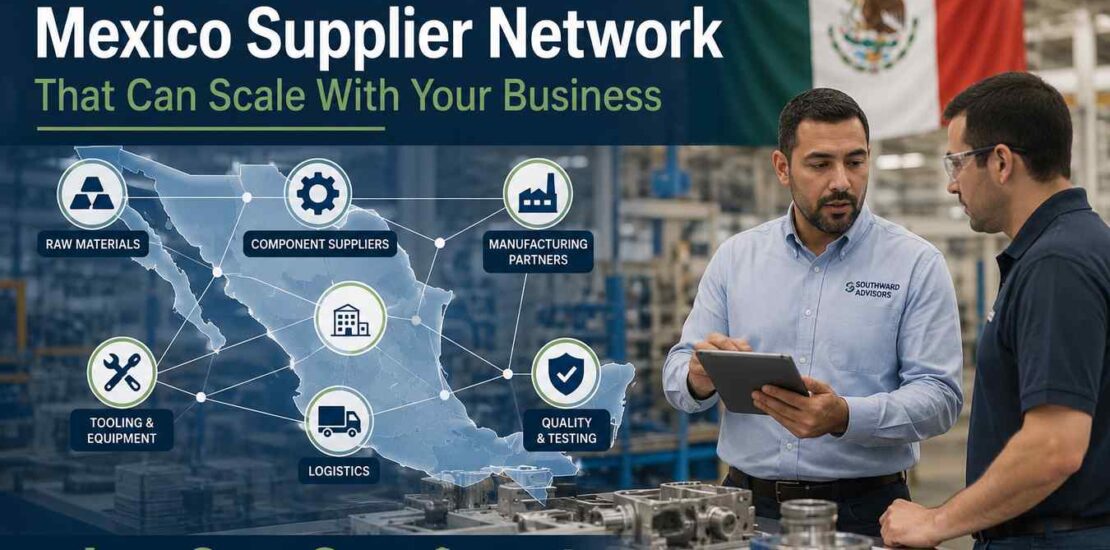
Building a manufacturing presence in Mexico is not simply a matter of finding a factory that can make your product.
A supplier may quote an attractive price, produce good samples, and still become a problem when your order volume doubles, a raw-material supplier misses a shipment, quality requirements become stricter, or a major customer suddenly accelerates demand.
That is why successful nearshoring strategies focus on building a Mexico supplier network, not just selecting individual suppliers.
A strong supplier network connects Tier 1 manufacturers with component suppliers, raw-material sources, tooling companies, logistics providers, packaging suppliers, testing resources, and other supporting partners. The objective is to create a supply ecosystem that can support today’s production while giving the business options for tomorrow.
Mexico has substantial manufacturing depth across automotive, aerospace, electronics, medical devices, appliances, industrial products and other sectors. The U.S. Commercial Service identifies distinct manufacturing strengths across regions such as the northern states, the Bajío, and Jalisco.
But the right question is not:
“How many Mexican suppliers can we find?”
It is:
“What supplier network gives our business the right combination of quality, capacity, cost, delivery, flexibility and resilience?”
What Is a Mexico Supplier Network?
A Mexico supplier network is the connected group of companies that provides the materials, components, manufacturing processes and services required to produce and deliver a product.
It can include:
- Tier 1 suppliers
- Tier 2 and Tier 3 suppliers
- Raw-material suppliers
- Component manufacturers
- Contract manufacturers
- Injection molders
- Metal fabricators
- Machining companies
- Tooling suppliers
- Packaging suppliers
- Logistics providers
- Testing and inspection companies
- Maintenance providers
- Warehousing providers
Consider a company manufacturing an industrial enclosure in Mexico.
The final supplier might fabricate and assemble the enclosure, but its production could depend on steel, fasteners, powder coating, fabricated components, packaging and transportation providers.
If one critical upstream supplier has no backup source, the apparent Tier 1 supplier network may be much less resilient than it looks.
Southward Advisors makes a similar distinction in its discussion of Mexican vertical supply-chain integration: complex bills of material often require coordination between OEMs, Tier 1 suppliers, Tier 2 suppliers and raw-material sources rather than expecting one factory to manage the entire ecosystem.
Why Supplier Network Design Matters for Mexico Manufacturing
Mexico can offer U.S. manufacturers geographic proximity, established industrial clusters, access to manufacturing capabilities and North American supply-chain integration. U.S.-Mexico goods trade alone reached an estimated $871.6 billion in 2025.
USMCA also provides the framework for preferential treatment when applicable origin requirements are satisfied. Those rules are product-specific, so companies should not assume that manufacturing in Mexico automatically means USMCA preferential treatment.
The practical benefits of a Mexico supply chain depend on the product, location, volumes, materials, supplier ecosystem, logistics model and trade requirements.
The key is therefore network design.
A well-designed network balances:
- Cost
- Quality
- Capacity
- Delivery
- Technical capability
- Financial stability
- Geographic concentration
- Supplier dependency
- Logistics
- Compliance
- Flexibility
- Long-term growth
Having 20 suppliers can actually create more problems than having five if those 20 suppliers are poorly qualified, difficult to manage and strategically redundant.
Step 1: Define Your Manufacturing and Sourcing Requirements
Start with the product, not the supplier directory.
Before finding Mexico manufacturing suppliers, document:
- Bill of materials
- Annual volume
- Monthly demand
- Forecast variability
- Product specifications
- Required tolerances
- Materials
- Manufacturing processes
- Certifications
- Packaging requirements
- Quality standards
- Target lead times
- Delivery locations
- Engineering requirements
- Tooling requirements
- Expected growth
Also develop a realistic three-year demand scenario.
A supplier capable of producing 50,000 units today may not be capable of producing 150,000 units next year.
Your Mexico sourcing strategy needs to account for both.
Step 2: Map Your Supply Chain
Create a complete supply-chain map before sourcing suppliers in Mexico.
Map:
Raw materials → components → subassemblies → final manufacturing → packaging → logistics → customer
Then add supporting requirements:
- Tooling
- Maintenance
- Testing
- Quality services
- Warehousing
- Customs
- Transportation
Identify:
- Single-source components
- Long-lead-time materials
- Imported inputs
- Bottleneck processes
- Critical suppliers
- Capacity constraints
- High-cost components
- Components with limited Mexican availability
This exercise frequently reveals that the biggest supply-chain risk is not the final manufacturer.
It may be a specialized material or Tier 2 component buried several levels upstream.
Step 3: Identify Critical Suppliers and Components
Not every component deserves the same sourcing strategy.
A practical segmentation is:
Strategic Suppliers
High business impact and high supply risk.
These suppliers require executive attention, long-term planning and close relationship management.
Critical Suppliers
Production depends heavily on them, even if alternatives exist.
Preferred Suppliers
Strong quality, cost and delivery performance.
Approved Suppliers
Qualified suppliers that can be used when appropriate.
Backup Suppliers
Alternative sources for important components or processes.
Development Suppliers
Potential suppliers that require capability, quality or process improvements before becoming preferred sources.
The objective is not to eliminate single sourcing at all costs.
Some specialized suppliers are worth maintaining as strategic single sources because of tooling investment, proprietary technology, certification requirements or economics.
Step 4: Find Potential Mexican Suppliers
Finding suppliers in Mexico can involve several channels:
- Industry associations
- Manufacturing clusters
- Trade shows
- Industry referrals
- Existing supplier relationships
- U.S.-Mexico business organizations
- Direct outreach
- Trade organizations
- Local sourcing specialists
- Government and commercial resources
The U.S. Commercial Service, for example, maintains Mexico market resources and offices in locations including Mexico City, Guadalajara and Monterrey.
Manufacturing trade events can also provide concentrated access to suppliers. Expo Manufactura 2026, for example, brings together companies across metalworking, automotive, medical-device and aerospace manufacturing.
But remember:
A supplier longlist is not a qualified supplier list.
A database can tell you that a company exists.
It cannot tell you whether that company can consistently meet your tolerance, volume, quality and delivery requirements.
Step 5: Qualify Mexican Suppliers
Mexico supplier qualification should evaluate much more than price.
Capability
Assess:
- Manufacturing processes
- Engineering resources
- Equipment
- Technology
- Product experience
- Technical expertise
Capacity
Assess:
- Current production
- Utilization
- Available shifts
- Equipment availability
- Workforce
- Expansion plans
Quality
Review:
- Quality-management systems
- Certifications
- Defect rates
- Inspection
- Testing
- Traceability
- Corrective-action processes
Commercial
Evaluate:
- Pricing
- Payment terms
- Minimum order quantities
- Tooling
- Lead times
- Cost structure
Supply Chain
Understand:
- Raw-material sources
- Tier 2 suppliers
- Imported components
- Backup sources
- Inventory policies
Business Stability
Consider:
- Management
- Years in operation
- Customer concentration
- Workforce stability
- Financial condition
- Investment plans
Logistics
Evaluate:
- Geographic location
- Border access
- Transportation
- Warehousing
- Cross-border experience
Compliance
Depending on the product and operation, review:
- Industry requirements
- Labor compliance
- Environmental requirements
- Safety
- Customs
- Trade compliance
For export-oriented operations, programs such as IMMEX can also be relevant. Mexico’s Secretariat of Economy describes IMMEX as a framework allowing qualifying companies to temporarily import certain merchandise for export-oriented manufacturing or services, subject to program requirements.
Step 6: Conduct Factory Audits
A supplier audit turns claims into evidence.
Inspect:
Facility
- Plant condition
- Organization
- Production flow
- Safety
- Infrastructure
Equipment
- Equipment condition
- Maintenance
- Calibration
- Capacity
- Redundancy
Production
- Cycle time
- Bottlenecks
- Workforce
- Process controls
- Production planning
Quality
- QMS
- Incoming inspection
- In-process inspection
- Final inspection
- CAPA
- Traceability
- Scrap
- Rework
Supply Chain
- Raw-material inventory
- Supplier controls
- Backup suppliers
- Material traceability
Logistics
- Warehouse
- Packaging
- Finished-goods handling
- Shipping process
A factory audit is one component of qualification, not the entire qualification process.
Southward Advisors specifically describes supplier discovery and qualification as including technical capability, capacity, quality systems, financial stability, scalability and geographic alignment, combined with on-the-ground validation.
Step 7: Verify Supplier Capacity
One of the most common mistakes in finding Mexico nearshoring suppliers is confusing current capacity with scalable capacity.
Ask a supplier:
“How much could you produce if our demand increased by 50%?”
Then test the answer.
Look at:
- Current utilization
- Available shifts
- Machine utilization
- Bottleneck equipment
- Labor availability
- Facility space
- Equipment lead times
- Expansion plans
- Capital requirements
- Upstream supplier capacity
A supplier operating at 90% utilization may have very little practical capacity remaining, even if management describes the facility as “expandable.”
Realistic scalable capacity means the supplier can increase output within a defined period without creating unacceptable quality, labor, equipment or delivery problems.
Step 8: Build Supplier Diversification and Backup Sources
Supplier diversification is not simply duplicating every supplier.
Use a risk-based approach.
For a commodity component with many qualified sources, dual sourcing may be easy to justify.
For a highly engineered component requiring specialized tooling, qualification testing and certification, maintaining two sources may cost more than the resilience benefit is worth.
Consider:
Single sourcing
Best when specialization or economics strongly favor one supplier.
Dual sourcing
Useful for strategically important components where continuity matters.
Multi-sourcing
Useful where several qualified suppliers can compete economically.
Geographic diversification
Useful when multiple suppliers are exposed to the same regional risk.
The decision should consider qualification cost, tooling, management complexity, volume fragmentation and quality risk—not just the theoretical benefit of having a second supplier.
Step 9: Develop Your Mexican Suppliers
Supplier selection asks:
“Can this company meet our requirements?”
Supplier development asks:
“Can we help this supplier become better?”
Promising Mexican suppliers may require support with:
- Process improvement
- Lean manufacturing
- Standard work
- Quality systems
- Production planning
- Inventory management
- Capacity planning
- Corrective actions
- Training
- Engineering
- Documentation
This is especially important when the supplier has strong technical capability but lacks some of the systems expected by a larger U.S. OEM.
Southward Advisors’ process-improvement offering includes supplier audits, capability assessments, process standardization, quality alignment and KPI development.
Step 10: Build Local Sourcing Capability
Local sourcing can reduce exposure to long inbound supply chains, but “local” should never become the objective by itself.
Evaluate Mexican sources for:
- Raw materials
- Components
- Packaging
- Tooling
- Maintenance
- Industrial services
Potential advantages include shorter replenishment cycles, reduced logistics exposure and greater supplier responsiveness.
But some materials or components may still be more competitive or technically appropriate when sourced from the United States, Canada, Asia or elsewhere.
Southward Advisors notes that complex Mexican supply chains can still require coordination with suppliers outside Mexico when particular components are not locally available.
Step 11: Manage Tier-2 and Tier-3 Supplier Risk
Your Tier 1 supplier may look excellent while depending on one fragile upstream source.
You do not necessarily need complete visibility into every supplier tier.
Prioritize deeper visibility for:
- Critical materials
- Specialized components
- Long-lead-time items
- Sole-source inputs
- Imported inputs
- High-value components
- Processes with limited alternatives
Ask Tier 1 suppliers where their most important materials originate and what happens if those sources become unavailable.
That level of visibility is often enough to uncover major risks without creating an impossible supplier-management workload.
Step 12: Establish Supplier KPIs
A scalable Mexico manufacturing supply chain requires measurable performance.
Core KPIs can include:
- OTIF delivery
- Defect rate
- PPM
- First-pass yield
- Scrap
- Rework
- Lead time
- Response time
- Corrective-action closure
- Capacity utilization
- Inventory accuracy
- Forecast adherence
Southward Advisors’ current supply-chain and process-improvement programs specifically reference KPIs such as lead time, OTIF, quality, throughput, first-pass yield, OEE, scrap and rework.
Do not give every KPI equal weight.
A supplier producing a highly engineered safety-critical component may need quality weighted more heavily than purchase price.
How to Manage Supplier Risk in Mexico
A useful risk model combines probability × business impact.
Low Risk
- Multiple qualified sources
- Stable supplier
- Strong quality
- Available capacity
- Reliable logistics
Medium Risk
- Some supplier concentration
- Limited backup capacity
- Moderate upstream dependency
- Manageable quality or logistics concerns
High Risk
- Single source
- No realistic backup
- Critical component
- High utilization
- Weak quality
- Significant Tier-2 dependency
- Financial or operational instability
- Major logistics exposure
Risk should be reviewed continuously.
Supplier risk is not a one-time qualification exercise.
How to Scale Your Supplier Network as Your Business Grows
Supplier-network maturity should evolve with manufacturing complexity.
Stage 1: Initial Mexico Entry
Focus on:
- Reliable suppliers
- Quality validation
- Logistics
- Pilot production
- Basic performance measurement
Stage 2: Production Growth
Focus on:
- Capacity expansion
- Backup sources
- Supplier development
- Local sourcing
- Better forecasting
Stage 3: Scale
Focus on:
- Strategic supplier relationships
- Long-term agreements
- Deeper Tier-2 visibility
- Automation
- Supplier investment
- Continuous improvement
Stage 4: Mature Mexico Supply Chain
Focus on:
- Cost optimization
- Innovation
- Resilience
- Supplier productivity
- Advanced planning
- Network redesign
The network should become more sophisticated as the business becomes more dependent on Mexico.
15 Common Supplier Network Mistakes
- Choosing suppliers based only on price
- Skipping factory audits
- Failing to verify capacity
- Depending on too few suppliers
- Maintaining too many suppliers without strategic justification
- Ignoring Tier-2 suppliers
- Failing to develop backup sources
- Keeping poor supplier documentation
- Using weak quality KPIs
- Ignoring logistics
- Underestimating supplier development
- Selecting suppliers without considering facility location
- Failing to plan for growth
- Overlooking workforce constraints
- Treating supplier selection as a one-time event
The last mistake is particularly costly.
A supplier that was ideal at 20,000 units may not be ideal at 200,000.
20 Supplier Red Flags
Not every red flag automatically disqualifies a supplier. Context matters.
Minor Concern
- Some documentation gaps
- Limited KPI history
- Basic facility organization issues
- Small process inconsistencies
- Limited formal supplier-development systems
Major Concern
- Unclear capacity
- Repeated delivery problems
- High turnover
- Weak traceability
- High scrap or rework
- Poor corrective-action discipline
- Excessive subcontracting
- Significant upstream dependency
- Outdated equipment
Critical Risk
- Resistance to audits
- Inconsistent information
- Unverifiable production claims
- Serious quality failures
- No credible capacity expansion plan
- Heavy dependence on one upstream supplier
- Severe financial or operational instability
- No continuity plan for critical operations
Mexico Supplier Network Scorecard
An illustrative scorecard might use:
| Category | Example Weight |
| Quality | 25% |
| Capacity | 20% |
| Cost | 15% |
| Delivery | 15% |
| Technical Capability | 10% |
| Business Stability | 5% |
| Supply Chain | 5% |
| Compliance | 5% |
| Total | 100% |
These percentages are examples, not universal standards.
An aerospace supplier, medical-device supplier and consumer-products supplier should not necessarily use the same weighting.
Combine the score with the supplier’s risk rating.
A supplier scoring 91/100 but classified as high-risk because it is the only source of a critical component deserves different management from a supplier scoring 88/100 with three qualified alternatives.
Mexico Supplier Network Checklist
Network Design
- Product requirements defined
- Supply-chain map completed
- Critical components identified
- Supplier risk assessed
Supplier Sourcing
- Supplier longlist created
- Suppliers screened
- RFQs issued
- References checked
Qualification
- Factory audited
- Capacity verified
- Quality reviewed
- Samples approved
- Production capability validated
Network Resilience
- Critical suppliers identified
- Backup suppliers evaluated
- Single-source risks documented
- Tier-2 risks reviewed
Supplier Development
- KPIs established
- Improvement plans created
- Corrective actions tracked
Scaling
- Capacity expansion plans reviewed
- Future demand forecast shared
- Supplier investment requirements identified
- Long-term sourcing strategy reviewed
Questions to Ask Mexican Suppliers
Not every question applies to every supplier, but the following are useful during qualification:
- What percentage of your production capacity is currently utilized?
- How quickly could you increase output?
- What are your biggest production bottlenecks?
- Which processes are performed internally?
- Which processes are subcontracted?
- Who are your key raw-material suppliers?
- Do you have backup suppliers?
- What happens if a major raw-material supplier cannot deliver?
- What is your current defect rate?
- What is your average on-time delivery rate?
- How do you handle demand spikes?
- What investments are planned over the next 12–24 months?
- How do you manage employee turnover?
- How do you handle quality problems?
- How quickly are corrective actions normally closed?
- What percentage of your materials are imported?
- How much capacity could you realistically add?
- What equipment would you need to add to support our forecast?
- How long would that equipment take to procure and install?
- What other customers use the same constrained equipment?
The objective is not simply to collect answers.
It is to compare the answers against what you see during the factory audit.
Mexico Manufacturing Clusters
There is no universally “best” manufacturing region in Mexico.
The right location depends on the product, workforce, supplier ecosystem, logistics, customer base and required manufacturing processes.
Current U.S. Commercial Service information identifies several major regional strengths:
- Nuevo León: advanced manufacturing, industrial production and electronics
- Coahuila: automotive and industrial manufacturing
- Chihuahua: aerospace and advanced manufacturing
- Baja California: medical devices, electronics and border manufacturing
- Sonora: aerospace and electronics
- Querétaro: aerospace and advanced manufacturing
- Guanajuato: automotive and broader manufacturing
- San Luis Potosí: automotive and industrial manufacturing
- Aguascalientes: automotive manufacturing
- Jalisco: electronics, semiconductors and technology-related manufacturing
The U.S. Commercial Service describes the Bajío, northern Mexico and Guadalajara as distinct advanced-manufacturing regions, while automotive supply chains are distributed across multiple states.
For aerospace, Querétaro, Chihuahua, Sonora and other regions have established capabilities, while Baja California is particularly significant for medical-device manufacturing.
The important point is to choose the ecosystem, not merely the lowest supplier quotation.
How Southward Advisors Can Help
Building a Mexico supplier network requires more than creating a list of manufacturers.
U.S. companies need a sourcing strategy that balances quality, capacity, cost, logistics, supplier risk and long-term scalability.
Southward Advisors’ current services include supplier discovery and qualification, site and facility assessment, supply-chain design, raw-material sourcing strategy, capacity planning, logistics, inventory and risk mitigation, KPI monitoring and process improvement.
The firm’s nearshoring offering also covers supplier sourcing, site selection, pilot production, process optimization and implementation support.
There are documented examples on the company’s site of supplier and supply-chain projects, including a cabinet manufacturer that shifted sourcing toward Guanajuato and reported more than $200,000 in tariff savings, as well as a Southeast U.S. manufacturer that diversified an Asian supply chain and reported approximately $1 million in annual tariff savings through Mexican supply-chain integration.
Frequently Asked Questions
How do I find suppliers in Mexico?
Start with your product requirements and supply-chain map, then use manufacturing clusters, industry associations, trade events, referrals, supplier networks and qualified local sourcing resources to build a longlist. The critical step is validating technical capability, quality, capacity, financial stability and logistics before approval.
How do I build a supplier network in Mexico?
Map your bill of materials and production requirements, classify supplier risk, identify qualified Mexican suppliers, audit facilities, validate samples, verify capacity, establish KPIs and develop backup sources for critical components.
How do I qualify a Mexican supplier?
Evaluate manufacturing capability, capacity, quality systems, financial and operational stability, logistics, supply-chain dependencies, compliance and scalability. Factory audits and sample validation should complement document reviews.
How many suppliers should a manufacturer have?
There is no universal number. The appropriate supplier count depends on component criticality, supplier concentration, qualification costs, tooling, volume, technical complexity and business-continuity requirements.
What is supplier diversification?
Supplier diversification means deliberately reducing excessive dependence on one supplier, location, process or upstream source. It can involve dual sourcing, multiple suppliers or geographic diversification.
How do you reduce supplier risk?
Identify critical dependencies, verify capacity, audit suppliers, monitor KPIs, understand important Tier-2 dependencies and establish backup sources where the business case justifies them.
What makes a supplier scalable?
A scalable supplier has available or expandable production capacity, sufficient equipment, workforce, management systems, upstream supply and capital-investment capability to support increased demand without unacceptable deterioration in quality or delivery.
How do I develop Mexican suppliers?
Supplier development can involve process improvement, quality-system strengthening, standard work, lean manufacturing, production planning, engineering support, training and corrective-action programs.
What are the best manufacturing regions in Mexico?
There is no single best region. Northern Mexico, the Bajío, Jalisco and other industrial regions have different manufacturing strengths. The best location depends on product requirements, supplier ecosystem, labor, logistics and customer geography.
How do I build a resilient Mexico supply chain?
Build resilience through risk-based supplier segmentation, realistic capacity planning, qualified alternatives for critical inputs, Tier-2 visibility where justified, strong logistics planning, supplier development and continuous performance monitoring.
A Mexico supplier network should not be measured by how many suppliers appear in a spreadsheet.
It should be measured by how well the network performs when conditions change.
Can suppliers increase output?
Can quality remain stable?
Can a critical material be replaced?
Can another supplier step in?
Can the network support a new product?
Can logistics keep pace with demand?
Can suppliers invest alongside your growth?
Those are the questions that turn Mexico sourcing into a long-term manufacturing strategy.
For U.S. manufacturers, OEMs and procurement teams, the goal is not simply to find suppliers in Mexico.
The goal is to build a scalable supplier ecosystem that can support production today and continue performing as the business becomes larger, more complex and more demanding.