
Supplier Qualification in Mexico: How to Avoid Costly Sourcing Mistakes
Expanding your manufacturing footprint into Mexico can create significant opportunities. Companies gain access to a growing industrial base, skilled labor, shorter supply chains, and the benefits of serving the North American market more efficiently. But none of those advantages matter if you choose the wrong supplier.
Many sourcing challenges don’t begin on the production floor—they start during supplier selection. A supplier may appear competitive on paper, offer attractive pricing, and promise quick turnaround times, only to struggle with quality, capacity, communication, or delivery once production begins.
That’s why supplier qualification deserves far more attention than simply comparing quotes.
Working with an experienced Mexico sourcing agent and following a structured supplier qualification process can help manufacturers reduce risk, improve product quality, and build a supply chain capable of supporting long-term growth.
This guide explains how supplier qualification in Mexico works, common sourcing mistakes companies make, and practical steps to identify reliable manufacturing partners before they become costly problems.
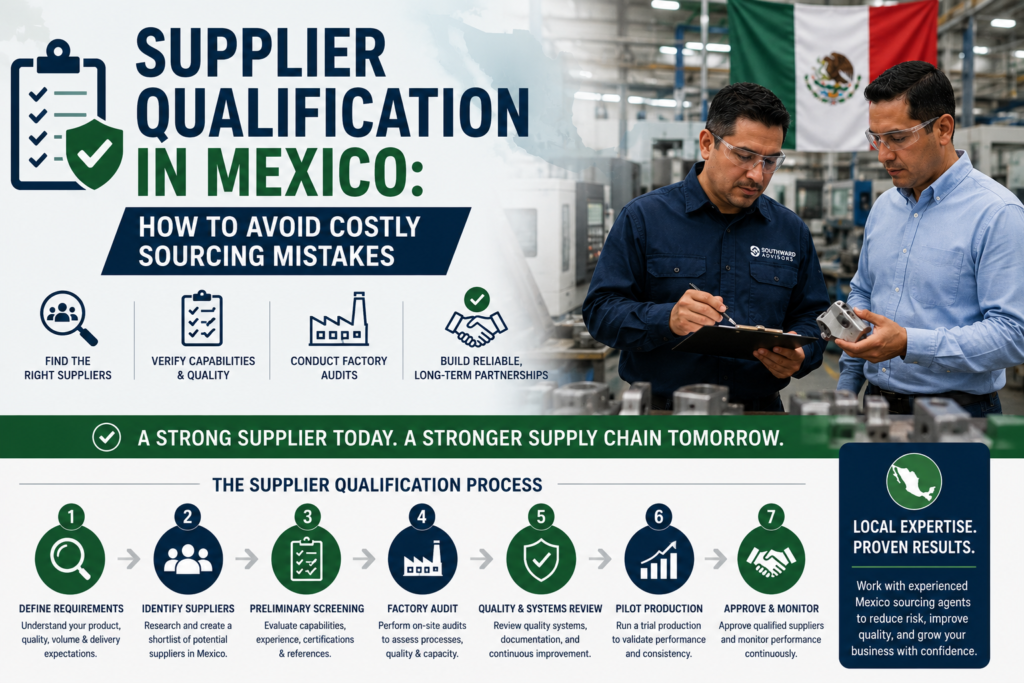
What Is Supplier Qualification?
Supplier qualification is the process of evaluating whether a manufacturer has the capabilities, systems, financial stability, and operational discipline to consistently meet your business requirements.
It goes beyond verifying whether a company can make your product.
A proper qualification process answers questions like:
- Can the supplier maintain consistent quality?
- Do they have enough production capacity?
- Are their processes documented and repeatable?
- Can they scale with future demand?
- Do they have reliable sub-suppliers?
- Are they financially stable?
- Do they communicate effectively?
The goal is simple: reduce uncertainty before production begins.
Why Supplier Qualification Matters in Mexico
Mexico has developed into one of North America’s strongest manufacturing destinations.
Its industrial clusters support industries such as:
- Automotive
- Aerospace
- Electronics
- Medical devices
- Consumer products
- Industrial equipment
However, like every manufacturing market, supplier capabilities vary widely.
Some facilities operate world-class production systems.
Others may specialize in lower-volume projects or lack the infrastructure needed for larger programs.
A structured supplier qualification Mexico process helps identify which manufacturers are the right fit for your specific requirements.
Why Price Should Never Be Your Only Decision Factor
One of the most common sourcing mistakes is selecting the lowest quotation.
Low pricing can be attractive during supplier selection, but unexpected costs often appear later through:
- Higher defect rates
- Production delays
- Missed deliveries
- Engineering changes
- Excessive scrap
- Rework
- Warranty claims
- Expedited freight
The lowest-priced supplier isn’t always the lowest-cost supplier over the life of a project.
Successful sourcing decisions balance cost, quality, delivery performance, and long-term reliability.
The Role of a Mexico Sourcing Agent
An experienced Mexico sourcing agent acts as a local partner who understands both the Mexican manufacturing environment and the expectations of international buyers.
Rather than relying solely on online research or supplier marketing materials, a sourcing agent helps companies make informed decisions through local knowledge and direct verification.
Typical responsibilities include:
- Identifying qualified manufacturers
- Conducting supplier research
- Coordinating factory visits
- Performing supplier assessments
- Supporting negotiations
- Monitoring production
- Facilitating communication
- Assisting with supplier development
This local presence often helps businesses identify issues long before they affect production.
Step 1: Clearly Define Your Requirements
Before contacting suppliers, define exactly what you need.
This includes:
Product Specifications
Provide detailed drawings, materials, tolerances, and performance requirements.
Production Volume
Estimate annual demand and future growth.
Quality Standards
Specify inspection requirements, certifications, testing procedures, and documentation.
Delivery Expectations
Determine acceptable lead times and shipping schedules.
The clearer your expectations, the easier it becomes to identify suppliers capable of meeting them.
Step 2: Build a Shortlist of Potential Suppliers
Not every manufacturer is suitable for every product.
When sourcing in Mexico, consider suppliers that have experience with:
- Similar products
- Comparable production volumes
- Your target industry
- Required manufacturing processes
Industry experience often reduces startup time and minimizes production risks.
Step 3: Perform a Supplier Capability Assessment
Before awarding business, evaluate the supplier’s overall capabilities.
Areas to review include:
Manufacturing Equipment
Is the equipment modern and properly maintained?
Production Capacity
Can the supplier support current and future demand?
Engineering Resources
Do they have experienced engineers who can support product improvements?
Workforce Skills
Is the workforce trained for your manufacturing requirements?
Facility Organization
A clean, organized factory often reflects disciplined operational practices.
Step 4: Conduct a Mexico Supplier Audit
A Mexico supplier audit provides firsthand insight into how a facility actually operates.
Rather than relying on presentations, an on-site audit allows companies to verify processes directly.
Typical audit areas include:
Quality Management
Review inspection processes, documentation, corrective actions, and traceability.
Production Flow
Observe how materials move through the facility.
Efficient workflows generally reduce waste and improve consistency.
Inventory Management
Evaluate storage practices and material control.
Maintenance Programs
Well-maintained equipment supports consistent production quality.
Safety Practices
Strong safety programs often indicate mature operational management.
Factory visits frequently reveal strengths and weaknesses that aren’t visible through email or video calls.
Step 5: Evaluate Quality Systems
Quality isn’t created during final inspection.
It is built into every manufacturing process.
Ask suppliers about:
- Incoming material inspections
- Process controls
- Statistical monitoring
- Corrective action procedures
- Employee training
- Document control
- Customer complaint handling
Suppliers with disciplined quality systems generally experience fewer production issues.
Step 6: Review Supply Chain Stability
A supplier’s performance depends heavily on its own supplier network.
Questions worth asking include:
- Where do critical materials come from?
- Are there backup suppliers?
- How are shortages managed?
- What inventory policies are used?
- How quickly can production recover after disruptions?
Understanding these relationships helps reduce downstream supply chain risk.
Step 7: Assess Communication
Communication is often underestimated during supplier selection.
Consider how suppliers respond to:
- Technical questions
- Engineering changes
- Production updates
- Delivery issues
- Corrective actions
Strong communication typically leads to faster problem resolution and better collaboration.
Step 8: Verify Financial Stability
Financial health matters.
A supplier facing financial challenges may struggle to:
- Purchase raw materials
- Invest in equipment
- Hire skilled employees
- Expand production
- Support long-term growth
While financial information isn’t always publicly available, discussing business growth, investments, and long-term planning can provide valuable insight.
Step 9: Start with a Pilot Project
Rather than immediately awarding full production, many manufacturers begin with a pilot run.
Pilot production helps evaluate:
- Product quality
- Delivery performance
- Communication
- Engineering support
- Process consistency
Small projects often reveal operational challenges before larger commitments are made.
Step 10: Continue Monitoring Supplier Performance
Qualification isn’t a one-time event.
Supplier performance should be reviewed regularly using measurable KPIs.
Common metrics include:
- On-time delivery
- First-pass yield
- Defect rate
- Customer complaints
- Corrective action response time
- Production lead time
- Cost performance
Continuous monitoring supports long-term supplier improvement.
Practical Example
Imagine a company sourcing metal components for industrial equipment.
Two suppliers submit nearly identical quotations.
Supplier A offers the lowest price.
Supplier B charges slightly more but demonstrates:
- Better process documentation
- Higher equipment utilization
- Stronger engineering resources
- Established quality procedures
- Proven experience with similar products
While Supplier A initially appears less expensive, Supplier B may ultimately reduce production delays, quality issues, and customer complaints.
That’s why supplier qualification focuses on overall business performance rather than price alone.
Common Mistakes to Avoid
Many sourcing problems can be traced back to rushed supplier selection.
Avoid these common mistakes:
Choosing Based Only on Price
Low pricing can hide operational weaknesses.
Skipping Factory Visits
Facilities should be evaluated in person whenever possible.
Ignoring Production Capacity
A supplier may perform well today but struggle as demand increases.
Overlooking Communication
Responsive suppliers often solve problems faster.
Failing to Audit Quality Systems
Strong quality management reduces long-term costs.
Assuming Every Supplier Can Scale
Growth requires planning, equipment, and workforce capacity.
Neglecting Ongoing Performance Reviews
Supplier relationships should continue evolving after production begins.
Frequently Asked Questions
What does a Mexico sourcing agent do?
A Mexico sourcing agent helps identify qualified manufacturers, perform supplier evaluations, coordinate factory visits, negotiate with suppliers, and monitor production to reduce sourcing risks.
Why is supplier qualification important?
Supplier qualification helps manufacturers verify quality systems, production capacity, financial stability, and operational capabilities before awarding business.
What happens during a Mexico supplier audit?
A supplier audit typically reviews production processes, quality systems, facility organization, maintenance, inventory management, workforce capabilities, and operational performance.
How long does supplier qualification take?
The timeline depends on project complexity, but qualification generally includes supplier research, audits, pilot production, and performance validation before full production begins.
Key Takeaways
Choosing the right supplier is one of the most important decisions you’ll make when expanding manufacturing into Mexico. A structured qualification process reduces risk and builds a stronger foundation for long-term success.
Remember these essentials:
- Work with an experienced Mexico sourcing agent to navigate the local manufacturing landscape.
- Evaluate suppliers based on quality, capacity, communication, and operational maturity—not just price.
- Conduct a thorough Mexico supplier audit before awarding production.
- Start with pilot projects to validate performance before scaling.
- Continuously monitor supplier performance using measurable KPIs.
- Build relationships with Mexico manufacturing suppliers that align with your long-term business goals.
Final Thoughts
Mexico offers outstanding opportunities for manufacturers seeking shorter supply chains, competitive production costs, and closer access to North American markets. But successful sourcing depends on more than finding a factory with available capacity. It requires selecting partners that can consistently meet your quality standards, delivery expectations, and growth plans.
Taking the time to conduct thorough supplier evaluations, perform on-site audits, and establish clear performance expectations helps prevent costly surprises later. Companies that invest in supplier qualification typically experience smoother production launches, stronger supplier relationships, and more resilient supply chains.
At Southward Advisors, we help manufacturers identify, qualify, and develop reliable suppliers throughout Mexico. From supplier sourcing and factory audits to production oversight and continuous improvement, our team works alongside clients to build sourcing strategies that support sustainable growth and long-term operational success.